

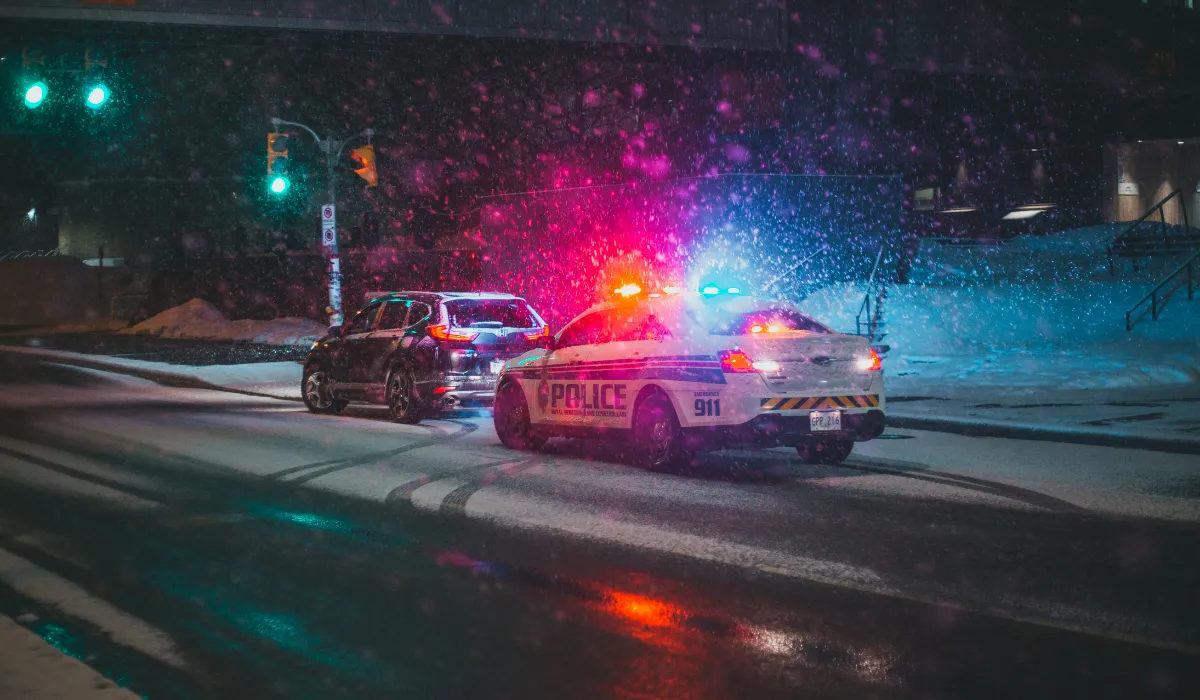








Almost every page about criminal court in Toronto is out of date. Six criminal courthouses folded into one building at 10 Armoury Street between March and May 2023, and Old City Hall, College Park, 1000 Finch Avenue West and 1911 Eglinton Avenue East no longer appear on the province's list of court locations. If you have been charged, the single most useful thing to know is which door your case is going through, because Toronto has more doors than anywhere else in Ontario.
This page is organised around that idea. Each section below is a fork in the system. Some will apply to you and most will not. Read the ones that do. A criminal lawyer in Toronto spends a large part of the first week working out exactly these questions, and you can save real time by arriving with the answers already in hand.
Kazandji Law works out of 180 John Street, Unit 320, in downtown Toronto. You can reach us at 647-588-3234 or through our contact page.
Start here: criminal charge, or provincial offence?
This is the first fork and the one people get wrong most often. A speeding ticket, a noise by-law charge and a careless driving charge are not criminal matters. They run under the Provincial Offences Act, they are prosecuted in a municipal courtroom, and in Toronto they are administered by the City rather than the province.
The Ontario Court of Justice puts the division of labour plainly: municipalities administer courts where most provincial offence cases are heard, and criminal and family courts are administered by the province. That does not mean a ticket is heard by a municipal tribunal. A justice of the peace still presides, and the Ontario Court of Justice is still the court. The City runs the building, the counters, the filing and the fines.
The City of Toronto operates three provincial offences courts, and the addresses matter because one of them moved and the old address is still all over the internet:
- Toronto South Court, St. Lawrence Market North, 92 Front Street East, 2nd Floor, M5E 0G2. Courtrooms S1 through S9. French language services. The provincial offences administration counter sits on the second floor, and it handles fine payments after a court appearance, witness fees, transcript requests, appeal inquiries and trial requests.
- Toronto East Court, 1530 Markham Road, Main Floor, Scarborough, M1B 3M4. Courtrooms E1 through E10.
- Toronto West Court, York Civic Centre, 2700 Eglinton Avenue West, M6M 1V1. Courtrooms W1 through W8. French language services at the counter.
Toronto South is not at 60 Queen Street West. It has not been for some time. Both the City and the Ministry of the Attorney General list it at 92 Front Street East today. If a website, a blog post or a friend sends you to Old City Hall for a ticket, they are working from stale information.
The statute itself draws the line. The Provincial Offences Act sets out a procedure that reflects the distinction between provincial offences and criminal offences, and the Ministry describes Highway Traffic Act, Liquor Licence Act, Fish and Wildlife Conservation Act and municipal by-law charges as non-criminal offences. That is a statement about which body of procedure applies. It is not the same as a statement about what will or will not show up on a records check, and anyone who tells you flatly that a provincial offence never touches your record is going further than the published sources do.
One practical consequence catches people out. Legal Aid Ontario duty counsel help with criminal, family and child protection matters. Provincial offences are not on that list. If you walk into a provincial offences courtroom expecting free on-the-spot legal help of the kind available in criminal court, you may not find it. For a criminal charge, help is available, and the rest of this page explains where.
Sources checked 14 September 2026: City of Toronto court services locations and the Ontario Court of Justice provincial offences pages.
How to choose a criminal lawyer in Toronto, and what drives the cost
Start with the Law Society of Ontario. Its Lawyer and Paralegal Directory shows whether a person is, or was, licensed, along with their practising status, discipline history and any restrictions on their practice. It takes a couple of minutes. Do it before you pay anyone a retainer.
Questions worth asking at the first meeting
- Who will actually appear for me in court?
- Is the fee hourly or a block fee, and which stages does it cover: bail, disclosure review, pre-trials, applications, trial, sentencing?
- What happens to money held in trust if the charge is withdrawn early?
- When will you go through the disclosure with me, and how will I hear from you between court dates?
What drives the cost
- Plea, withdrawal or trial. Resolving a case without a trial takes fewer hours, and the length of a trial drives most of the bill.
- Which court. A judge-alone trial at 10 Armoury Street is a different job from a jury trial in the Superior Court at 361 University Avenue.
- Disclosure. Witness statements, video recordings and forensic reports all take time to review, and some files have a lot of them.
- Applications. Charter applications, and in sexual cases the sexual history and records applications, each need written materials and hearing time.
- Outside reports. A toxicologist or forensic accountant adds a separate cost.
- Bail. A contested hearing with sureties takes more preparation than a consent release.
If you cannot afford a lawyer
Legal Aid Ontario may pay a roster lawyer for your whole case if you are charged with a crime that could send you to jail and you qualify financially. Until spring 2028, the income threshold for a criminal certificate is $45,440 for a family of up to four and $50,803 for five or more, and the asset threshold is $15,000 regardless of family size. You can apply online or by calling 416-979-1446. If you qualify, duty counsel at the courthouse can advise you, meet with the Crown and represent you at a bail hearing, but they are your lawyer for that day only. And if you face serious, complex charges and have been refused legal aid, you can ask a judge for a state-funded lawyer through what is called a Rowbotham application.
Our first consultation is free. Call 647-588-3234 or use our contact page.
Where Toronto criminal cases are actually heard now
The Ontario Court of Justice for Toronto sits at 10 Armoury Street, Toronto, Ontario M7A 0B9. The criminal line is 416-212-2701. That single building replaced six others.
The Ministry of the Attorney General records what happened. The OCJ-T criminal courthouse at 10 Armoury Street opened in March 2023, and six courthouses amalgamated into it in a phased approach between March and May 2023: 2201 Finch Avenue West, which stayed open as the Toronto Region Bail Centre for adult bail hearings, 311 Jarvis Street, 444 Yonge Street at College Park, 1000 Finch Avenue West, 1911 Eglinton Avenue East, and 60 Queen Street West, better known as Old City Hall.
A careful word about Old City Hall. The Ministry says those courthouses amalgamated into 10 Armoury Street. It does not say the buildings closed, and it gives no closure date. What can be checked today is this: on 14 September 2026 the province's court location index lists exactly eight Toronto entries, and 60 Queen Street West, 444 Yonge Street, 1000 Finch Avenue West and 1911 Eglinton Avenue East are not among them. If your case is a Toronto criminal matter, the courthouse you are looking for is 10 Armoury Street.
The eight Toronto locations the province currently lists are 10 Armoury Street, 2201 Finch Avenue West, 361 University Avenue, 330 University Avenue, 393 University Avenue, 130 Queen Street West, 311 Jarvis Street and 47 Sheppard Avenue East. Only three of those touch criminal work. Two of the University Avenue addresses are civil and enforcement offices. 130 Queen Street West is Osgoode Hall, home of the Court of Appeal for Ontario and the Divisional Court, and it is not a criminal trial courthouse whatever the address may suggest.
10 Armoury Street was built at a scale that reflects the volume. The facility runs to 17 above-ground storeys with 63 courtrooms, 10 conference settlement rooms and 5 intake courts. It handles post-bail adult criminal matters, youth criminal matters, Provincial Offences Act appeals, and the specialty courts.
The second criminal courthouse is the Superior Court of Justice at 361 University Avenue, M5G 1T3, criminal line 416-327-5284. Your case goes there if you are charged with an indictable offence and elect trial in the Superior Court, if you are tried by judge and jury, or if your matter proceeds there after a preliminary inquiry. Most Toronto cases never leave the Ontario Court of Justice, but the election is one of the genuinely consequential decisions a person makes, and it is worth making with advice.
Counter and office hours are the same at every Toronto location. Court offices open Monday to Friday, 8:30 a.m. to 5:00 p.m. Counter service runs Monday to Friday from 9:00 to 11:00 a.m. and from 2:00 to 4:00 p.m.
One more point that saves people a wasted trip. Scarborough, North York and Etobicoke are not separate court jurisdictions. They are part of the City of Toronto, they are policed by the Toronto Police Service, and criminal charges laid there run through 10 Armoury Street like any other Toronto charge. If you are looking for local context on any of those, we keep dedicated pages for Scarborough, North York and Etobicoke.
Amalgamation detail from the 2023-2024 Court Services Division Annual Report, checked 14 September 2026.
The police division that charged you decides your courtroom
This is the mechanic almost nobody explains, and it is the reason two people charged on the same night end up in different rooms on different days.
The Toronto Police Service runs 16 divisions, all open 24 hours a day, seven days a week. They are grouped into two field commands. West Field Command covers 11, 12, 14, 22, 23, 31, 51 and 52 Divisions. East Field Command covers 13, 32, 33, 41, 42, 43, 53 and 55 Divisions. There are no districts in the current published structure, whatever older articles say, and there is no 54 Division. It was consolidated into 55 Division.
At 10 Armoury Street, adult criminal case management courtrooms are assigned by division. The Ontario Court of Justice publishes the assignments like this:
- Courtroom 201 takes adult matters from Divisions 11, 12, 13, 22 and 23.
- Courtroom 202 takes adult matters from Divisions 31, 32, 53, 54 and 55, reproduced here exactly as the court publishes it.
- Courtroom 203 takes adult matters from Divisions 11, 51 and 52.
- Courtroom 204 is the intimate partner violence courtroom.
- Courtroom 205 takes adult matters from Divisions 32, 41, 42 and 43.
- Courtroom 1001 is federal case management.
- Courtroom 604 is youth court case management.
Two oddities are worth naming rather than smoothing over. Division 11 appears under both courtroom 201 and courtroom 203. And courtroom 202 is still listed as serving 54 Division, a unit that was folded into 55 Division on or before November 2018. The court's own scheduling materials have not caught up with the police reorganisation. We reproduce what is published rather than guessing at a correction, because the published version is what the court staff will be working from when they call your name.
Two courtrooms run on a rotation rather than a fixed list. Courtroom 204, the intimate partner violence room, sits Central on Monday and Friday, West on Tuesday, South on Wednesday and East on Thursday. Courtroom 205 takes all divisions as overflow on Monday, 41 Division on Tuesday, 43 Division on Wednesday, 42 Division on Thursday and 33 Division on Friday.
Why this matters in practice: the division that laid the charge determines the courtroom, the courtroom determines the day, and the day determines whether the person standing up for you is available. It also determines which Crown team holds your file, which is the subject of a later section on this page.
The division numbers are also the quickest way to work out where a person is being held. That is the next fork.
Division list and field commands from the Toronto Police Service contact directory, checked 14 September 2026.
Where you are held before your first appearance
Not every Toronto division holds prisoners. Five of them do, and the Toronto Police Service publishes the list in the appendix to its procedure on persons in custody. Knowing which one applies tells a family where to direct a phone call, and tells a lawyer where to send a request to speak to a client before bail.
- 14 Division, 350 Dovercourt Road. Male adults from 11, 14 and 52 Divisions. It is also the primary lock-up for male young persons from every division.
- 23 Division, 5230 Finch Avenue West. Male adults from 12, 22 and 23 Divisions, and the primary lock-up for adult female and female young persons from every division.
- 32 Division, 30 Ellerslie Avenue. Male adults from 13, 31, 32 and 33 Divisions.
- 43 Division, 4331 Lawrence Avenue East. Male adults from 41, 42 and 43 Divisions.
- 51 Division, 51 Parliament Street. Male adults from 51, 53 and 55 Divisions.
The procedure also sets out what happens first. Everyone in custody is processed, investigated and fingerprinted before being lodged at any lock-up. If there are significant delays or unusual circumstances, the officer in charge can ask the lock-up itself to do the fingerprinting and photographs. The service also has a redirect protocol for when a central lock-up is out of service or full.
The right that matters most in that window is the right to counsel. It attaches immediately, and free legal advice through duty counsel is part of it. Two practical points follow.
First, telephone calls with a lawyer are supposed to happen where they cannot be overheard. If you are put on a phone in an open area and you can hear other people, say so. Ask for a private line. That request is consistent with the service's own written procedure, not a favour.
Second, the right to counsel is not a single moment. If your situation changes materially, for example if the police tell you the charge has become something more serious than what you were arrested for, the right can be triggered again. Speak to a lawyer, and say as little else as possible while you wait.
A person held after arrest in Toronto is generally moved from the divisional lock-up to the bail process rather than to 10 Armoury Street. That is the next fork, and it is the one part of the Toronto system that is genuinely centralised in a single building.
If you are trying to help someone who has been arrested, the two most useful things you can do in the first hours are find out which division has them, and get a lawyer on the phone. Our page on bail and bail hearings covers what happens next in more detail, and our Toronto bail lawyers page covers the local process.
Bail in Toronto runs through one building on Finch Avenue
Toronto splits bail off from the main criminal courthouse. Adult bail is not heard at 10 Armoury Street at all. It is heard at the Toronto Regional Bail Centre, 2201 Finch Avenue West, M9M 2Y9. The criminal line there is 416-314-3962 and the Crown office is at 416-314-3936.
The Ontario Court of Justice describes the arrangement directly. The Toronto Region bail centre at 2201 Finch Avenue West accommodates all adult bail operations as well as weekend and statutory holiday bail matters. That building was one of the six courthouses folded into 10 Armoury Street in 2023, and the Ministry notes it remained open specifically as the bail centre. One visible trace of the move survives in the court's own paperwork: a sign-up sheet for courtroom 201 at 10 Armoury Street is labelled as formerly courtroom 202 at 2201 Finch.
So if someone is arrested in Toronto and held, the bail hearing is at Finch and Weston, not downtown. Families regularly go to the wrong building.
The timing rule is the one most often stated incorrectly. Section 503 of the Criminal Code says that a peace officer who has arrested someone and not released them shall cause the person to be taken before a justice, and then splits into two limbs. If a justice is available within 24 hours of arrest, the person must be taken before a justice without unreasonable delay and within that period. If a justice is not available within 24 hours, the person must be taken before a justice as soon as possible.
Read that carefully. The 24 hour limit is conditional on a justice being available. A flat claim that everyone must see a justice within 24 hours is incomplete, and it sets up families for a bad shock when the deadline passes on a long weekend. The Ontario Court of Justice puts the same point in plain language on its step-by-step guide, and adds that weekend and statutory holiday bail courts exist so that a hearing can happen within 24 hours where possible.
Those weekend and holiday sittings are known in the system as WASH courts. In Toronto they run out of the bail centre. What the court does not publish is when they sit. There is no published start time, no published finish time and no published sitting schedule for Toronto WASH court, and the court states that weekend and statutory holiday court lists for criminal cases are not published at all. If a website gives you WASH hours for Toronto, ask where the number came from.
The bail centre serves Toronto. It does not serve the surrounding regions, and that catches people who live in one place and were arrested in another. A charge laid in Peel is dealt with at the Ontario Court of Justice in Brampton. A charge laid in York Region runs through Newmarket. A charge laid in Durham runs through Oshawa. Bail in each of those regions is run locally and on local timetables, and the last section of this page sets out which courthouse takes which area.
General principles are the same across Ontario, and our Ontario bail lawyers page covers those. What changes between regions is logistics, and logistics is what decides whether somebody sleeps at home tonight.
Section 503 text from the Criminal Code on the Justice Laws website, checked 14 September 2026.
Consent release, contested hearing, or Complex Bail Matter
Once you are at the bail centre, your hearing takes one of three shapes, and since 1 June 2026 the Ontario Court of Justice has published what it expects each one to take in time. The practice direction was issued under Rule 5.1 of the Criminal Rules and signed by Chief Justice Sharon Nicklas. It applies across Ontario, and it replaced the old bail protocol.
Consent release. The Crown agrees to your release on terms. The court expects these to be completed in no longer than 15 minutes, subject to the discretion of the presiding judicial officer, and it says that all proposed consent releases put before the court shall be accommodated the same day. That last point is the one to hold on to. If the Crown has agreed, you should not be sitting in custody overnight waiting for a slot.
Routine contested hearing. The Crown opposes release, evidence is called and submissions are made. The court expects these to be completed in no longer than 30 minutes, again subject to the judicial officer's discretion.
Complex Bail Matter. This is the designation worth knowing about, because it is the only route to more court time. Where a matter has two or more of the listed features, counsel may identify it to the presiding judicial officer as a Complex Bail Matter, and it becomes eligible for additional time that will not ordinarily exceed two hours. The four features are: two or more proposed sureties where the Crown seeks to cross-examine, matters requiring an interpreter, a section 524 application with two or more existing release orders, and specialised prosecution team matters identified as such at the time of the hearing. A matter designated as complex is heard the same day it is identified.
The practice direction also reshapes how sureties are handled, which is where most Toronto bail hearings live or die. Release with a surety is only required where the court is satisfied that a surety release is the least onerous form of release possible in the circumstances, regardless of onus. Where a surety declaration has been filed, the expectation is that examination in chief and cross-examination of the surety are not required. And sureties should make themselves available at the time of the hearing so that if release is ordered it can be entered into immediately.
That last line is worth reading twice. A surety who is at work, unreachable, or three hours away is the most common reason a granted release does not actually get someone out the same day.
Ontario has also expanded the surety declaration itself. The Expanded Surety Declaration provincial protocol took effect on 13 April 2026 and was updated on 1 July 2026, and it is available for use in any bail matter at any location in the province. The point of it is to reduce how much the court has to rely on a surety giving live evidence.
One small definitional point with large consequences: in this practice direction, the term defence counsel includes duty counsel. The timelines and expectations apply whether you have retained a lawyer or you are being helped by duty counsel on the day.
The court's expectation is also that in many cases the only Crown materials filed at bail will be the criminal record, the synopsis and copies of any existing release orders. If your matter needs more than that, say so early.
Timings from the Practice Direction Regarding Bail Hearings, effective 1 June 2026, checked 14 September 2026.
Your surname can decide which day you appear
This is the most quietly useful fact on this page. In several case management courtrooms at 10 Armoury Street, your appearance day is set by the first letter of your last name. There is no single Toronto alphabet split. There are three of them, and they disagree with each other.
Courtroom 201 publishes this split: Monday A to B including R, Tuesday C to F including J, Wednesday G to L excluding J, Thursday M to P, Friday Q to Z excluding R.
Courtroom 202 publishes a different one: Monday N, O, P, Q, R and T with S scheduled on Friday, Tuesday A, B and C, Wednesday D, E, F, G, H and I, Thursday J, K, L and M, Friday S, U, V, W, X and Y with T scheduled on Monday.
Courtroom 203 publishes a third: Monday and Tuesday A, B, C, D, E, F and V, Wednesday G, H, I, J, K, L and M, Thursday morning N through U plus X, Y and Z with V scheduled Monday and Tuesday, Thursday afternoon G through M again, and Friday N through U plus X, Y and Z.
All three are reproduced as published. Courtroom 202's list has no letter Z on any day. Courtroom 203's list prints Y twice and omits W. We have not corrected either, because court staff work from the published list and a tidy version would not match what is on the wall.
The practical consequence is straightforward. Someone named Robertson appears on Monday in courtroom 201 and on Monday in courtroom 202, but a Sullivan appears Friday in courtroom 201 and Friday in courtroom 202, while in courtroom 203 the same Sullivan is called Thursday morning or Friday. The only way to know your day is to know your courtroom, and the only way to know your courtroom is to know which division charged you.
The daily timetable is courtroom-specific too, and this is another place where a single published schedule would be wrong. Courtroom 201 runs case management at 9:00, video remand at 11:00, lunch at 1:00, and first appearance and self-represented matters at 2:00. Courtroom 202 runs case management at 9:00, video remand at 10:00, self-represented matters at 11:30 and first appearance at 2:00. Courtroom 205 starts with video remand at 9:00, case management at 10:00 and first appearance at 2:00.
Other rooms do not use surnames at all. The intimate partner violence courtroom and the overflow courtroom both rotate by police division, as set out earlier on this page. Youth court runs on its own pattern. Plea courts sit on the eighth floor and in courtroom 607.
None of this is hidden. It is published on the court's own location page. It is just buried inside collapsed panels that most people, and most search engines, never open.
Provincial Crown or federal Crown
Two different prosecution services operate at 10 Armoury Street, and which one holds your file changes who you negotiate with, where your disclosure comes from, and which support programmes you can use.
Most charges are prosecuted by the provincial Crown, the Ministry of the Attorney General. The Toronto Crown Attorney's Office main line is 416-212-2707. What is unusual, and genuinely useful, is that the Toronto Crown is split into four teams by police division, and the province publishes the split:
- West Toronto Crown Team covers Divisions 12, 22, 23, 31 and 32.
- East Toronto Crown Team covers Divisions 33, 41, 42 and 43.
- South Toronto Crown Team covers Divisions 11, 14 and 51.
- Central Toronto Crown Team covers Divisions 13, 52, 53 and 54 slash 55, again as published.
So the division that charged you decides your courtroom, your appearance day and your Crown team. One number governs three things. If you take nothing else from this page, take the division number off your release paperwork and write it down.
A word of caution about disclosure. Each Crown team has a published email address, but neither the province nor the court states that those addresses are the route for a disclosure request. Treating them as a disclosure inbox is an assumption, not a published instruction. The safest route is for counsel to make the request through the ordinary channel for your courtroom, and to follow up in writing.
On timing, the province's Crown Prosecution Manual is blunt: the prosecutor has discretion as to the timing of disclosure and the form it will take. There is no fixed clock in the policy itself. There is, however, a scheduling consequence, and the section below on deadlines explains it. The manual also restricts certain material. Audio or video that depicts or recounts child abuse or a sexual offence must not be provided to an unrepresented accused without a court order, which in practice means some cases cannot move forward until a person has a lawyer.
The other prosecution service is federal. The Public Prosecution Service of Canada handles drug offences under the Controlled Drugs and Substances Act, most federal regulatory charges, and some organised crime files. Federal case management at 10 Armoury Street runs in courtroom 1001, on a different pattern from the divisional rooms.
The federal stream also carries an exclusion that surprises people. Cases prosecuted by the Public Prosecution Service of Canada are excluded from the Self-Represented Court described later on this page. If you are charged federally and you do not have a lawyer, you do not get routed into the dedicated support stream that a provincially prosecuted accused gets. That asymmetry is a real argument for getting counsel early on a federal file.
Toronto's own numbers show how much federal work there is. In the twelve months to December 2025 the Ontario Court of Justice in Toronto received 1,192 drug trafficking cases and 136 drug possession cases, alongside 126 other federal statute matters.
If your charge involves alleged dishonesty rather than drugs, the provincial Crown will almost always have it. Our pages on fraud defence, theft defence and forgery cover those charges in detail.
Adult court or youth court
If the accused was under 18 at the time of the alleged offence, the Youth Criminal Justice Act applies, and the case runs on a separate track inside the same building.
Youth criminal matters are heard at 10 Armoury Street. The province lists criminal youth as a court type there with the same phone number as adult criminal, 416-212-2701. Youth court case management sits in courtroom 604, and youth plea court sits in courtroom 607. The Ministry confirms that youth was among the operations brought under one roof when the courthouse opened.
There is a genuine ambiguity here that deserves an honest answer rather than a confident one. A great many pages still say 311 Jarvis Street is Toronto's youth court. In the 2023 to 2024 reporting year that was true of the transition: the Ministry recorded 311 Jarvis as handling youth criminal matters only during the amalgamation. But the Ontario Court of Justice's current courthouse contact table designates 311 Jarvis as a family location, and the province's own location page for 311 Jarvis carries no types of court listing at all. At the same time, the court's specialised courts page still places a specialised Aboriginal Youth Court at the 311 Jarvis courthouse in Toronto. Those two statements sit awkwardly together, and we are not going to resolve them by guessing. If your matter involves a young person and you have been given a Jarvis Street date, confirm it with the courthouse before you travel.
Duty counsel for young people is available and has its own route. The Toronto Duty Counsel Office at the Ontario Court of Justice can be reached at 416-646-1286. The menu asks you to press 1 for English or 2 for French, and then press 1 for youth duty counsel. Option 3 is for clients appearing that day or the next, and option 4 is for clients appearing two or more days away.
Youth cases are also excluded from the Self-Represented Court pilot, and out-of-custody young persons are excluded from the new three appearance cap in case management court described below. Youth court has always run on a different rhythm, and the recent efficiency measures have deliberately left it alone.
Volumes are small next to the adult list. Toronto received 22 Youth Criminal Justice Act matters as the most serious charge in the twelve months to December 2025, though that figure counts cases where a YCJA offence was itself the top charge rather than every case involving a young person.
Two practical points for parents. The lock-up rules put male young persons from every Toronto division at 14 Division on Dovercourt Road, and female young persons from every division at 23 Division on Finch Avenue West. And publication restrictions under the Youth Criminal Justice Act are strict, so be careful about what goes on social media, by anyone, including relatives.
Intimate partner violence and the Integrated Domestic Violence Court
Toronto handles intimate partner violence charges differently from anywhere else in Canada, and the arrangement changed again in April 2026.
Most intimate partner violence matters at 10 Armoury Street are case managed in courtroom 204, which rotates by police division across the week. Central divisions are heard Monday and Friday, West on Tuesday, South on Wednesday and East on Thursday. That courtroom is also expressly excluded from the Self-Represented Court, so an accused in courtroom 204 without a lawyer does not get diverted into that stream.
Alongside it sits the Integrated Domestic Violence Court. The Ontario Court of Justice describes it as the first and only one of its kind in Canada, and says it has been studied by other countries wanting to set up something similar. It first opened in 2011 at the 311 Jarvis Street courthouse. Since 2 April 2026 it has been at 10 Armoury Street, under a practice direction signed by the Chief Justice.
What makes it unusual is that one judge hears a related criminal case and a related family case at the same time, rather than the family and criminal streams running in parallel and contradicting each other. The eligibility test is narrow and worth reading closely:
- The criminal charge must be an intimate partner violence summary conviction charge scheduled for appearance at 10 Armoury Street.
- The accused must not be in custody.
- The same person must be a litigant in a related Children's Law Reform Act or Family Law Act case at the Ontario Court of Justice family courts at 47 Sheppard Avenue East or 311 Jarvis Street.
- The family case must concern decision-making responsibility, parenting time, support, or a restraining order.
The court is equally clear about what it cannot do. The Integrated Domestic Violence Court cannot hear matters dealing with divorce, the division of family property, or child protection cases. Family documents cannot be filed at 10 Armoury Street, so the family file stays where it was opened.
A point on which the court's own website disagrees with itself. The April 2026 practice direction says the Integrated Domestic Violence Court will not hear trials, other than short focused hearings in a family law context, and that where a triable issue exists the proceeding is referred back to the originating court and set for trial. An older information page still suggests it may conduct trials. The practice direction is the later instrument and it is signed by the Chief Justice, so that is what we have followed. Do not go in expecting a criminal trial in this court.
The terminology has moved too. The 2013 practice direction spoke of domestic violence charges. The 2026 one speaks of intimate partner violence charges. Court staff use the current wording.
If you are facing a charge of this kind, the criminal and family sides genuinely do interact, and decisions taken quickly in one can close off options in the other. Our pages on domestic violence charges, assault offences and family law deal with each side.
Mental health, addiction and Gladue: the therapeutic routes
Toronto runs several specialised court programmes, and three of them come up most often.
Mental Health Court. The Ontario Court of Justice states that the first Mental Health Court in Canada opened in the Ontario Court of Justice at Old City Hall in Toronto, in response to a need to respond better to the challenges faced by people with mental health disorders. That is a historical statement and we treat it as one. The court's page dates the opening only in relative terms with no drafting date attached, so we are not going to publish a founding year from it. What is current is that the Ministry lists mental health among the specialty courts consolidated at 10 Armoury Street, and that the Toronto practice direction on self-represented accused refers to mental health court as an active option today.
The court describes how these courts work in general terms: designated days of operation, eligibility criteria, dedicated legal staff including a judge, a Crown and duty counsel, and specialised mental health court workers. Mental health diversion is one of its main shared elements, and fitness to stand trial is a significant part of its work.
Drug Treatment Court. The court describes drug treatment courts as offering court-monitored treatment, trauma-informed support and an alternative to incarceration. In most jurisdictions they operate through three activities: pre-court meetings where the judiciary and the client's treatment team discuss progress, direct interaction between the judicial officer and the client at scheduled appearances, and community treatment services. Drug treatment is listed by the Ministry among the specialty courts at 10 Armoury Street. There is one feature of these programmes that anyone considering the route must understand before starting, which is that participation is normally conditional on pleading guilty to the charges first. That is a significant decision and it should not be made without advice.
Gladue or Indigenous Peoples' Court. The court uses both names and treats them as interchangeable. These courts apply Canadian law and also include Indigenous cultural practices and Indigenous concepts of justice such as restorative justice, following R. v. Gladue, [1999] 1 S.C.R. 688 and section 718.2(e) of the Criminal Code. The court is explicit about their scope: they focus on sentencing, in some locations also on bail and case management, and they do not handle trials or preliminary hearings. The Toronto practice direction on self-represented accused confirms that a person who identifies as Indigenous may have their case streamed into Gladue Court in Toronto if they wish.
What we will not tell you. No primary source publishes a street address for Toronto's drug treatment court, its mental health court or its adult Gladue court. They operate within the Ontario Court of Justice in Toronto. Anyone giving you a specific room number for these programmes is guessing. There is one exception: the court does name a specialised Aboriginal Youth Court at the 311 Jarvis courthouse in Toronto, and that single sentence is the entirety of what is published about it.
Screening into any of these programmes usually happens early, often at a first appearance, and always with the accused's agreement. If a mental health condition, an addiction, or Indigenous identity is part of your situation, raise it at the outset rather than months in.
No lawyer yet? The Self-Represented Court in courtroom 101
The Ontario Court of Justice has issued a Toronto practice direction creating a dedicated court for people who do not have a lawyer. If you are facing a Toronto charge and you have not retained counsel, this section is the one that applies to you.
Since 5 May 2025, anyone appearing for a first appearance in regular case management court at the Ontario Court of Justice in Toronto without a lawyer is adjourned to appear in person in courtroom 101, the Self-Represented Court, for their second appearance four weeks later.
The court is deliberately in person. The practice direction says the Self-Represented Court does not have a Zoom link, and that in-person attendance is required so that self-represented people can actually receive the supports on offer and move their matter forward. If you have been told your second appearance is in courtroom 101, do not try to attend remotely.
What you get there is substantial:
- System Navigators, who are not lawyers but who provide information and guidance about court processes, agency referrals and supports.
- Dedicated duty counsel, who give case-specific legal advice, conduct resolution-focused Crown and judicial pre-trials where eligible, and help resolve cases. Critically, they do this regardless of whether the accused meets Legal Aid Ontario's financial eligibility criteria.
- Dedicated Crown counsel, who conduct in-person Crown pre-trials with duty counsel, give early time estimates for trial, and address disclosure issues.
That middle point is unusual and worth repeating. Ordinary duty counsel eligibility is means tested. In the Self-Represented Court it is not. Legal Aid Ontario publishes the ordinary thresholds, and as they stood on 14 September 2026 a family of one to four needed income below $45,440 and assets below $15,000, and a family of five or more needed income below $50,803. Inside courtroom 101, those thresholds do not gate the advice.
Four categories of matter are excluded from the pilot: youth cases, cases prosecuted by the Public Prosecution Service of Canada, intimate partner violence cases in courtroom 204, and in-custody accused.
The practice direction also carries a detail for impaired driving accused. Those interested in participating in Stream A or D of the Ministry of Transportation's reduced suspension programme are handled under a separate arrangement at the first appearance. If a driving prohibition or an ignition interlock timeline is part of your problem, our Toronto impaired driving page explains how those streams interact with the criminal charge, and our dangerous driving defence page covers the related offences.
There is one inconsistency we will flag rather than paper over. Courtroom 101 does not appear anywhere on the Ontario Court of Justice's own list of courtrooms at 10 Armoury Street, which runs 201 through 205, 604, 607, 801 to 804, 807, 1001 and 1006. The practice direction is the authoritative source for the Self-Represented Court, so 101 is where it sits, but the location page appears incomplete. Give yourself extra time on the day.
Once you retain a lawyer, there are set routes to stream your matter out of the Self-Represented Court, including counsel emailing the Toronto criminal duty counsel office with the subject line Self-Represented Court. Legal Aid Ontario also publishes a dedicated Toronto page, and its Toronto duty counsel line is 416-646-1286.
From the Self-Represented Court practice direction and Legal Aid Ontario on duty counsel, both checked 14 September 2026.
The clock on a Toronto case, and why it runs slower here
Toronto is the busiest criminal court location in Ontario, and it runs well above the provincial average on delay. Both figures come from the court's own published statistics for January to December 2025.
- Toronto received 42,014 criminal cases, against 249,612 for the whole province. That is roughly one in six Ontario criminal cases running through essentially one building.
- Toronto disposed of 40,480 cases and carried 32,778 pending.
- Average time to disposition in Toronto was 223 days, against a provincial average of 183.
- Average appearances to disposition in Toronto was 12.0, against a provincial average of 9.4.
- The trial rate was 4.4 per cent. The overwhelming majority of cases resolve without a trial.
For scale, the next busiest court location in the province received 16,528 cases. Toronto took roughly two and a half times that. Note one trap for anyone checking these numbers themselves: the Toronto worksheet carries a period label of January 2024 to December 2025, while the provincial worksheet covering the same data says January 2025 to December 2025. The regional figures sum exactly to the provincial total, so the Toronto label is an error in the file. These are twelve month figures.
The same file shows what Toronto is actually prosecuting. Crimes against the person were 17,113 cases, or 40.7 per cent of the total, and crimes against property were 10,223. Within those, major assault accounted for 5,334 cases and common assault 5,116, which is why our assault offences page is one of the most read on this site. Uttering threats accounted for 2,411, robbery 1,283, sexual assault 986 and criminal harassment 779. Failure to comply with an order accounted for 4,707 cases on its own. Weapons offences accounted for 879, and impaired driving 1,494.
Against that backdrop, the court has been tightening its scheduling rules. The Jordan-compliant trial scheduling practice direction took effect on 1 November 2023 and was revised on 1 June 2026. It applies across Ontario, and it sets internal targets measured from the date the Information was sworn: For offences committed on or after July 18, 2026, a new part of the Criminal Code keeps the Jordan framework but adds rules on case complexity and on time that does not count, and a judge can stay the charges only if no other remedy would be appropriate and just.
- The court will offer a trial date expected to result in the trial being completed within 15 months of the Information sworn date.
- Within six months of that date, both the Crown and the defence are expected to be ready either to resolve the matter or to set a trial date.
- A judicial pre-trial must be scheduled if substantial disclosure has not been received within four months of the Information sworn date.
- Since 1 June 2026, out-of-custody adult criminal cases shall have no more than three appearances in case management court, unless a judicial officer orders otherwise. In-custody accused, young persons and cases in a specialised court programme are excluded.
That three appearance cap is new, and it changes how a Toronto file should be run. Twelve appearances was the Toronto average in 2025. Three is the target for case management going forward. The practical effect is that the early work has to be front-loaded, because the adjournments that used to absorb a slow start are no longer available on request.
These internal targets are not the constitutional ceiling, and conflating the two is a common mistake. The 15 month figure is a scheduling standard measured from the swearing of the Information. The constitutional standard comes from R. v. Jordan, 2016 SCC 27, where the Supreme Court set a presumptive ceiling of 18 months for cases tried in the provincial court and 30 months for cases in the superior court, measured from the charge to the actual or anticipated end of trial. The 30 month ceiling also covers cases tried in the provincial court after a preliminary inquiry, which is the part most summaries leave out. Delay attributable to or waived by the defence does not count towards the ceiling.
Charges where the evidence takes longest to assemble tend to sit closest to those limits. Firearm and weapon allegations often turn on forensic and disclosure timelines, which our Toronto weapons defence page covers, and sexual offence prosecutions carry their own procedural applications, dealt with on our sexual offences page.
Scheduling targets from the Jordan-compliant trial scheduling practice direction, revised 1 June 2026, checked 14 September 2026. Case volumes from the Ontario Court of Justice 2025 offence-based criminal statistics.
Charged outside Toronto: the courthouse that will actually hear it
This is the fork that sends the most people to the wrong building, and the legal point behind it is simple. Jurisdiction follows where the offence is alleged to have occurred, not where you live. Someone who lives near Yonge and Eglinton and was charged on a night out in Peel is going to Brampton, repeatedly, for months.
Ontario does not publish catchment maps. What it publishes is a list of court locations and the court types at each. Working from that list, here is where the nearest listed Ontario Court of Justice criminal location sits for the communities we serve. Case volumes and delay figures are from the same 2025 statistics used above.
- Peel Region. The province lists no court location in Mississauga at all. Peel criminal matters run through 7755 Hurontario Street in Brampton, which received 16,528 cases in 2025 and averaged 269 days and 10.0 appearances to disposition, making it slower per case than Toronto on days but lighter on appearances. See our pages for Mississauga and Bolton.
- Halton Region. There is no criminal court in Oakville and none in Burlington on the province's criminal list. Halton criminal matters run through 491 Steeles Avenue East in Milton, which received 4,693 cases and averaged 219 days and 11.2 appearances. See Oakville, Burlington and Milton.
- York Region. This one surprises people. The province does list a court at 855 Major Mackenzie Drive East in Richmond Hill and another at 8500 Leslie Street in Markham, but both are small claims locations with no criminal court type listed. York Region criminal matters run through 50 Eagle Street West in Newmarket, which received 13,693 cases and averaged 177 days and 8.6 appearances. See Richmond Hill, Markham, Vaughan and Woodbridge.
- Durham Region. No criminal court is listed in Whitby, Ajax or Pickering. Durham criminal matters run through 150 Bond Street East in Oshawa, which received 12,163 cases and averaged 148 days and 7.8 appearances, the fewest appearances of any large location listed here. See Whitby, Ajax and Pickering.
- Hamilton. Criminal matters are heard at 45 Main Street East, which received 7,453 cases and averaged 185 days and 10.3 appearances. See Hamilton.
- Simcoe County. Barrie's criminal courthouse at 75 Mulcaster Street received 10,021 cases and averaged 161 days and 10.3 appearances. Orillia has its own criminal location at 700 Memorial Avenue. See Barrie, Innisfil and Orillia.
- Waterloo Region and the western corridor. Kitchener's criminal court at 85 Frederick Street received 9,495 cases and averaged 144 days and 8.2 appearances, the shortest average time to disposition of the large locations listed here. Guelph sits at 36 Wyndham Street South, Brantford at 44 Queen Street, London at 80 Dundas Street with 11,863 cases, and Windsor at 200 Chatham Street East. See Kitchener-Waterloo, Guelph, Brantford, London and Windsor.
- Niagara. Two criminal locations serve the region, 59 Church Street in St. Catharines with 7,197 cases and 102 East Main Street in Welland. See Niagara.
- Eastern Ontario. Ottawa's criminal court at 161 Elgin Street received 11,145 cases and averaged 185 days and 9.0 appearances. Kingston sits at 279 Wellington Street and Peterborough at 70 Simcoe Street. See Ottawa, Kingston and Peterborough.
Two things follow from all of this. Your court date is fixed by where the alleged offence happened, so check the address on your release paperwork rather than assuming. And the delay figures differ enough between regions that the same charge can take twice as long in one place as another, which is a real factor in how a file should be run.
If your charge was laid inside Toronto, everything above the last section applies to you, and the building is 10 Armoury Street.
Questions people ask about criminal court in Toronto
Where is criminal court in Toronto?
Most Toronto criminal cases are heard at the Ontario Court of Justice at 10 Armoury Street, M7A 0B9. The courthouse opened in March 2023 and brought together six former Toronto criminal courthouses. Cases that go to the Superior Court of Justice are heard at 361 University Avenue.
Is Old City Hall still a criminal courthouse?
No. The Ontario Court of Justice criminal operations at 60 Queen Street West were amalgamated into 10 Armoury Street between March and May 2023, along with College Park at 444 Yonge Street and three other locations. Old City Hall no longer appears on the Ministry of the Attorney General list of Ontario court locations.
Where do bail hearings happen in Toronto?
Adult bail hearings are held at the Toronto Regional Bail Centre, 2201 Finch Avenue West, M9M 2Y9. It handles all adult bail operations for Toronto, including weekend and statutory holiday bail court. It is a different building from the main criminal courthouse at 10 Armoury Street.
How long does a bail hearing take in Toronto?
Under the Ontario Court of Justice practice direction that took effect on 1 June 2026, the Court expects a routine contested bail hearing to finish within 30 minutes and a consent release within 15 minutes. A matter identified as a Complex Bail Matter can get extra time that will not ordinarily exceed two hours. All of these are subject to the discretion of the presiding judicial officer.
What happens if I am arrested on a weekend in Toronto?
The Ontario Court of Justice runs weekend and statutory holiday bail courts, known as WASH courts. In Toronto these sit at the Toronto Regional Bail Centre at 2201 Finch Avenue West. The Court does not publish WASH court sitting hours or weekend criminal court lists, so plan around the building rather than a timetable.
How long after arrest do I have to be brought to court?
Section 503 of the Criminal Code says that if a justice is available within 24 hours of arrest, you must be taken before a justice without unreasonable delay and within that period. If a justice is not available within 24 hours, you must be taken before one as soon as possible. The 24 hour limit is conditional, not absolute.
Why is my Toronto court date on a particular day of the week?
In several case management courtrooms at 10 Armoury Street your appearance day is set by the first letter of your last name. The alphabet split is different in courtroom 201, courtroom 202 and courtroom 203, so the same letter can fall on a different day depending on which courtroom your case is in. Other courtrooms are scheduled by police division instead.
How do I get my disclosure in Toronto?
Disclosure comes from the Crown Attorney office at 10 Armoury Street, reachable at 416-212-2707. The Toronto Crown is divided into four teams by police division, so the team handling your file depends on which division laid the charge. Under the Crown Prosecution Manual the prosecutor has discretion over the timing of disclosure and the form it takes.
Is there a mental health court in Toronto?
Yes. The Ontario Court of Justice states that the first mental health court in Canada opened at Old City Hall in Toronto. Mental health court is now among the specialty courts operating at the 10 Armoury Street courthouse. Cases can be streamed into it at a first appearance if the accused agrees, and mental health diversion is one of its main functions.
What is the Integrated Domestic Violence Court?
It is a court where one judge hears a related criminal case and family case together. The Ontario Court of Justice describes it as the first and only one of its kind in Canada. It requires a summary conviction intimate partner violence charge at 10 Armoury Street plus a family case at 47 Sheppard Avenue East or 311 Jarvis Street. It cannot hear divorce, division of family property, or child protection cases, and the accused cannot be in custody.
How long does a criminal case take in Toronto?
Ontario Court of Justice statistics for January to December 2025 show Toronto cases took an average of 223 days and 12 appearances to reach disposition, against a provincial average of 183 days and 9.4 appearances. Toronto runs well above the provincial average on both measures. The Court aims to complete trials within 15 months of the date the Information was sworn.
What if I cannot afford a lawyer for my Toronto case?
If you appear in case management court at 10 Armoury Street without a lawyer, your next appearance is moved to the Self-Represented Court in courtroom 101, four weeks later, in person. That court has dedicated duty counsel who can help regardless of whether you meet the Legal Aid Ontario financial test, plus system navigators and a dedicated Crown. Toronto duty counsel can be reached at 416-646-1286.
Speak to a criminal defence lawyer in Toronto. Kazandji Law is at 180 John Street, Unit 320, Toronto, M5T 1X5. Call 647-588-3234 or use our contact page.
We also meet clients at 7191 Yonge Street, Suite 310, Thornhill, L3T 0C4 and at 70 Forest Manor Road, Unit 4B, North York, M2J 0A9, both on 647-588-3234, and at 466 Speers Road, Oakville, L6K 3W9 on 647-269-8414.
Talk it through with a lawyer today. No cost, no obligation, and the conversation stays confidential.