

Toronto Identity Theft Lawyers
Home › Criminal Defence › Toronto Identity Theft Lawyers
Identity fraud was the single most-reported fraud type to the Canadian Anti-Fraud Centre in 2025, and Toronto is where a large share of those reports become criminal prosecutions. If you have been arrested, had your phone or computer seized, or been contacted by Toronto Police about identity theft, identity fraud, forged documents or credit card data, the decisions you make in the next 48 hours can shape the entire case. Kazandji Law defends identity-crime allegations at every stage, from the first police call to trial.
Under investigation or charged with identity theft in Toronto? Do not give a statement before you get advice.
Call (647) 588-3234 NowConfidential consultation, serving Toronto and the GTA from four offices.
On this page:
- Identity theft charges in Toronto: what you are actually facing
- What counts as identity information under s. 402.1
- The three-rung offence ladder: possessing, trafficking, using
- Identity documents, credit cards, skimmers and forgery
- How identity theft cases are built in Toronto
- Digital-evidence defences: phones, warrants and the Charter
- Innocent explanations the Criminal Code recognizes
- What a conviction actually costs
- The Toronto court path: from bail to verdict
- Why Kazandji Law
- Frequently asked questions
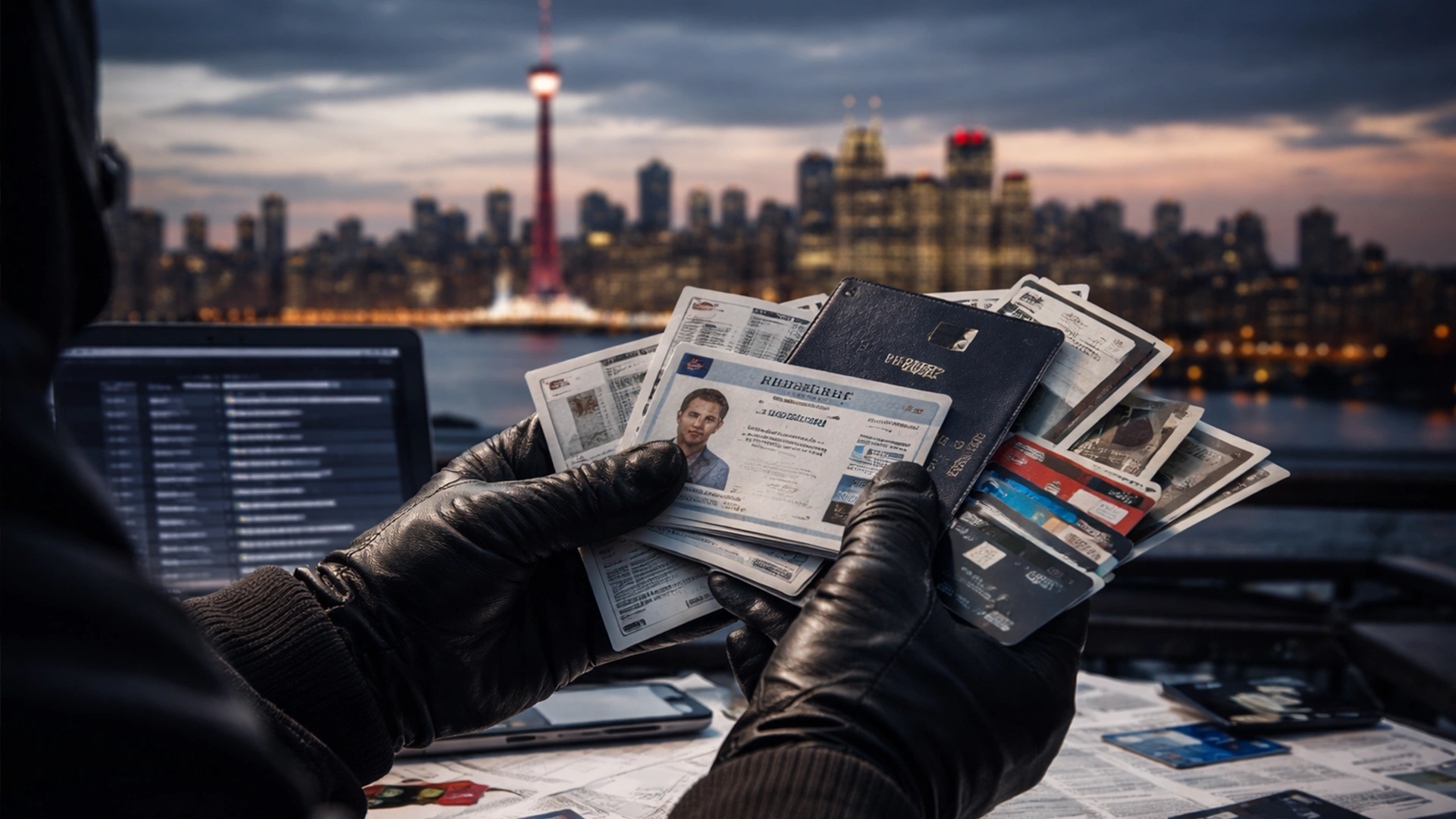
Identity Theft Charges in Toronto: What You Are Actually Facing
There is no single crime called “identity theft” in Canada. What police and Crown attorneys call an identity theft file is almost always a cluster of overlapping Criminal Code charges: identity theft and trafficking in identity information under s. 402.2 (maximum five years), identity fraud, also called personation, under s. 403 (maximum ten years), offences involving identity documents under s. 56.1, credit card and card-data offences under ss. 342 and 342.01, and the forgery cluster in ss. 366 to 368. Every one of these is a hybrid offence, meaning the Crown can proceed summarily or by indictment, and none of them carries a mandatory minimum sentence. That matters: the full range of outcomes, from withdrawal and discharge through to penitentiary custody for sophisticated schemes, stays legally available, and the result usually turns on how early and how well the defence is built.
The scale of the problem explains why Toronto police and prosecutors treat these files aggressively. The Canadian Anti-Fraud Centre reported in March 2026 that Canadians lost more than $704 million to fraud in 2025, that reported losses since 2022 exceed $2.4 billion, and that an estimated 5 to 10 per cent of frauds are ever reported at all. In 2025, the three most-reported fraud types were identity fraud, investment fraud and service fraud, identity fraud sitting at the top of the list. Toronto prosecutions now run through the city’s consolidated criminal courthouse at 10 Armoury St., with bail handled at the Toronto Regional Bail Centre.
Because these charges are laid in clusters, an experienced criminal defence strategy looks at the whole indictment, not one count at a time. Weakening the Crown’s theory on intent or knowledge often collapses several counts at once. The sections below walk through the statutory framework the way we analyze it for clients: what identity information is, the ladder from possession to trafficking to use, the document and card offences layered on top, and where the winnable issues usually live.
What Counts as Identity Information Under s. 402.1
Section 402.1 of the Criminal Code defines “identity information” for the purposes of the identity theft and identity fraud offences. The definition is deliberately broad: any information, including biological or physiological information, of a type that is commonly used, alone or in combination with other information, to identify or purport to identify an individual. The section then gives a long, non-exhaustive catalogue:
- name, address and date of birth;
- written signature, electronic signature and digital signature;
- user name and password;
- credit card number, debit card number and financial institution account number;
- passport number, Social Insurance Number, health insurance number and driver’s licence number;
- biometric identifiers: fingerprint, voice print, retina image, iris image and DNA profile.
In practice, this definition is why a smartphone or laptop full of other people’s data becomes the Crown’s exhibit one. Screenshots of someone’s banking page, a spreadsheet of client SINs, saved images of driver’s licences, autofill profiles on a shared browser, text threads containing card numbers, all of it is capable of being “identity information.” The breadth cuts both ways, though. Enormous amounts of identity information move through ordinary life for entirely legitimate reasons: landlords hold tenants’ IDs and SINs, bookkeepers hold banking credentials, family members hold each other’s health cards, employers hold complete personnel files. The definition tells you what the information is; it says nothing about whether holding it was criminal. That question is answered by the offence provisions, and, as the next section explains, the modern versions of those provisions demand proof of a specific criminal purpose, not just possession.
For the defence, s. 402.1 is also a map of the Crown’s forensic case. When police seize devices, analysts search for exactly these categories of data and build charts of how many “identities” appear. Challenging how that data was extracted, who actually placed it on the device, and what it was for is often where the case is decided.
The Three-Rung Offence Ladder: Possessing, Trafficking, Using
Parliament structured Canada’s identity-crime law as a ladder with three rungs, each targeting a different stage of conduct. Understanding which rung you are charged on, and what the Crown must actually prove at that rung, is the starting point of every defence.
Rung one: obtaining or possessing, s. 402.2(1)
Identity theft itself is the preparatory offence. Under s. 402.2(1), a person commits an offence who obtains or possesses another person’s identity information with intent to use it to commit an indictable offence that includes fraud, deceit or falsehood as an element of the offence. The maximum penalty is five years when the Crown proceeds by indictment.
A critical point many websites still get wrong: before amendments made by 2018, c. 29, s. 45, this offence could be proved by showing possession “in circumstances giving rise to a reasonable inference” of criminal use. That standard is gone. The current text requires the Crown to prove you possessed the information with intent to use it to commit a qualifying indictable offence. Mere possession, even suspicious possession, is not enough without proof of that intended use. Pages that still quote the old “reasonable inference” wording are describing law that no longer exists.
Rung two: trafficking, s. 402.2(2)
The second rung criminalizes the market in identity information. It is an offence to transmit, make available, distribute, sell or offer for sale another person’s identity information, or to possess it for any of those purposes, knowing that, or being reckless as to whether, the information will be used to commit such an indictable offence. The mental element here is different from rung one: knowledge or recklessness about someone else’s intended use, which raises its own defences where an accused handled data without appreciating what a buyer or associate planned to do with it. The maximum is again five years.
Rung three: actually using it, s. 403 identity fraud
The top rung is identity fraud, or personation. Under s. 403(1), it is an offence to fraudulently personate another person, living or dead, with intent to (a) gain advantage for yourself or another person, (b) obtain property or an interest in property, (c) cause disadvantage to the person personated or another person, or (d) avoid arrest or prosecution, or obstruct, pervert or defeat the course of justice. Section 403(2) makes clear that “personating” includes simply using the person’s identity information, alone or combined with anyone else’s, as if it pertains to you. Giving a sibling’s name at a traffic stop is the classic s. 403(1)(d) example. The maximum on indictment is ten years, which carries serious immigration consequences discussed below.
Section 402.2(3) lists the target offences that qualify for the possession and trafficking rungs: forged passports (s. 57), fraudulent use of a certificate of citizenship (s. 58), personating a peace officer (s. 130), perjury (s. 131), credit card offences (s. 342), false pretence (s. 362), forgery (s. 366), use of forged documents (s. 368), fraud (s. 380) and identity fraud (s. 403). Because s. 380 fraud is on that list, synthetic-identity files in Toronto are routinely charged as identity theft paired with fraud over $5,000 or fraud under $5,000, depending on the alleged value.
| Offence | Section | What the Crown must prove | Maximum (indictment) |
|---|---|---|---|
| Identity theft | s. 402.2(1) | Obtaining or possessing another person’s identity information with intent to use it to commit an indictable offence involving fraud, deceit or falsehood | 5 years (hybrid) |
| Trafficking in identity information | s. 402.2(2) | Transmitting, making available, distributing, selling or offering for sale, or possessing for those purposes, knowing or reckless as to criminal use | 5 years (hybrid) |
| Identity fraud (personation) | s. 403 | Fraudulently personating a living or dead person, including using their identity information as your own, with intent to gain, obtain property, cause disadvantage or avoid arrest | 10 years (hybrid) |
Identity Documents, Credit Cards, Skimmers and Forgery Overlays
Around the core ladder, prosecutors layer a set of document and payment-card offences. These charges frequently appear on the same information as s. 402.2 and s. 403 counts, and they each have their own elements, and their own escape hatches.
Identity documents, s. 56.1
Section 56.1 makes it an offence, without lawful excuse, to procure to be made, possess, transfer, sell or offer for sale an identity document that relates, or purports to relate, in whole or in part, to another person. “Identity document” is a defined list: a Social Insurance Number card, driver’s licence, health insurance card, birth certificate, death certificate, passport, a document simplifying entry into Canada, a certificate of citizenship, a document indicating immigration status, a certificate of Indian status, an employee identity card bearing a photograph and signature, and any similar document issued by a federal, provincial or foreign government body. The maximum is five years on indictment. Critically, the section has four built-in statutory exceptions, covered below, which decide many real-world cases.
Credit cards and card data, ss. 342 and 342.01
Section 342(1) criminalizes stealing a credit card, forging or falsifying one, possessing, using or trafficking in a card known to have been obtained or altered by crime, and using a revoked or cancelled card, maximum ten years. Section 342(3) reaches further into the digital space: it is an offence to fraudulently and without colour of right possess, use, traffic in or permit another person to use credit card data, including “personal authentication information” such as a PIN or password, whether or not the data is authentic. That last phrase matters, even made-up or test card numbers can ground a charge. Section 342.01 then targets the hardware: making, repairing, buying, selling, importing or possessing any instrument, device, apparatus, material or thing used, adapted or intended for copying credit card data or forging cards, without lawful justification or excuse. Both card-data and device offences carry ten-year maximums, and s. 342.01(2) adds forfeiture of the equipment on conviction, unless it belongs to an innocent third party.
The forgery cluster, ss. 366 to 368
Forgery under s. 366 is making a false document, knowing it to be false, with intent that it be acted on as genuine to anyone’s prejudice, or to induce someone to act or refrain from acting. It includes materially altering a genuine document, is complete even if the document is unfinished or never used, and carries a specific exception for false documents made in good faith at the request of a police force, the Canadian Forces or a government department. Punishment is set by s. 367: up to ten years. Section 368 covers the use side, using, dealing or acting on a forged document as if it were genuine, attempting to cause anyone else to do so, or transferring, selling or possessing it with intent, also a ten-year maximum, and s. 368(2) confirms it does not matter where the document was forged.
| Charge | Section | Maximum on indictment | Notes |
|---|---|---|---|
| Identity documents | s. 56.1 | 5 years | Four statutory exceptions; hybrid |
| Credit card theft, forgery, trafficking | s. 342(1) | 10 years | Hybrid; special jurisdiction rules |
| Unauthorized use of credit card data | s. 342(3) | 10 years | Includes PINs and passwords; authenticity irrelevant |
| Instruments for copying card data | s. 342.01 | 10 years | Forfeiture of devices on conviction |
| Forgery | ss. 366, 367 | 10 years | Complete even if document never used |
| Use, trafficking or possession of forged documents | s. 368 | 10 years | Place of forging not material |
Where cards or documents are alleged to have been taken by force, a stolen wallet in a mugging, for example, the file can also include robbery counts, which raise a different set of issues we cover on our Toronto robbery lawyers page.
How Identity Theft Cases Are Built in Toronto
Identity-crime prosecutions in Toronto are usually the product of a long paper-and-data investigation rather than a single arrest. Knowing who is investigating and how they assemble the file tells you where the defence opportunities are.
The Toronto Police Service Financial Crimes unit sits within Specialized Operations Command, under Detective Operations and Organized Crime Enforcement, and investigates frauds occurring in or connected to the city of Toronto. Its Corporate Section handles payment-card crime, manufacturing, forgery and distribution of cards, false card applications and re-encoding of legitimate cards, alongside securities, real-estate, mortgage and insurance fraud and large-scale frauds on the public. A Mass Marketing Section leads the multi-agency Toronto Strategic Partnership, and an Asset Forfeiture Section pursues proceeds-of-crime and money-laundering angles. The unit operates from 40 College St. and can be reached at 416-808-7300. In recent years, TPS financial-crime investigators, working with the service’s cyber capabilities, have run dedicated projects into synthetic-identity credit fraud and SIM-swap account takeovers, the two fact patterns behind many current Toronto files.
Reporting channels feed these investigations from two directions. Locally, TPS directs victims to report frauds under $5,000 through its online reporting portal and frauds over $5,000 by phone at 416-808-2222, a split that mirrors the charge threshold in s. 380 of the Code. Nationally, the Canadian Anti-Fraud Centre, jointly managed by the RCMP, the Competition Bureau and the OPP, collects fraud and identity theft reports from across the country and shares intelligence with local police.
From those reports, investigators typically build the case through production orders to banks, credit bureaus and phone companies, surveillance and controlled deliveries in card-skimming cases, and, above all, the seizure and forensic imaging of phones and computers. The digital seizure is almost always the heart of the Crown’s case, which is exactly why it is the first thing we scrutinize.
Digital-Evidence Defences: Phones, Warrants and the Charter
Most Toronto identity theft prosecutions rise or fall on data pulled from a phone, a laptop or a cloud account. That makes search-and-seizure law the evidentiary spine of the defence.
The Supreme Court of Canada’s decision in R. v. Fearon, 2014 SCC 77, governs cell phone searches conducted on arrest. Police may search a phone incident to a lawful arrest without a warrant, but the Court modified the common-law power in three important ways to reflect the intense privacy interest in a phone. First, the search must be truly incidental to the arrest: undertaken for a valid law-enforcement purpose genuinely connected to that specific arrest. Second, the nature and extent of the search must be tailored to that purpose, a focused look, not a general rummage through years of personal data. Third, officers must take detailed notes of what they examined and how. Where police blow through those limits, and in fast-moving fraud arrests they often do, the search breaches s. 8 of the Charter, and the defence can apply under s. 24(2) to exclude everything that flowed from it. Search warrants for devices and production orders to banks and telecoms are attacked the same way: through the sufficiency of the sworn grounds and the scope of what was actually examined.
Beyond the Charter, identity files present classic possession and knowledge fights. Shared households, shared devices, borrowed laptops, roommates on one Wi-Fi network, second-hand phones with old data, all of these break the inference that the accused knowingly possessed the data at all. And because the post-2018 version of s. 402.2(1) requires proof of intent to use the information for a fraud-type indictable offence, data sitting on a device is not enough: the Crown needs evidence of a plan, messages, templates, card-writing tools, drafted applications. Where the alleged target offence is fraud itself, the Crown’s burden is shaped by R. v. Théroux, [1993] 2 S.C.R. 5: it must show a dishonest act plus deprivation, which can include placing someone’s financial interests at risk, and subjective knowledge on your part that the conduct could cause that deprivation. Each of those elements is a live target at trial.
Innocent Explanations the Criminal Code Itself Recognizes
Parliament understood that identity documents and identity information circulate constantly for legitimate reasons, so it wrote defences directly into the offences. These built-in excuses resolve more real cases than most people expect.
For identity documents, s. 56.1(2) expressly carves out acts done:
- in good faith in the ordinary course of the person’s business or employment, or in the exercise of the duties of their office;
- for genealogical purposes;
- with the consent of the person to whom the document relates, or of a person authorized to consent on their behalf, or of the entity that issued the document; and
- for a legitimate purpose related to the administration of justice.
That is why the bookkeeper holding a client’s SIN card, the executor holding a deceased parent’s passport, the property manager photocopying tenant IDs, or the spouse carrying a partner’s health card to a pharmacy is not committing an offence. The charging sections also open with the phrase “without lawful excuse,” which preserves the full range of innocent explanations beyond the enumerated list.
On the payment-card side, s. 342(3) requires the Crown to prove the accused acted “fraudulently and without colour of right.” An honest belief in entitlement to use the card or the data, a shared family account, an authorized user arrangement that went sour, a business dispute over who controls a corporate card, negates colour of right and defeats the charge. Similarly, s. 402.2 requires intent to commit a qualifying indictable offence: possession for embarrassing, nosy or even civilly wrongful purposes is not identity theft if no fraud-type crime was intended.
These defences matter most at the charge-screening stage. Presented early and with documentation, retainer agreements, consent emails, corporate records, they persuade Crown counsel to withdraw counts before trial dates are ever set. That is one of the reasons retaining counsel immediately, rather than after the first few court appearances, changes outcomes.
What a Conviction Actually Costs
The sentence is only part of the price of an identity-crime conviction. Three consequences deserve particular attention before you decide how to run your case.
Restitution designed for identity offences
Section 738(1)(d) of the Code contains a restitution power unique to s. 402.2 and s. 403 convictions: the court may order the offender to compensate anyone who incurs expenses to re-establish their identity, including the cost of replacing identity documents and correcting their credit history and credit rating, up to reasonable, readily ascertainable amounts. Under s. 739.1, your financial means or ability to pay does not prevent the court from making the order, and under s. 741 an unpaid restitution order can be entered as a civil judgment against you and enforced like any debt; money found on you at arrest can even be directed to payment. Restitution exposure therefore follows you long after the criminal file closes.
Immigration jeopardy under IRPA s. 36
For permanent residents and foreign nationals, the offence maximums drive everything. Identity fraud under s. 403 carries a ten-year maximum, which meets the “punishable by a maximum term of imprisonment of at least 10 years” branch of serious criminality in s. 36(1)(a) of the Immigration and Refugee Protection Act, regardless of the sentence actually imposed, and s. 36(3)(a) deems hybrid offences to be indictable even when the Crown proceeded summarily. A conviction can therefore trigger inadmissibility and removal proceedings even after a modest sentence. The five-year-maximum offences (s. 402.2 and s. 56.1) engage serious criminality only where a sentence of more than six months is actually imposed, though foreign nationals can also be caught by ordinary criminality under s. 36(2). If you are not a Canadian citizen, immigration strategy has to be built into the defence from day one.
Records, employment and the long tail
A conviction for an offence of dishonesty is uniquely damaging to employment in banking, fintech, real estate, law, accounting and any bonded position. Because all of these offences are hybrid with no minimums, outcomes like absolute or conditional discharges, which avoid a conviction record, and conditional sentences served in the community (available under s. 742.1 where the fit sentence is under two years) remain on the table in appropriate cases. Protecting your record is often the true objective of the defence.
The Toronto Court Path: From Bail to Verdict
None of the identity offences appears in s. 469 of the Code, so bail falls within the jurisdiction of the Ontario Court of Justice. In practice, that means police may release you directly on an undertaking with conditions; if they hold you, your bail hearing happens at the Toronto Regional Bail Centre, 2201 Finch Ave. W., which handles all Toronto adult bail matters, including weekend and statutory-holiday courts. Typical conditions in identity files include device and internet restrictions, no-contact terms and bans on possessing others’ identity documents, conditions worth fighting at the outset, because they can make ordinary work life impossible.
The case itself proceeds at the Ontario Court of Justice in the new Toronto courthouse at 10 Armoury St., the purpose-built high-rise that amalgamated six OCJ criminal courthouse locations across the city. Because every offence on this page carries a maximum below 14 years, s. 535 of the Code, as amended in 2019, means no preliminary inquiry is available. For the ten-year offences (s. 403, s. 342, s. 342.01, ss. 366 to 368), you may still elect trial in the Superior Court of Justice at 361 University Ave., with or without a jury; for the five-year offences the practical route is trial in the OCJ. The Crown’s own election matters enormously too: a summary election caps the penalty and signals the realistic range, while an indictable election on a multi-victim scheme telegraphs a custody position. Disclosure in these files, device extractions, bank records, credit bureau files, is voluminous, and pushing for complete disclosure early is both a defence right and a source of leverage.
Why Kazandji Law for a Toronto Identity Theft Charge
Kazandji Law is a criminal defence firm built for exactly these prosecutions. The firm defends identity theft, identity fraud, forgery and payment-card allegations across the GTA from four offices, headquartered at 180 John St., Unit 320, in downtown Toronto, minutes from the 10 Armoury St. courthouse and the Superior Court at 361 University Ave. Founding partner Fadi Matthew Kazandji leads every file with a consistent method:
- Charter audit first. Every seizure, phone search, warrant and production order is mapped against Fearon and s. 8 case law before anything else, because exclusion of the digital evidence usually ends the case.
- Forensics, not assumptions. We retain digital forensic analysts to test attribution: who actually created, downloaded or accessed the data the Crown attributes to you.
- Early Crown engagement. Statutory excuses, colour-of-right materials and restitution strategy are put in front of the Crown at screening, where withdrawals and diversions are won.
- Collateral-consequence planning. Immigration, professional licensing and record outcomes are engineered into the resolution, not discovered after it.
You can review the firm’s track record in fraud, forgery and dishonesty prosecutions on our case results page, and read about the full scope of our criminal defence practice. Every case is different and past results do not guarantee future outcomes, but preparation, speed and technical rigour are repeatable.
Results matter. See our recent case successes and read our client reviews on Google, then call 647-588-3234 for a free, confidential assessment of yours.
Your defence starts with one phone call. Speak directly with a Toronto identity theft lawyer today.
Call (647) 588-3234Kazandji Law, 180 John St., Unit 320, Toronto. Four offices across the GTA.
Toronto Identity Theft Charges: Frequently Asked Questions
Is it a crime just to have someone else’s identity information, even if I never used it?
Yes, s. 402.2(1) criminalizes obtaining or possessing another person’s identity information with intent to use it to commit an indictable offence involving fraud, deceit or falsehood. The Crown must prove that intent. Mere possession without a proven criminal purpose is not enough, and since the 2018 amendments the older ‘reasonable inference’ standard no longer applies.
What counts as identity information?
Section 402.1 lists name, address, date of birth, signature (written, electronic or digital), user name, passwords, credit and debit card numbers, bank account numbers, passport number, SIN, health insurance number, driver’s licence number, and biometrics such as fingerprints, voice prints, retina and iris images and DNA profiles, plus any information commonly used alone or in combination to identify an individual.
What is the penalty for identity theft in Canada?
Identity theft under s. 402.2 is a hybrid offence: up to 5 years in prison if the Crown proceeds by indictment, or a summary conviction penalty. Trafficking in identity information under s. 402.2(2) carries the same maximum. There is no mandatory minimum sentence for either offence.
What is the difference between identity theft and identity fraud?
Identity theft (s. 402.2) targets the preparatory stage, obtaining, possessing or trafficking the information. Identity fraud (s. 403) is actually personating a living or dead person, including simply using their identity information as if it were yours, to gain an advantage, obtain property, cause disadvantage, or avoid arrest or prosecution. Identity fraud carries a maximum of 10 years.
Can I be charged for holding a friend’s driver’s licence or health card?
Section 56.1 makes possessing another person’s identity document an offence with a 5-year maximum, but only without lawful excuse. The section expressly excludes acts done with the consent of the document holder, in good faith in the ordinary course of business or employment, for genealogical purposes, or for a legitimate purpose related to the administration of justice.
What about credit cards and skimming equipment?
Section 342 covers stealing, forging, possessing, using or trafficking in credit cards, and s. 342(3) covers fraudulent possession or use of credit card data, including PINs and passwords, whether or not the data is authentic, with a 10-year maximum. Section 342.01 separately criminalizes possessing instruments for copying card data or forging cards, also a 10-year maximum, with forfeiture of the equipment on conviction.
Police searched my phone when they arrested me, is that legal?
Only within limits. In R. v. Fearon, 2014 SCC 77, the Supreme Court held phone searches incident to arrest are permitted only where the arrest is lawful, the search is truly incidental to it for a valid law-enforcement purpose, the search is tailored in nature and extent to that purpose, and police take detailed notes of what they examined and how. A non-compliant search can lead to exclusion of the evidence under s. 24(2) of the Charter.
Will I go to jail for a first offence?
There is no mandatory minimum for ss. 402.2, 403, 56.1, 342, 342.01 or 366 to 368. All are hybrid offences, so outcomes range from discharges and probation to conditional sentences served in the community (available where the fit sentence is under two years, s. 742.1) to custody in large or sophisticated schemes. The result depends on scale, role, record and restitution.
I am not a citizen, can an identity charge get me deported?
Potentially. Identity fraud (s. 403) carries a 10-year maximum, so a conviction is serious criminality under IRPA s. 36(1)(a) for permanent residents and foreign nationals regardless of the sentence imposed, and s. 36(3)(a) deems hybrid offences indictable even if the Crown proceeded summarily. Identity theft (5-year maximum) triggers serious criminality only if more than six months of imprisonment is actually imposed; foreign nationals can also face ordinary criminality findings under s. 36(2).
Can the court make me pay the person whose identity was used?
Yes. Section 738(1)(d) authorizes restitution specifically for s. 402.2 and s. 403 offences: the victim’s reasonable, ascertainable costs of re-establishing their identity, replacing identity documents and correcting their credit history and credit rating. Your ability to pay does not prevent the order being made (s. 739.1), and unpaid orders can be entered as civil judgments (s. 741).
Which Toronto court will my case be in?
Bail is handled at the Toronto Regional Bail Centre, 2201 Finch Ave. W. The case then proceeds at the Ontario Court of Justice at 10 Armoury St. Because these offences carry maximums under 14 years, no preliminary inquiry is available (s. 535). For the 10-year offences you may still elect trial in the Superior Court of Justice at 361 University Ave.
Who investigates identity theft in Toronto, and where do reports go?
The Toronto Police Service Financial Crimes unit, based at 40 College St., leads payment-card, synthetic-identity and organized fraud investigations. Victims report frauds under $5,000 through the TPS online portal and frauds over $5,000 at 416-808-2222, and can also report to the Canadian Anti-Fraud Centre. CAFC data shows identity fraud was the most-reported fraud type in Canada in 2025.
This page provides general legal information about identity theft and identity fraud charges in Toronto, Ontario. It is not legal advice, and reading it does not create a lawyer-client relationship. Criminal Code references reflect the Justice Laws consolidation last amended March 26, 2026, and case law as of the July 2026 update; the law can change. If you are facing charges, contact Kazandji Law at (647) 588-3234 for advice about your specific situation. Kazandji Law, 180 John St., Unit 320, Toronto, ON M5T 1X5.