

Toronto Youth Assault Lawyer: School, TTC and Party Fight Charges Under the YCJA
Home › Criminal Defence › Youth Assault Lawyer
Your phone rings at lunch. There was a fight at school, someone recorded it, and now Toronto police are involved. For a young person aged 12 to 17, an assault allegation is a real Criminal Code charge, prosecuted under the Youth Criminal Justice Act in the youth court at 10 Armoury Street. The youth system is built by law to favour rehabilitation and restraint, but none of it runs on autopilot. This page dissects the assault charge itself: which section fits, the categories that quietly decide everything, the defences, and the off ramps.
Your teenager is facing an assault charge? Get advice before anyone gives a statement.
Call 647-588-3234Free consultation. Parents welcome at every meeting.
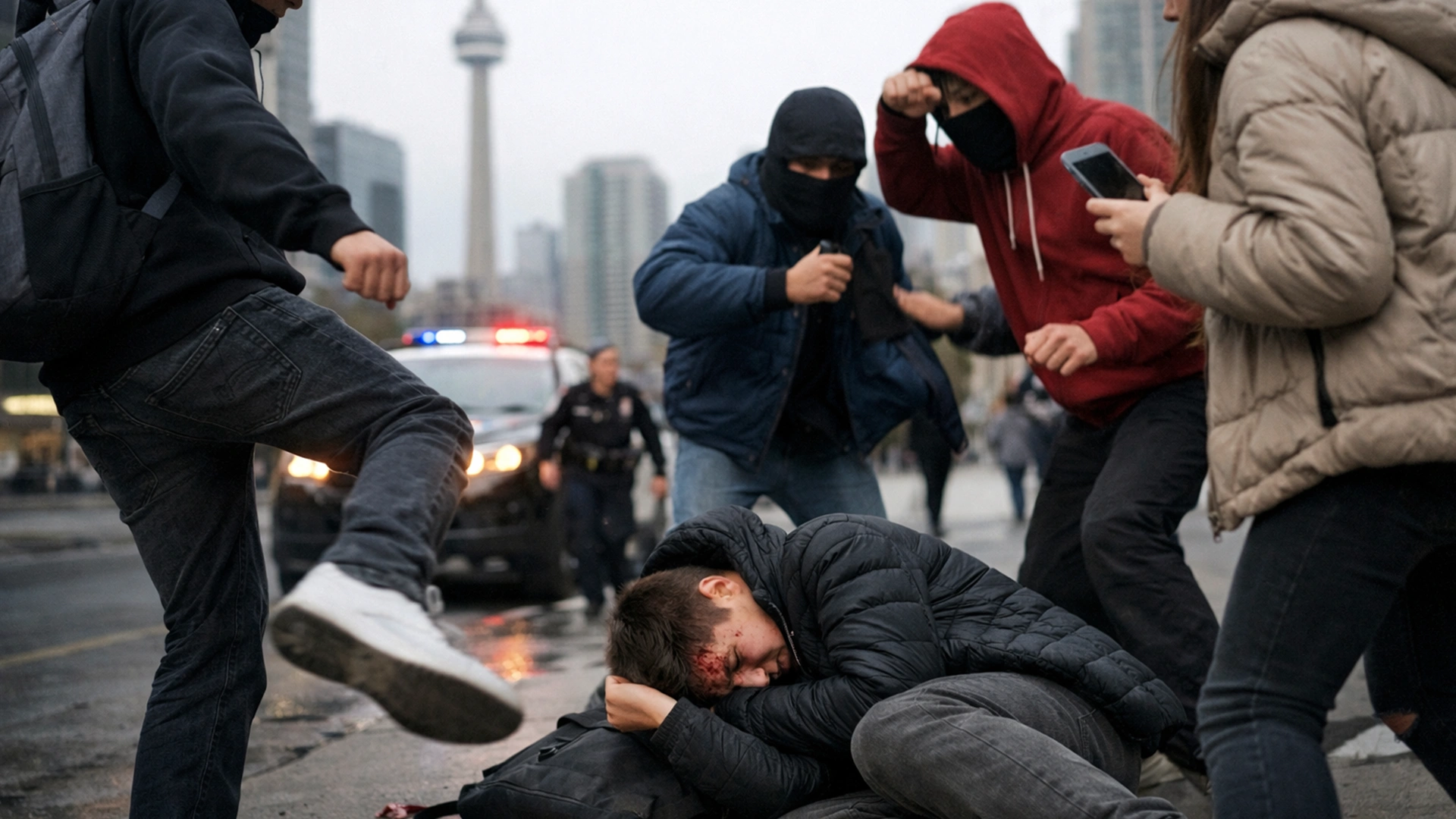
- A fight at school is not just a suspension anymore
- Which assault charge is it? The ladder, translated
- Why violent offence are the two most important words in the file
- Consent fights and self-defence
- The video, the statement, the DM screenshots
- Will my kid be held? Youth bail on an assault charge
- Diversion is harder on a violent charge, not impossible
- If there is a finding of guilt: the real sentencing ladder
- What the school can and cannot learn
- The record: shorter than you fear, longer than you would like
- Youth court at 10 Armoury Street
- Why Kazandji Law
- Frequently asked questions
A fight at school is not just a suspension anymore
The fact patterns repeat. A hallway confrontation that a dozen phones captured. A shoving match on a TTC platform that ended with someone on the ground. A house party where a punch was thrown and a parent called police the next morning. In each case, what would once have ended in the principal's office can now arrive as a criminal charge, because there is video, there is an injured complainant, and there is pressure on every institution to hand these situations to police.
Parents set the tone in the first hours, usually before any lawyer is involved. Three things help every file. First, find out exactly what stage this is at: is your child being investigated, has a charge been laid, or has a form been issued with a court date? Second, do not arrange for your teenager to go in and give their side, to police or to anyone else, until counsel has been consulted; the urge to clear things up quickly is the single most damaging instinct in youth files. Third, start a folder. Screenshots, names of witnesses, the timeline as your child tells it to you, medical notes if your child was hurt too. Files are won on details that evaporate within a week.
Two tracks then run at once. The school applies its own discipline process under its own rules, and that track has its own timelines and appeals. This page is about the other track: the criminal one, where your child is a young person under the Youth Criminal Justice Act and the stakes are a youth record, court conditions and, in serious cases, custody. The criminal track is the one with formal protections built in, and the one where early legal work changes outcomes.
Before going further, a placement note. This page belongs to a family of resources: our Toronto youth criminal defence hub walks through the whole system, from the first 24 hours to records, and it is the right read for how youth court works generally. What follows here goes deep on one offence family only: assault. If your teen's file involves shoplifting or fraud instead, the companion page on youth theft and fraud charges covers the property side.
Which assault charge is it? The ladder, translated for teenagers
Assault in Canadian law starts from a single definition. Under section 265 of the Criminal Code, an assault is the intentional application of force to another person without their consent, and it extends to attempts and threats by act or gesture to apply force. No injury is required. From that base, the Code builds a ladder, and where a charge sits on it drives everything that follows in youth court.
| Charge | What typically triggers it | Adult maximum |
|---|---|---|
| Assault, s. 266 | A shove, a punch, grabbing someone; no weapon, no lasting injury required | 5 years by indictment |
| Assault with a weapon or causing bodily harm, s. 267 | Anything held or thrown counts as a weapon; bodily harm means more than something transient or trifling, so a chipped tooth or bruising that lasts can qualify; choking is specifically included | 10 years |
| Aggravated assault, s. 268 | Wounding, maiming, disfiguring or endangering life | 14 years, indictable only |
Read the third column carefully, then set it aside. Those adult maximums matter for a young person mainly as classification anchors: they determine which YCJA categories a charge falls into, which is the subject of the next section. Youth sentences themselves come exclusively from the YCJA's own ladder, and a youth sentence can never be harsher than what an adult would receive for the same act. For families outside the city, our Ontario youth assault page covers the same charges province wide.
Why violent offence are the two most important words in the file
The YCJA sorts charges into categories, and the category does more work than the charge itself. Three definitions in section 2(1) matter for an assault file.
A violent offence is one where the young person caused, attempted to cause or threatened to cause bodily harm, or endangered someone's life or safety. Most assault charges fit this description where bodily harm is caused, attempted or threatened, though a no injury shove charged under section 266 sits closer to the line than people assume. A serious offence is an indictable offence with an adult maximum of five years or more, which captures section 267 and section 268 clearly, and can capture section 266 where the Crown proceeds by indictment. And a serious violent offence is a closed list: murder, attempted murder, manslaughter and aggravated sexual assault. Notice what is not on that list. Even an aggravated assault under section 268 is not a serious violent offence under the YCJA, a point that surprises parents who have been reading worst case scenarios online.
Why the sorting matters, in three consequences. First, diversion: section 4(c) presumes that extrajudicial measures are adequate for a first time, non violent offence, so an assault charge typically falls outside that automatic presumption. It does not fall outside diversion altogether, because section 4(d) expressly keeps extrajudicial measures available even where the presumption does not apply. Second, custody: section 39(1)(a) makes a violent offence the main statutory gateway through which a custody sentence even becomes possible. Third, bail: the detention test in section 29(2) is built around serious offences and patterns of findings, which shapes how a bail argument runs. Category fights are quiet, technical and enormously valuable, and they are exactly the kind of argument a defence lawyer who lives in assault files knows how to make.
Consent fights and self-defence
Two defences dominate youth assault files, and both come with limits that teenagers rarely see coming.
The first is consent. Plenty of school fights are agreed fights: two kids square up, friends film it, nobody claims ambush. Consent matters because assault requires the absence of it, but the Supreme Court drew a hard line in R. v. Jobidon: consent to a fist fight is vitiated where serious bodily harm is both intended and caused. A schoolyard scrap with real injuries can therefore still be an assault even if both participants wanted the fight. The practical translation for a young person: agreeing to fight is not a licence for what happens once someone is hurt.
The second is self-defence under section 34 of the Criminal Code. It protects a person who reasonably believed force or a threat of force was being used against them or someone else, acted for a defensive purpose, and responded in a way that was reasonable in the circumstances. Factors include proportionality, the history between the parties, and who did what first. Critically, once self-defence has an air of reality on the evidence, the Crown must disprove it beyond a reasonable doubt. In hallway fights where the complainant threw the first shove, that burden becomes the whole case.
One warning belongs beside both defences. Escalation changes the section. A single punch that causes bodily harm can move a file from section 266 to section 267, and a fall against a curb or a locker can move it further. The person who started as the sympathetic party can end up with the heavier charge, which is why we never let a file be judged on who seemed justified in the video's first five seconds.
The video, the statement, the DM screenshots
Youth assault prosecutions in Toronto are built from three piles of evidence: phone video, message threads, and statements. The video usually shows the middle of the story, not the beginning. The DMs and group chats before and after the fight often matter more, because they speak to who arranged what, who threatened whom, and whether this was defence or retaliation. Assume everything was screenshotted before anything was deleted.
Then there is your child's own statement, and here the law gives young people protections adults do not get. Under section 146 of the YCJA, a statement to police is presumptively inadmissible unless the officer explained your child's rights in language appropriate to their age and understanding, gave a real opportunity to consult a lawyer and a parent or appropriate adult, and allowed those people to be present for any statement. A waiver of those rights must be recorded or put in writing. Courts take these requirements seriously, and challenged statements are one of the most litigated issues in youth court. The full walkthrough of police questioning lives on our youth defence hub.
Will my kid be held? Youth bail on an assault charge
Rarely, on a first fight. The YCJA makes pre trial detention genuinely hard to justify for young people. Under section 29(2), a court may only detain a youth where the charge is a serious offence or there is a meaningful history of outstanding charges or findings, where the Crown shows a substantial likelihood the young person will not attend court or will endanger the public by reoffending, and where no conditions of release could manage those concerns. The onus sits on the Crown throughout.
The Act also says plainly what bail cannot be used for: section 29(1) forbids detention as a substitute for child protection, mental health or other social measures. And before detention, the court must consider releasing the young person to a responsible person, under section 31, which in practice usually means a parent who signs on to supervise. Most contested territory in youth bail is not detention at all; it is the conditions list, which can quietly strangle a teenager's school and social life if nobody pushes back. Bail practice generally, including reviews of bad conditions, is covered by our Toronto bail team and the youth specifics live on the youth hub.
A word about what release actually looks like, because the conditions matter more than the label. Typical terms on a youth assault release include no contact with the complainant and other named students, not attending a particular school or address, and residing with a parent. Each one sounds manageable in a courtroom and gets complicated by Monday morning: shared classes, shared bus routes, shared teams. Conditions should be negotiated with the actual timetable in hand, and varied promptly when they prove unworkable rather than quietly ignored.
Diversion is harder on a violent charge, not impossible
Here is the honest version of the diversion picture for assault, without the sales gloss.
The YCJA's automatic presumption that extrajudicial measures are adequate applies to a first time, non violent offence under section 4(c). Shoplifting is the paradigm case, which is why diversion dominates our companion page on youth theft and fraud. An assault charge usually cannot ride that presumption. But section 4(d) keeps the door open: extrajudicial measures remain available for violent charges where they would be adequate to hold the young person accountable.
The off ramps come in escalating structure. Police can take no further action or issue a warning, and section 6(1) requires an officer to consider those options before starting a charge. The Crown can issue a formal caution under section 8. And where more is needed, extrajudicial sanctions under section 10 provide a structured program, often counselling, community service or a restorative element. EJS has preconditions: your child must consent, must be given the chance to consult a lawyer first, and must accept responsibility for what happened. Two protections make it workable: under section 10(4), admissions made to get into the program cannot be used in evidence, and under section 10(5)(a), completing the sanctions means the court must dismiss the charge.
Positioning an assault file for one of these outcomes is advocacy, not paperwork. It means putting context in front of the youth Crown at 10 Armoury Street early: who threw the first shove, what the injuries actually were, what the video does not show, what your teenager has done since. Done well, it can turn a violent charge into a closed file without a finding of guilt.
Timing matters as much as merit. Diversion conversations are most productive early, before positions harden and before the file has been shaped entirely by one side's account. When we push an assault file toward an off ramp, the package we put in front of the Crown is concrete: what the video actually shows frame by frame, injury documentation read against the statutory definition of bodily harm, context the synopsis left out, and evidence of what the young person has done since the incident. Vague requests for leniency achieve nothing; specific, documented submissions change outcomes.
If there is a finding of guilt: the real sentencing ladder
Youth sentencing runs on its own statute and its own philosophy. Section 38(2) requires a sentence proportionate to the seriousness of the offence and the young person's responsibility, with the least restrictive option that can hold them accountable, and it forbids a youth sentence harsher than what an adult would receive for the same conduct. General deterrence, the idea of punishing your child to send a message to other people's children, is not a permitted objective of youth sentencing.
The section 42(2) ladder starts far below jail: a reprimand, an absolute or conditional discharge, a fine of up to 1,000 dollars, community service, and probation with a two year maximum. Above those sit intensive supervision options and the deferred custody and supervision order, a community based order of up to six months available in defined circumstances. Custody itself is a last resort with locked gateways: for an assault file the relevant one is section 39(1)(a), which requires a violent offence, and even through a gateway the court must find no reasonable community alternative exists. Youth custody sentences are also structured as custody and supervision orders, with the final third served in the community under supervision.
At the extreme end sits the adult sentence application, and it deserves exactly one honest paragraph. The Crown can apply only for offences committed at fourteen or older that carry more than two years for an adult, and it must rebut the presumption that young people have diminished moral blameworthiness. The Supreme Court reaffirmed in 2025, in R. v. I.M., that this rebuttal must be proven beyond a reasonable doubt. For ordinary assault files, an adult sentence is not a realistic outcome. The youth hub explains that regime in full.
What the school can and cannot learn
Parents ask about the school before they ask about court, and the answer has two honest halves.
The formal half protects your child. Section 110 of the YCJA bans publishing anything that would identify a young person dealt with under the Act. News outlets cannot name them, and the ban reaches social media posts too. Nothing in the ban, though, stops hallway gossip, and pretending otherwise helps no one; the fight had an audience, and the audience talks. What the law actually controls is institutional information.
The second half is the part parents actually need. Under section 125(6), police or youth justice officials may disclose limited information from a youth file to a school where it is needed to ensure the safety of staff, students or others, to ensure compliance with court orders and conditions such as a no contact term, or to facilitate the young person's rehabilitation. That disclosure comes with statutory strings under section 125(7): the school must keep the information separate from your child's student record, share it with no one who does not need it, and destroy it when it is no longer needed for the purpose it was given. If a school treats youth charge information casually, that is a legal problem with a legal answer.
The record: shorter than you fear, longer than you would like
A youth finding is not a permanent criminal record, and it is not nothing. The YCJA gives every outcome a defined access period under section 119(2), after which the record closes by operation of law, with no pardon application required.
The windows that matter on an assault file: a completed extrajudicial sanctions program closes after two years. A withdrawn or dismissed charge closes after two months. An absolute discharge closes after one year and a conditional discharge after three. A finding of guilt closes three years after the sentence is completed for summary matters and five years for indictable ones. While a window is open, the record can surface on some checks; once it closes, it is sealed.
Two conversions can wreck that timeline, and your teenager should hear both from someone other than the internet. A new finding during an open window extends the clock, and an adult conviction during the window converts the youth record into part of a permanent adult record. Otherwise, the law leans toward a clean start: section 82 deems a young person not to have been convicted once discharge or sentence conditions are satisfied, and federal employment forms cannot ask about closed or discharged youth findings. The mechanics, including how to answer job and volunteer application questions, are laid out on our youth defence hub.
Youth court at 10 Armoury Street
Toronto youth matters, including bail appearances, proceed at the Ontario Court of Justice at 10 Armoury Street, which houses the city's youth courts. It sits a short walk from Osgoode station, and it moves fast in the mornings; arriving early with counsel already retained changes how the day goes.
Two contacts every Toronto parent should save. Youth duty counsel through Legal Aid Ontario can be reached at 416-646-1286, pressing 1 for youth matters; duty counsel can help on the spot on a first appearance, though they cannot run a defence file over months. The courthouse itself handles scheduling questions, not legal advice.
When we take on a youth assault file, the structure is deliberate. The retainer is the young person's: instructions come from your teenager, not from you, because the YCJA builds the case around their participation and their rights. But parents are in the room from the first meeting, notices to parents are part of the statute, and our job includes translating every step so the family moves as one unit. Teenagers who understand their own case make better decisions in it.
A note on what a first appearance is and is not. Nothing is decided that day: no trial, no evidence, usually no plea. It exists to get disclosure moving and to set the next date, which is why a prepared family treats it as an information gathering step rather than a crisis. Your teenager should dress simply, arrive early, and let counsel speak. The version of your child the Crown meets across a hallway conversation, calm, in school, supported at home, is quietly part of the advocacy, because every discretionary decision described on this page is made by people forming impressions as well as applying law.
Why Kazandji Law for a youth assault file
Youth court is not adult court with smaller chairs. The categories, the off ramps, the statement protections and the record rules above are a different statute, and using them well is the entire game. Kazandji Law defends assault allegations across Toronto at every level of seriousness, from hallway fights to section 268 files, and brings the same evidence first approach to youth court that our adult assault defence practice is built on. Fadi Matthew Kazandji leads every strategy personally.
We serve Toronto from our headquarters at 180 John Street, Unit 320, with offices in Thornhill, North York and Oakville for families across the GTA. Consultations are free, and the first one usually answers the question every parent arrives with: how bad is this, really?
One fight should not define a future.
Call 647-588-3234Free consultation with a Toronto youth assault lawyer. Evenings and weekends available for parents.
Frequently asked questions: youth assault charges in Toronto
My teenager was charged after a school fight in Toronto. Is this a real criminal charge?
Yes. It is assault under the Criminal Code, prosecuted in youth justice court under the Youth Criminal Justice Act at 10 Armoury Street. The youth system is separate and rehabilitation focused by law, but the charge, the process and the record windows are real.
What is the difference between assault, assault causing bodily harm and aggravated assault?
Assault under section 266 covers any intentional non consensual force. It becomes section 267 where a weapon is involved, where bodily harm results that is more than trifling, or where choking is alleged, and section 268 aggravated assault where someone is wounded, maimed, disfigured or their life is endangered. The adult maximums of 5, 10 and 14 years matter mainly because they set the YCJA categories; youth sentences come from the YCJA's own ladder.
Both kids agreed to the fight. Does that end it?
Not necessarily. The Supreme Court held in Jobidon that consent to a fist fight is no defence where serious bodily harm is intended and caused. A schoolyard scrap with real injuries can still be an assault.
Can my child claim self-defence?
Section 34 protects a young person who reasonably responded to force or a threat of force, judged on factors like proportionality and who did what first. Once the defence has an air of reality on the evidence, the Crown must disprove it beyond a reasonable doubt.
Can an assault charge be diverted out of court?
Often. The automatic presumption favouring extrajudicial measures applies to non violent offences, so it usually does not attach to assault, but the Act still allows warnings, Crown cautions and extrajudicial sanctions on violent charges where they are adequate. Completing extrajudicial sanctions requires the court to dismiss the charge, and what your child admitted to enter the program cannot be used against them.
Will my child be held for bail?
Rarely on a first assault charge. Detention requires a serious offence or a significant history, Crown proof of a substantial flight or public safety risk, and a finding that no conditions could manage the concern. The court must also consider releasing your teen to a responsible person, often a parent, before detention.
Can the police question my child without me?
Statements are presumptively inadmissible unless police explained your child's rights in age appropriate language, gave a real chance to consult a lawyer and a parent, and allowed them to be present, and any waiver must be recorded or signed. Section 146 is one of the most litigated defence levers in youth assault files.
Will the school find out about the charge?
The publication ban in section 110 protects your child's identity publicly, but the YCJA lets police or youth justice officials share limited information with a school where needed for safety, supervision of conditions or rehabilitation. The school must keep that information separate from the student record and destroy it when it is no longer needed.
What sentence does a youth actually face for assault?
The ladder starts at reprimands and discharges, runs through fines capped at 1,000 dollars, community based orders and probation with a two year maximum, and reaches custody only through statutory gateways. For assault the gateway is that a violent offence was committed, and even then custody requires that no reasonable alternative exists. A youth sentence can never exceed what an adult would get for the same act.
Could my 16 year old get an adult sentence for a fight?
Only on a Crown application, only for offences committed at fourteen or older that carry more than two years for an adult, and only if the Crown rebuts the presumption of diminished moral blameworthiness beyond a reasonable doubt, as the Supreme Court confirmed in its 2025 decision in R. v. I.M. For ordinary assault files it is not a realistic outcome.
How long does a youth assault finding stay on the record?
Fixed windows apply: three years after sentence for summary findings and five for indictable ones, while a completed extrajudicial sanctions program closes after two years and a withdrawn charge after two months. The record then seals by operation of law, with no pardon needed, unless a new offence or an adult conviction inside the window converts it.
Where will the case be heard, and who can help today?
Toronto youth matters proceed at the Ontario Court of Justice at 10 Armoury Street, which houses the youth courts. Youth duty counsel can be reached at 416-646-1286, pressing 1, and calling a youth defence lawyer before any police statement protects every option, including diversion.
This page provides general legal information for Toronto families, not legal advice about your child's specific situation, and reading it does not create a lawyer client relationship. Criminal and youth justice law change; statutory references reflect the law as reviewed in July 2026. For advice about a youth assault charge, call Kazandji Law at 647-588-3234 for a free consultation.