

Markham Divorce Lawyer. Divorce Applications at the Newmarket Family Court
Home › Family Law › Markham Divorce Lawyer
Every divorce for a Markham couple ends in the same place: a divorce order of the Superior Court of Justice, issued for York Region at the Newmarket Family Court Branch, 50 Eagle St. W. What differs is the route each family takes to get there. This guide walks the whole journey, stage by stage, whether you qualify, which application to file, financial disclosure, the Newmarket conference pathway, how property and support are decided, and the day your divorce finally takes effect, under the federal Divorce Act and Ontario's Family Law Act.
Separated, or served with divorce papers in Markham?
Call 647-588-3234Confidential consultations. Kazandji Law serves Markham, Thornhill and all of York Region.
- Stage 0. Do you qualify? The single ground for divorce
- Stage 1. Sole, joint or general: choosing your application
- Stage 2. Financial disclosure: Form 13 vs Form 13.1
- Stage 3. The Newmarket court pathway, step by step
- Stage 4. Property: equalization and the matrimonial home
- Stage 4. Support decided within your divorce
- Stage 5. The divorce order, the 31-day rule and your certificate
- The off-ramp: separation agreements and consent orders
- Special situations in a Markham divorce
- Filing from Markham: Newmarket court logistics
- Why Kazandji Law
- Frequently asked questions
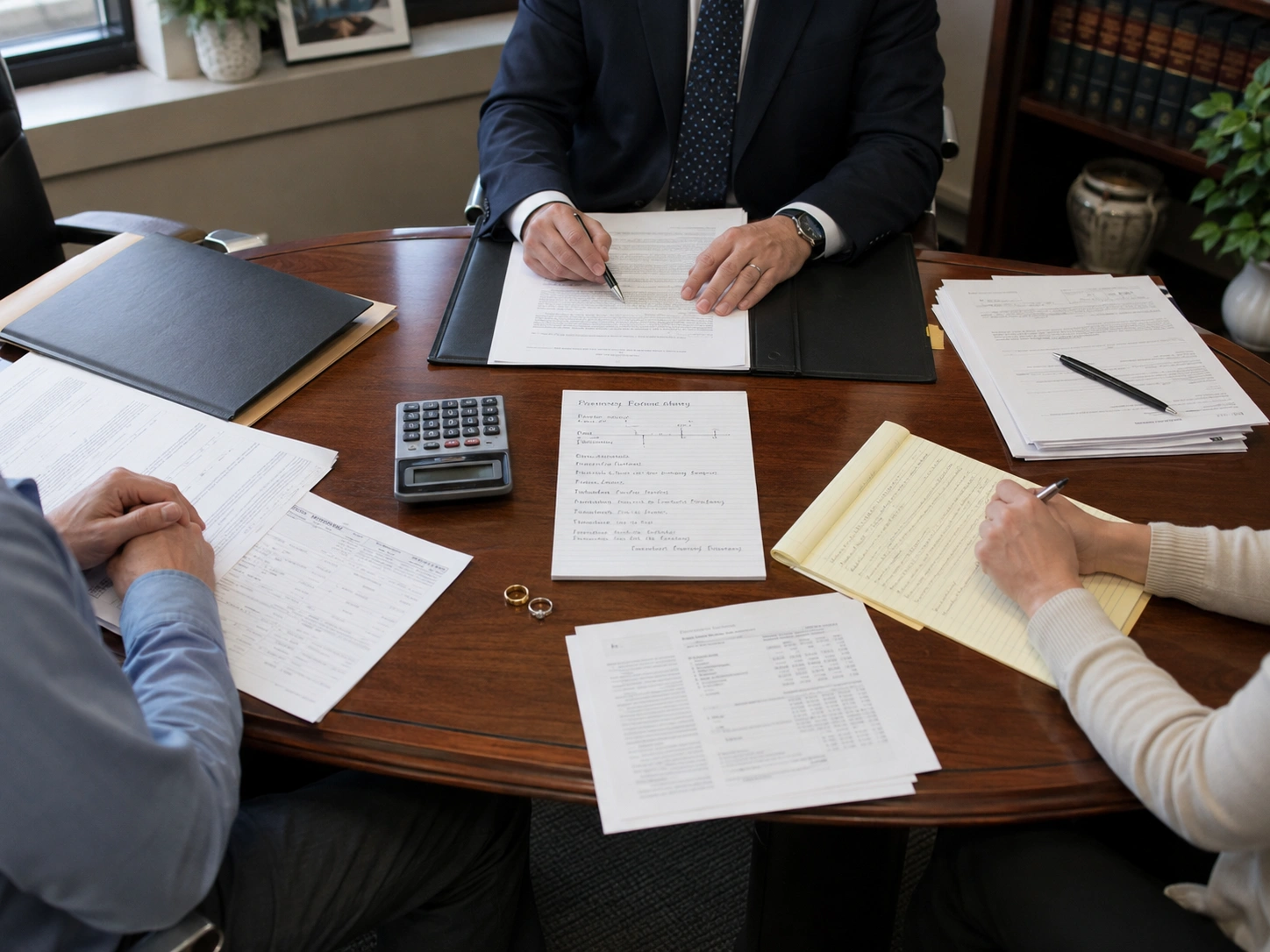
Divorce in Canada is a two-level affair. The federal Divorce Act, R.S.C. 1985, c. 3 (2nd Supp.), supplies the ground for divorce and the corollary orders, parenting, child support and spousal support, while Ontario's Family Law Act governs the division of property and the matrimonial home. For Markham families there is one piece of genuinely good procedural news: Newmarket is one of Ontario's 25 Family Court Branch (Unified Family Court) locations, so a single court, the Superior Court of Justice, hears the divorce and everything attached to it. Our Markham family lawyer hub covers parenting, support and property as practice areas; this page follows the divorce process itself, from first questions to final certificate.
Stage 0. Do You Qualify? The Single Ground for Divorce
Canada has exactly one ground for divorce: breakdown of the marriage (Divorce Act, s. 8(1)). Section 8(2) recognizes only three ways of establishing that breakdown:
- One year of separation. You and your spouse have lived separate and apart for at least one year immediately before the divorce is determined and were living separate and apart when the proceeding began (s. 8(2)(a)). Because the year must be complete when the divorce is determined, not when the papers are filed, an application can be started during the separation year.
- Adultery committed by the other spouse (s. 8(2)(b)(i)).
- Cruelty, physical or mental cruelty by the other spouse of a kind that makes continued cohabitation intolerable (s. 8(2)(b)(ii)).
The separation route requires no proof of misconduct. The fault routes remain available, but they attract their own statutory bars, condonation and connivance (s. 11), and choosing them does not improve the outcome on property, support or parenting.
Separated under one roof
Separation does not require two addresses. Spouses are deemed to have lived separate and apart for any period during which they lived apart and either of them had the intention to live separate and apart (s. 8(3)(a)). With Markham housing costs, many separating couples stay in the same house for months, the question is whether the shared life of the marriage has genuinely ended, and that is assessed case by case. Keep your evidence tidy: the date of separation not only starts the divorce clock, it also anchors the property valuation used for equalization and starts limitation periods running.
Jurisdiction: the one-year residence rule
An Ontario court may hear a divorce only if at least one spouse has been habitually resident in the province for the year immediately before the proceeding starts (s. 3(1)). New arrivals to Markham may need to wait out that period. Under the Act, the court for Ontario is the Superior Court of Justice, and for York Region residents that means the Newmarket Family Court Branch.
Stage 1. Sole, Joint or General: Choosing Your Application
Ontario's family court system offers three doors into a divorce. Picking the right one shapes the cost, the timeline and the temperature of everything that follows.
| Application | Form | Built for | How it runs |
|---|---|---|---|
| Simple (sole) | Form 8A | A divorce and nothing else | One spouse applies and serves the other; the respondent has 30 days to answer (60 outside Canada or the U.S.); exempt from the Mandatory Information Program. |
| Joint | Form 8A, signed by both spouses | Uncontested divorce, with or without agreed orders | Filed together, there is no respondent, so no service; supported by a Form 36 affidavit from each spouse, a draft Divorce Order (Form 25A) and stamped envelopes for the court's mailing. |
| General | Form 8 | Divorce plus contested claims, parenting, support or property | The full application stream: service, answer, financial disclosure and the conference track described below. |
Your claims drive the paperwork. Parenting claims add a Form 35.1 affidavit; support or property claims add a sworn financial statement (Form 13 or 13.1) with its Form 13A certificate; any support order needs a draft Support Deduction Order so payments can be enforced. For how we handle these files across Ontario, see our divorce practice page.
Three documents every divorce needs
- Your marriage certificate. File the original certificate or registration of marriage; if you cannot obtain one, a Form 36 affidavit must explain why. Certificates not in English require a certified translation, a routine step for many Markham families married abroad.
- The federal clearance certificate. Before granting any divorce, the court must receive a clearance from the Central Registry of Divorce Proceedings confirming that no duplicate divorce case is pending anywhere in Canada.
- Your duty certification. Since the 2021 reforms, the first documents you file certify that you know your statutory duties: to try to resolve matters through a family dispute resolution process where appropriate, to protect children from the conflict, to provide complete, accurate and up-to-date information, and to comply with orders (ss. 7.1 to 7.6).
Where to file: in the municipality where either spouse lives, or, where parenting claims are made, where the children live. For Markham residents that is the Newmarket Family Court Branch, and most documents can be issued and filed through Ontario's online family filing portal without a trip up the highway.
Stage 2. Financial Disclosure: Form 13 vs Form 13.1
Financial disclosure is the engine room of any divorce that raises money issues. Rule 13 of the Family Law Rules decides which sworn statement you file:
- Form 13. Financial Statement (Support Claims): used where support is claimed but no property or debt claims are made.
- Form 13.1. Financial Statement (Property and Support Claims): used whenever property or debts are in issue, with or without support, the usual form in a divorce, because equalization is on the table.
- Form 13A. Certificate of Financial Disclosure: the index of the supporting documents you have produced.
The exceptions are narrow. No financial statement is required where the only support claim is the table amount of child support, on consent motions to change support where both sides agree, or where the financial claims are being decided in arbitration alone.
The Divorce Act adds its own obligation: every party owes complete, accurate and up-to-date information (s. 7.4), and the duty is continuing, so statements must be corrected and refreshed as the case advances. Incomplete disclosure invites adjournments, disclosure orders and costs consequences, and an agreement built on bad disclosure is an agreement built on sand.
Stage 3. The Newmarket Court Pathway, Step by Step
After your application is issued at Newmarket, it is served on your spouse (joint applications skip service entirely, there is no respondent). The Answer is due within 30 days if served in Canada or the United States, 60 days if served elsewhere.
A Family Court Branch quirk that matters here: first appearances are scheduled at FCB sites unless the case deals with divorce or property, so a divorce file typically moves straight toward its first conference, and your side must ask the court office to schedule it.
From there, the Family Law Rules (r. 17) run every contested case down the same track:
- Case conference, the first working discussion with a judge: prospects of settlement, narrowing the issues, disclosure orders and next steps.
- Settlement conference, a judge works with both sides to resolve or narrow every issue that remains.
- Trial scheduling conference, tied to the Trial Scheduling Endorsement Form; trial dates are fixed.
- Trial management conference, final organization of witnesses, exhibits and time.
- Trial, evidence and judgment on whatever could not be settled.
Most of those steps exist to end the case early, and Newmarket adds settlement off-ramps of its own: Dispute Resolution Officer (DRO) conferences, judicial dispute resolution (JDR), free on-site family mediation on your court date, and off-site mediation available at any time on a sliding-scale fee. The Divorce Act itself expects this: parties must try to resolve their matters through a family dispute resolution process to the extent that it is appropriate (s. 7.3), which it is not in every case, particularly where safety is a concern.
Two housekeeping notes. If your application raises parenting, support or property claims, both spouses attend separate sessions of the free Mandatory Information Program no later than 45 days after the case starts; divorce-only cases are exempt. And Superior Court filing fees apply (fee waivers exist for those who qualify), amounts change, so check the current schedule on ontario.ca rather than relying on any figure printed online.
Stage 4. Property: Equalization and the Matrimonial Home
Property on divorce is Ontario law. Part I of the Family Law Act, and Ontario does not split each asset in half. It equalizes the growth in each spouse's net worth over the marriage:
- Each spouse calculates a net family property (NFP): the value of what you own at the valuation date, minus your debts, minus your net worth on the date of the marriage.
- The spouse with the higher NFP pays the other half the difference, the equalization payment.
- A negative NFP counts as zero.
Some property never enters the calculation: gifts and inheritances received from third parties after the marriage, certain personal-injury damages, life insurance proceeds, property traceable to those sources, and property excluded by a valid domestic contract.
The matrimonial home plays by its own rules
The family home is the Family Law Act's great exception. Its full value is shared even if one spouse owned it before the marriage, and a home received as a gift or inheritance loses those exclusions too, the usual date-of-marriage deduction does not apply to a matrimonial home. Separately, Part II of the Act gives both spouses an equal right to possession of the matrimonial home regardless of whose name is on title, and a court may award one spouse exclusive possession while matters are sorted out.
Courts can depart from an equal division only in narrow circumstances where equalization would be extremely unfair, a deliberately demanding threshold. And the claim has a shelf life: equalization must be claimed within six years of separation or two years of the divorce, whichever comes first. Divorcing quickly and leaving property for later can quietly shorten your window.
Stage 4. Support Decided Within Your Divorce
Support claimed inside a divorce is corollary relief under the Divorce Act, and child support sits at the front of the line. Where money cannot cover everything, the court gives priority to child support over spousal support (s. 15.3), and, as Stage 5 explains, the divorce itself waits until the children's support is reasonably arranged.
Child support
Child support must follow the Federal Child Support Guidelines (s. 15.1): the Ontario table amount for the payor's income and the number of children, plus a proportionate sharing of s. 7 special or extraordinary expenses, child care, the child's share of medical and dental premiums, health expenses exceeding insurance reimbursement by at least $100 a year, extraordinary school and extracurricular expenses, and post-secondary education. New federal tables came into force on October 1, 2025, the first update since 2017, and they do not automatically change orders made before that date. Where each spouse has the children at least 40% of the time over the year, s. 9 replaces the simple table with a shared-parenting-time analysis of both parents' table amounts, the increased costs of shared arrangements and each household's means and needs. Our child support page goes deeper.
Spousal support
Spousal support in a divorce runs on the s. 15.2 framework. The factors are the condition, means, needs and other circumstances of each spouse, including the length of cohabitation, the functions each spouse performed, and any existing order or agreement (s. 15.2(4)). The objectives are to recognize the economic advantages and disadvantages of the marriage and its breakdown, apportion the financial consequences of caring for children beyond child support, relieve hardship, and promote each spouse's self-sufficiency so far as practicable (s. 15.2(6)). Marital misconduct is expressly off the table (s. 15.2(5)). The Supreme Court of Canada recognizes compensatory, needs-based and contractual foundations for support (Moge v. Moge; Bracklow v. Bracklow). The Spousal Support Advisory Guidelines supply the ranges family lawyers quote, but they are advisory only, never legislated, and never a statutory entitlement.
Stage 5. The Divorce Order, the 31-Day Rule and Your Certificate
Even a fully agreed divorce passes through statutory gates before it is granted:
- Children come first. The court must stay the divorce until reasonable arrangements have been made for the support of the children of the marriage, judged against the Child Support Guidelines (s. 11(1)(b)). An otherwise perfect application will sit until the numbers make sense.
- No collusion, and, where the divorce is sought for adultery or cruelty, no condonation or connivance, subject to a public-interest override (s. 11).
- The federal clearance. The Central Registry of Divorce Proceedings must confirm there is no competing divorce case elsewhere in Canada.
Once granted, the divorce takes effect on the 31st day after the judgment (s. 12(1)), a built-in appeal window; it can take effect earlier only in special circumstances where the parties undertake that no appeal will be taken. From the effective date the marriage is dissolved (s. 14) and the divorce has legal effect all across Canada (s. 13). On request, the court issues a certificate of divorce, conclusive proof of the divorce and of the date it took effect (s. 12(7)).
The Off-Ramp: Separation Agreements and Consent Orders
Not every divorce needs a judge to decide anything. Many Markham couples resolve property, support and parenting terms in a separation agreement first, and then file a joint or simple application that asks the court for only one thing: the divorce itself. It is often the calmest route through everything this page describes, and it converts the conference track from a battleground into a formality.
For an agreement to carry that weight, the fundamentals have to be right:
- Form matters. Domestic contracts must be in writing, signed and witnessed, a handshake arrangement is not a separation agreement.
- Disclosure matters more. An agreement negotiated on incomplete financial information is fragile. The complete, accurate and up-to-date standard that governs court disclosure is the practical benchmark for private deals too, and independent legal advice for each spouse is the norm before signing.
- Parenting cannot be pre-decided. Marriage contracts and cohabitation agreements may deal with property, support and the home, but they cannot fix decision-making responsibility or parenting time in advance, and child support arrangements will still be measured against the Guidelines before any divorce is granted (s. 11(1)(b)).
An agreement also plugs directly into the divorce machinery. A joint application can ask the court to turn agreed terms into orders, supported by each spouse's Form 36 affidavit and a draft order, and even a divorce-only file benefits, because the court will not grant the divorce until the children's support is reasonably arranged, and a proper agreement is how you show it.
The Divorce Act's definition of a family dispute resolution process expressly includes negotiation, mediation and collaborative law (s. 2(1)), and spouses have a duty to attempt one to the extent appropriate (s. 7.3). Where negotiation stalls, York Region families can use the court-connected mediation service, free on-site on a court date, sliding-scale off-site at any time, or private mediation, arbitration or med-arb if both sides prefer to keep decisions out of the courtroom entirely. Financial claims resolved in arbitration alone even sit outside the financial-statement requirement of Rule 13. Whatever the forum, the sequence is the same: disclosure, terms, independent advice, signatures, then a joint application carries the result to the Newmarket court.
Even in a fully agreed divorce, the clocks from the earlier stages keep running: the equalization limitation (six years from separation, two from divorce) and the 31-day effective-date rule apply no matter how amicably the file ends.
Special Situations in a Markham Divorce
Family violence and safety
The Divorce Act defines family violence broadly, violent or threatening conduct, a pattern of coercive and controlling behaviour, or conduct that causes a family member to fear for their safety, whether or not the conduct would be a criminal offence, and makes it a mandatory consideration in any parenting decision, together with any related criminal or civil proceeding (ss. 2(1), 16(3)(j) and (k)). The process bends for safety too: the duty to attempt family dispute resolution applies only to the extent appropriate, and relocation notice requirements can be modified by court order where there is a risk of family violence. Where criminal charges or bail conditions collide with a divorce, coordinated advice matters, the criminal-family overlap is covered on our Markham family lawyer page.
Incomes over $150,000
For payor incomes above $150,000, the Guidelines permit either the full table amount or the table amount on the first $150,000 plus an amount the court considers appropriate having regard to the children's circumstances and the parents' means (FCSG s. 4), plus s. 7 expenses either way. High-income support in a divorce is argued, not looked up.
Business owners and disclosure
Where a spouse is self-employed or holds corporate interests, the file turns on documents: business valuations for equalization and a fair determination of income for support. Form 13.1 disclosure is document-heavy, and the statutory duty of complete, accurate and up-to-date information (s. 7.4) applies with full force to corporate records. Build in time for valuators, it is money well spent on both sides of the table.
Relocation after divorce
A move, by a parent or a child, likely to have a significant impact on the child's relationships is a relocation under the Divorce Act. The relocating parent must give at least 60 days' written notice in the prescribed form; the other parent has 30 days to object; and the burden of proof follows the existing arrangement (ss. 16.9 to 16.93). Relocation is also deemed a change of circumstances for varying parenting orders (s. 17(5.2)). Parenting arrangements themselves are covered on our Markham child custody and parenting page.
Changing final orders
The divorce itself is final, but corollary orders can be varied on a material change: child support where a change would produce a different Guidelines result (s. 17(4)); spousal support on a change in the condition, means, needs or other circumstances of either former spouse (s. 17(4.1)); parenting orders on a change in the circumstances of the child (s. 17(5)). Retroactive child support claims are governed by the Supreme Court's D.B.S. framework, which weighs the reason for delay, the payor's conduct, the child's circumstances and any hardship a retroactive award would cause.
Filing From Markham: Newmarket Court Logistics
- The court: Newmarket Family Court Branch of the Superior Court of Justice, 50 Eagle St. W., Newmarket L3Y 6B1, the Unified Family Court for all of York Region. There is no courthouse in Markham itself; every family appearance for a Markham resident happens in Newmarket or virtually.
- Contacts: family court office 905-853-4809; family scheduling (conferences, motions, trials) Newmarket.SCJ.TC@ontario.ca or 905-853-4823.
- Online filing: family court documents, including divorce applications, can be filed through Ontario's online family filing portal.
- FLIC: the courthouse's Family Law Information Centre offers free information, referral coordinators and Legal Aid Ontario duty counsel for eligible parties.
- Divorce-only files: exempt from the Mandatory Information Program, and no first appearance is scheduled, the file moves to a case conference when a party asks.
Two practical notes before you make the drive north. Counter service at the Newmarket courthouse runs on weekday windows, 9 to 11 a.m. and 2 to 4 p.m., with offices open 8:30 to 5, so time any in-person filing accordingly, and remember that the Family Law Information Centre can help with court forms and referrals to the court-connected mediation providers as well. Many routine steps in a divorce file no longer require attendance at all, but when a conference or motion does, build Newmarket travel into your day: the courthouse serves every family case from Markham, Richmond Hill and Vaughan.
Why Kazandji Law for Your Markham Divorce
Kazandji Law is a Toronto-area firm practising family law and criminal defence side by side, a combination that earns its keep when a separation collides with domestic allegations, police involvement or bail conditions that decide who stays in the house. Founding partner Fadi Matthew Kazandji leads a team that serves York Region families through the Newmarket Family Court Branch.
- Four offices: Toronto (180 John St.), Thornhill (7191 Yonge St., Suite 310, minutes from Markham), North York and Oakville.
- One court, one strategy: in a Unified Family Court region, your divorce, property, parenting and support all run through the same Newmarket courtroom, we build the file once, for every issue in it.
- Process-first advice: we push the settlement off-ramps. DRO conferences, JDR, mediation, where they serve you, and prepare for trial where they do not.
Read about our recent work on our results page, or start with the family law overview.
Results matter. See our recent case successes and read our client reviews on Google, then call 647-588-3234 for a free, confidential assessment of yours.
Get clear answers before your next step, from separation date to final certificate.
Call 647-588-3234 NowKazandji Law, serving Markham from Thornhill, Toronto, North York and Oakville.
Markham Divorce Lawyer. Frequently Asked Questions
What is the only ground for divorce in Canada?
Breakdown of the marriage (Divorce Act s. 8(1)), established in one of three ways: one year of separation, or the other spouse's adultery or cruelty (s. 8(2)).
Do we have to live at separate addresses for a year to divorce?
No. Spouses are deemed to live separate and apart for any period during which they lived apart and at least one of them intended to live separate and apart (s. 8(3)(a)), and that can happen under one roof. The assessment is case-specific, so document your separation date carefully.
Will trying to reconcile reset our one-year separation clock?
Not if you resume cohabitation for 90 days or less with reconciliation as the primary purpose (s. 8(3)(b)(ii)). A longer reconciliation attempt interrupts the separation period.
Can I file for divorce in Ontario right after moving here?
Only once the residence rule is met: an Ontario court has divorce jurisdiction if either spouse has been habitually resident in the province for at least one year immediately before the proceeding starts (s. 3(1)).
Where do Markham residents file for divorce?
At the Superior Court of Justice, for York Region, the Newmarket Family Court Branch at 50 Eagle St. W., Newmarket. Most documents can be filed through Ontario's online family filing portal.
What is the difference between a sole, joint and contested divorce?
A simple (sole) application on Form 8A seeks only a divorce. A joint application is filed by both spouses together with agreed terms, so there is no respondent and no service. A general application on Form 8 adds contested claims, parenting, support or property, and follows the full conference track.
Do I have to attend the Mandatory Information Program?
Cases dealing only with a divorce are exempt from the MIP. If your application includes parenting, support or property claims, both spouses attend separate sessions of the free program no later than 45 days after the case starts.
How long does a divorce take in Ontario?
There is no fixed statutory timeline, it depends on whether matters are contested and on court scheduling. What is fixed: the answer is due in 30 days (60 outside Canada and the U.S.), the court must hold a federal Central Registry clearance certificate, and the divorce takes effect on the 31st day after the order.
Can the court refuse to grant a divorce?
The court must stay the divorce until reasonable arrangements have been made for the support of the children, measured against the Child Support Guidelines (s. 11(1)(b)). Collusion, and, for adultery or cruelty divorces, condonation or connivance, are also statutory bars (s. 11).
How is property divided when we divorce?
Through Ontario's equalization regime: each spouse calculates net family property to the valuation date, and the spouse with the higher amount pays the other half the difference. The matrimonial home's full value is shared even if one spouse owned it before the marriage or inherited it. Court claims face a limitation of six years from separation or two years from divorce, whichever comes first.
Who pays spousal support after divorce, and for how long?
Entitlement follows the s. 15.2(4) factors and the s. 15.2(6) objectives, compensating economic disadvantage, relieving hardship and promoting self-sufficiency where practicable, and marital misconduct is irrelevant (s. 15.2(5)). Amount and duration ranges from the Spousal Support Advisory Guidelines are advisory only, not law.
When can I remarry after my divorce?
The divorce takes effect on the 31st day after the divorce order is granted (s. 12(1)). The court can issue a certificate of divorce as conclusive proof of the divorce and its effective date (s. 12(7)).
This page is legal information for Markham and York Region residents, not legal advice, and reading it does not create a lawyer-client relationship. Statutory references are to the Divorce Act, R.S.C. 1985, c. 3 (2nd Supp.), the Federal Child Support Guidelines, SOR/97-175 (tables amended effective October 1, 2025), and Ontario's Family Law Act, R.S.O. 1990, c. F.3, as consolidated at July 2026. Court practices, forms and fees change, obtain advice about your own situation before acting. Kazandji Law: 180 John St., Toronto, 647-588-3234 · 7191 Yonge St., Suite 310, Thornhill, 647-697-5975 · North York, 647-588-3234 · Oakville, 647-696-1468.