

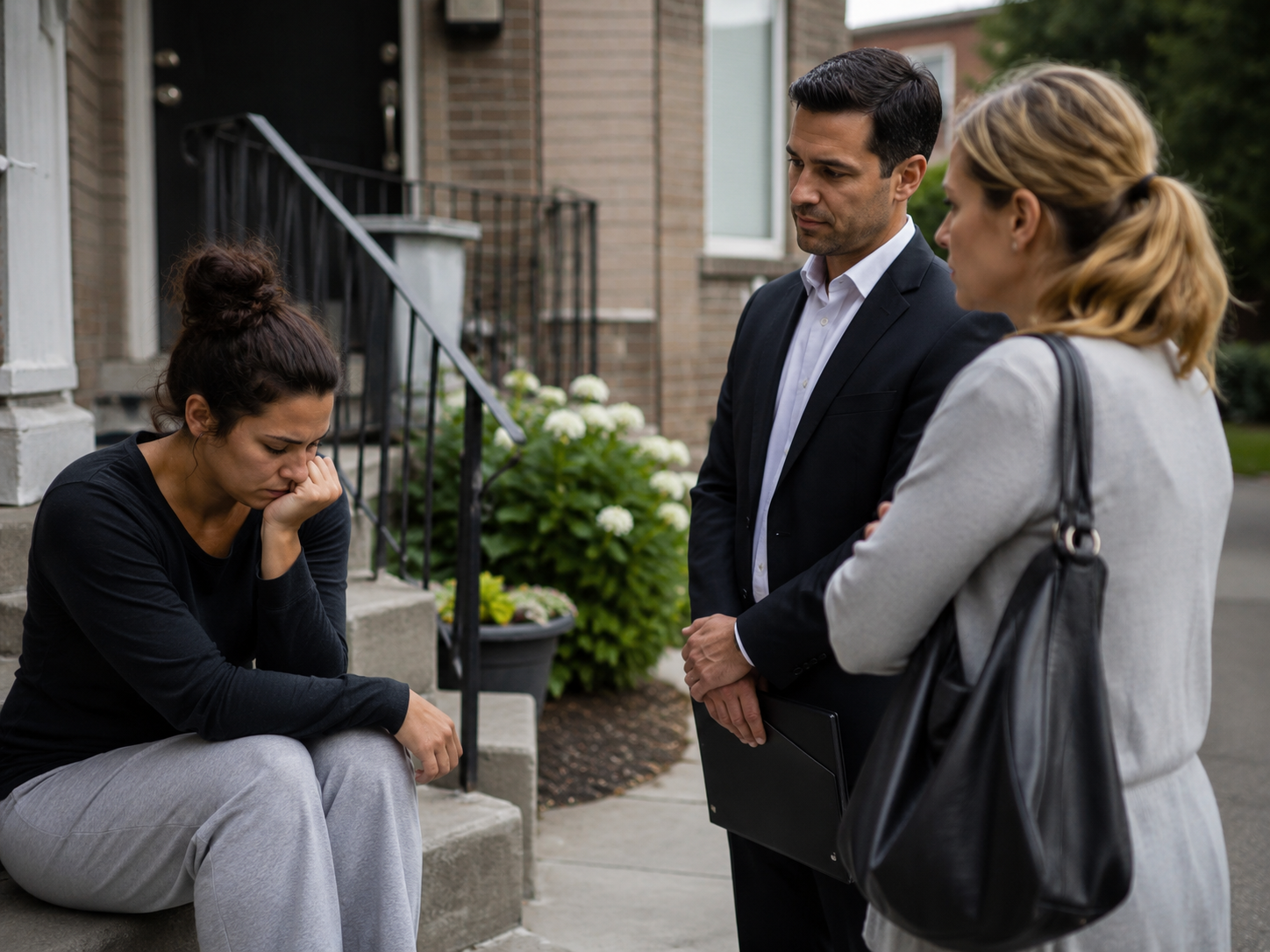

One moment there is an argument. Maybe things escalated. Maybe they did not, and the call to police was made out of frustration or fear or something more complicated than either of you can explain clearly right now. When police arrive, everything moves fast. You were taken to the police station. There were conditions. There was paperwork. And now you are trying to figure out what any of it actually means and what comes next.
Domestic assault charges in Ontario move quickly, and they carry immediate consequences that most people are not prepared for. This post walks through exactly what happens after domestic assault charges in Ontario, what the domestic assault bail conditions typically look like, what the no-contact order covers, and what the road ahead in the criminal case looks like from here.
Why the Charges Get Laid Even When Nobody Wants Them To
Many domestic assault cases begin with one party calling police and then almost immediately changing their mind. The complainant says it was an unfortunate domestic incident. They want their partner home. They do not want anyone criminally charged. And yet the charges still get laid.
In Ontario, police are required to lay a charge if they have reasonable grounds to believe a domestic violence incident occurred. That decision does not belong to the complainant. When police arrive and the evidence supports an assault allegation, or even utter threats or mischief charges in some situations, the decision to lay a charge is made by the police and the Crown, not by the people involved. Even if the complainant initially called for help and then changed their position, charges in Ontario can and do proceed without the complainant’s active cooperation.
There is no separate domestic violence offence under the Criminal Code of Canada. What we call domestic assault is prosecuted under the same assault provisions that apply to any other physical altercation, under Sections 265 through 268. Domestic violence charges arise in the domestic context when the offence involves intimate partners, family members, or former spouses. Courts and prosecutors treat domestic criminal cases more seriously than stranger-on-stranger violence cases, because intimate partner violence is treated as an aggravating factor at every stage of the criminal case.
One thing that catches people off guard in domestic cases is that the Crown attorney can continue to pursue charges even if the complainant later tries to withdraw the charges entirely. Even if the complainant recants their statement, stops cooperating with the investigation, or tells the Crown attorney they want to withdraw the charges, the Crown can proceed using other evidence. Police observations, photographs, audio recordings, prior incident history, and anything else the investigation produced can all be used. This is true across Canada area cases involving domestic assault allegations. The underlying domestic assault does not go away simply because the complainant no longer wants to participate. Many domestic assault cases are resolved through the criminal courts without the complainant ever testifying.
What Actually Happens at the Police Station
Once you are arrested and charged, the process at the police station is structured. You are fingerprinted and photographed. Everyone charged with a criminal offence in a domestic context goes through that procedure under the Identification of Criminals Act, regardless of whether they are ever convicted of anything.
Police also conduct an Ontario Domestic Assault Risk Assessment, known as ODARA, after a domestic violence incident. This standardized tool helps officers evaluate the likelihood of future violence based on factors like prior criminal record, the circumstances of the incident, and the complainant’s own concerns. The outcome of the ODARA can influence what conditions are imposed and what the Crown attorney will seek at the bail stage.
After processing, one of two things happens. Police either release you on an undertaking, sometimes called a Form 10, which is a written document setting out conditions you must follow while the criminal case is before the courts. Or they hold you and bring you before a bail hearing before a justice of the peace, which must happen within 24 hours of your arrest.
What Happens After a Domestic Assault Charges in Ontario, whether you are released at the police station or held for a bail hearing depends on the seriousness of the assault charges in Ontario, your prior criminal record if one exists, whether police assessed you as a continued risk to the complainant, and the officer’s overall read of the situation. More serious domestic assault matters involving injury, or situations where prior domestic charges are on record, make it more likely you will be held for a bail hearing rather than released on an undertaking.
What Domestic Assault Charges Mean for Your Bail Conditions
Whether you are released on an undertaking or through a formal bail hearing, the conditions that attach to domestic charges in Ontario follow a recognizable pattern. These are not casual suggestions. You must follow certain conditions exactly as written for as long as the criminal case is before the courts, which in domestic criminal cases is often many months.
The standard domestic assault bail conditions typically include:
- A no-contact condition prohibiting any contact with the complainant, directly or indirectly, by any means whatsoever
- No attendance at the family home, the complainant’s workplace, or any location the complainant is known to frequent
- No contact with any witnesses connected to the criminal case
- A requirement to reside at a specific approved address, away from the shared home
- A weapons prohibition covering firearms and other restricted items
- In some cases, a curfew or a requirement to report regularly to police
The Partner Assault Response program, known as PAR, is a counselling and community education program that courts sometimes impose as a condition in first offence domestic matters. It focuses on accountability and behavioural change, and for first time domestic offenders with no prior criminal record, completing a PAR program can sometimes be part of how a case gets resolved favourably.
Having to move out of the house is one of the most immediately disruptive parts of these conditions. It can happen within hours of being released, sometimes with almost no time to collect essentials. Getting back into the family home to retrieve additional belongings later requires a court order. What Happens After a Domestic Assault Charges in Ontario, and any attempt to enter the home without that court order while a no-contact condition is in place can lead to a new criminal offence being charged.
The No-Contact Order: What It Actually Covers
The no-contact order covers more ground than most people realize What Happens After a Domestic Assault Charges in Ontario when they first read through their conditions.
No contact means no contact at all. No phone call, no text message, no email, no postal mail, no message passed through a mutual friend or family member, no social media interaction of any kind. Courts interpret these conditions strictly in domestic cases, and even what seems like a harmless or brief message can lead to criminal charges for a breach.
Here is what trips up many people in these situations: even if the complainant reaches out to you first, responding is still a breach. If your partner calls, texts, shows up at where you are staying, and says they want you home, any response or contact from you violates the condition. Courts are clear that contact with the complainant initiated by the other party does not give the accused permission to respond. The no-contact condition is placed on you, and it does not have exceptions for when the other person was the one who reached out first.
Breaching a bail condition is a criminal offence under Section 145 of the Criminal Code. Many domestic criminal cases that started as a manageable criminal matter became significantly more complicated because the accused was charged with a criminal offence for a bail breach on top of the original assault charge. Being criminally charged with a breach can mean being kept in jail until the trial date, new charges added to an already difficult file, and a much harder path when arguing for reasonable bail conditions in any future hearing.
If your conditions need to change because of a genuinely changed situation, such as agreed parenting arrangements or a shared residence that needs to be accessed, the proper step is bringing a formal application to vary the conditions through proper counsel. Not acting on a verbal agreement with the complainant that the condition does not apply in certain situations.
The Court Process After a Domestic Assault Arrest
Once the bail situation is settled, the criminal case moves through the courts. This part is slower than the arrest and involves more steps than most people anticipate going in.
After the first court date, disclosure is provided. This is the package of evidence the Crown attorney is relying on: the arresting officer’s notes, any recordings, photographs, the complainant’s statement, prior incident history, and the ODARA assessment. Reviewing that disclosure carefully is one of the most important early steps in any domestic assault case, and having a criminal defence lawyer review it with you is how you start building your defence properly from a position of knowledge rather than guesswork.
The disclosure review is where your criminal defence lawyer begins to assess the full picture of your domestic assault charges in Ontario, identify where the Crown’s case has weaknesses, and map out what a realistic defence strategy looks like.
The file then moves through appearances in criminal court where both sides assess the evidence and explore whether the matter can be resolved without a full trial. The Crown attorney will seek different outcomes depending on the strength of their evidence, the complainant’s level of cooperation, and whether this is a first offence domestic matter or something with a more serious background. In criminal cases involving domestic assault, the Crown must prove the charge beyond a reasonable doubt at trial if the matter goes that far. That is a demanding standard, and genuinely weak evidence, credibility issues with the complainant, or procedural problems in the investigation can all affect the outcome.
Community legal education resources are available through various Ontario organizations for people navigating this process, though nothing replaces speaking directly to a criminal defence lawyer who knows your file.
How Domestic Cases Can Resolve Without Going to Trial
Not every domestic assault case ends with a criminal conviction or a jail sentence, and understanding the realistic resolution paths is part of what good counsel does for you at the start.
A peace bond under Section 810 of the Criminal Code is one of the more common resolutions for domestic assault charges in Ontario involving a first offence and no prior criminal history. The accused agrees to keep the peace and follow conditions for a fixed period, and the Crown agrees to withdraw the charges. No criminal conviction is registered. No criminal record results from the peace bond itself. For first time domestic offenders with a clean prior background and a lower-severity incident, a peace bond is often the cleanest path through the criminal justice system.
A conditional discharge is another option. The accused is found guilty but no criminal conviction is formally registered provided probation conditions are met and completed. Courts grant a conditional discharge when it is in the accused’s best interest and not contrary to the public interest. For domestic assault charges without serious injury and where the accused has no prior criminal record, a conditional discharge is sometimes the outcome.
Some people choose to plead guilty, particularly where the evidence is strong and an early resolution produces a more favourable outcome than taking the matter all the way to trial. Plead guilty at an early stage and courts typically view that as a mitigating factor in sentencing, which can affect whether there is jail time, the length of any probation period, and what other conditions are imposed. For many first offence domestic matters, a guilty plea with mitigating factors often results in probation and programming rather than an actual jail sentence.
In stronger defence situations, the matter goes to trial with the goal of an acquittal. If the accused is found guilty after trial, sentencing is then determined based on the specific facts, prior criminal history, and what counsel presents as mitigation. Domestic assault cases involving patterns of violence, prior domestic charges, or serious injury are treated more seriously at sentencing, and the Crown attorney will seek a meaningful jail sentence in those circumstances.
For those concerned about whether they are going to go to jail, the honest answer is that it depends entirely on the specific facts. First time domestic offenders with no prior criminal record and a non-serious incident are far more likely to be looking at a period of probation and programming than actual custody. But the more serious the underlying domestic assault, and the more prior history exists, the more realistic a jail sentence becomes.
What a Criminal Record for Domestic Assault Actually Costs You
People sometimes focus entirely on whether they are going to jail and underestimate the other ways a criminal conviction reshapes daily life long after the criminal case is resolved.
What Happens After Domestic Assault Charges Ontario? A criminal record for domestic violence carries consequences well beyond the criminal courts. Employment background checks are a real and immediate concern. Any role involving a security clearance, work with children, professional licensing in healthcare, finance, or education, or a position involving trust is affected when a domestic violence offence appears on a record check. Many employers conduct employment background checks as a standard part of hiring, and an assault charge showing up on that check creates problems at the application stage regardless of how minor the original incident was.
Travelling to the US becomes significantly more complicated. US Customs and Border Protection has access to Canadian criminal records, and domestic violence charges are among the categories that routinely result in denied entry, sometimes permanently.
Family court matters can also be impacted. If there are children involved and parenting time or decision-making responsibility is being litigated separately, a criminal conviction for domestic assault will be part of what the family court considers when assessing the best interests of the child. A criminal conviction does not automatically determine a family court outcome, but it is a factor that gets weighed.
Charged? Talk to Kazandji Law as Soon as Possible
Domestic assault charges in Ontario carry consequences that begin moving the moment charges are laid, and the decisions made in the first hours and days after an arrest shape the direction of the entire criminal case. Waiting too long to get proper legal counsel, or trying to navigate the situation without experienced representation, often makes things harder and more expensive to address later.
At Kazandji Law, our experienced criminal defence lawyer team handles clients facing domestic assault charges in Ontario at every stage. We understand how domestic criminal cases move through Ontario courts, what the Crown attorney will seek in different types of domestic cases, how to start building your defence based on the actual facts of your file, and what the realistic outcomes look like for your specific situation.
You can review our domestic assault page and our criminal defence overview to understand how we approach these files. Reach us at 647-588-3234 in Toronto or 647-588-3234 in Thornhill, or book a free consultation through our contact page. The sooner you speak to a lawyer after a domestic assault arrest, the more options remain available to you.