

Markham Firearms Offence Lawyer
Home › Markham Criminal Defence › Markham Firearms Offence Lawyer
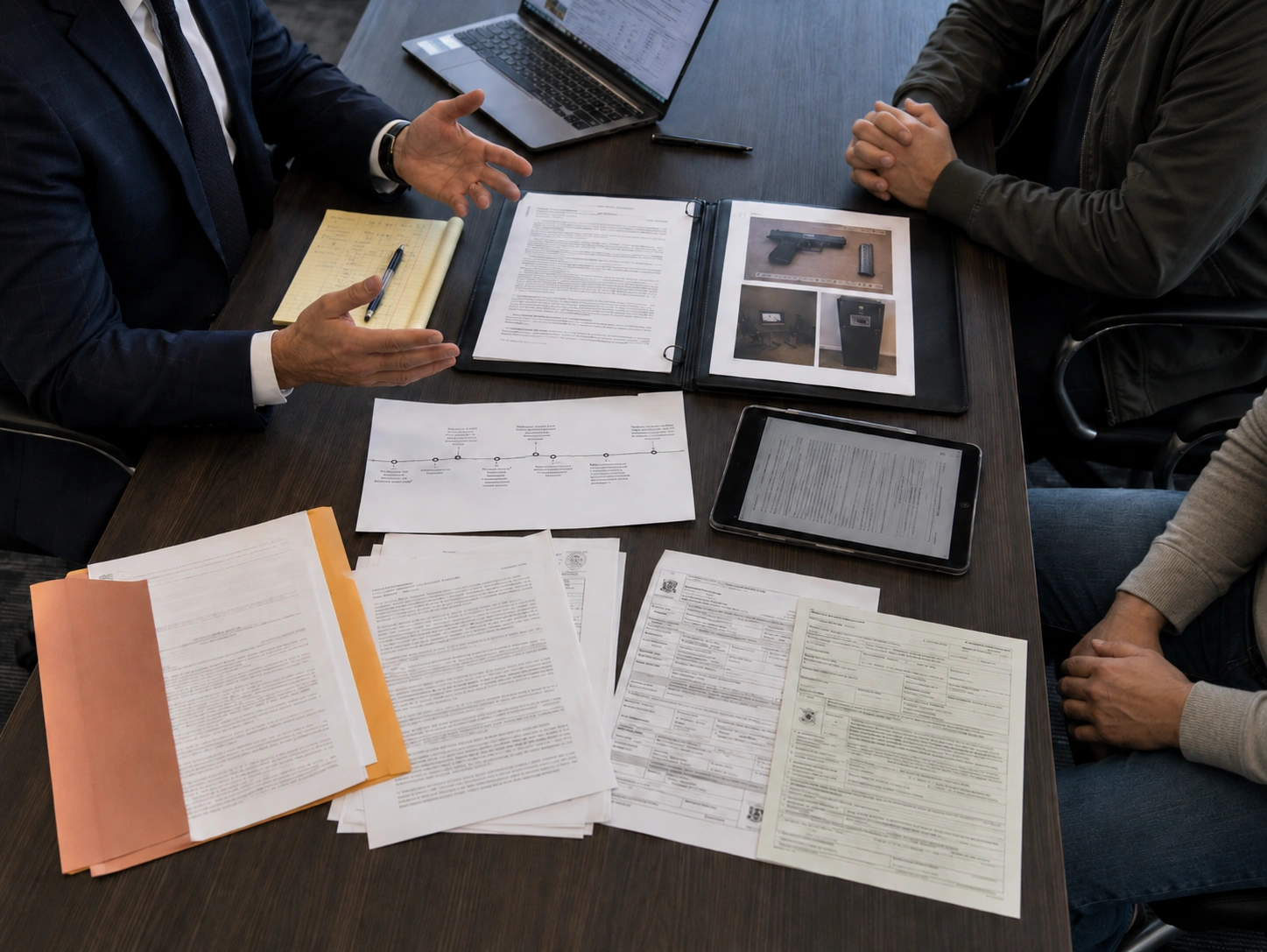
Canadian gun charges are mostly paper, place and knowledge crimes. The identical pistol is a five year charge if the licence is missing, a ten year charge if the Crown says you knew it was missing, a ten year charge if it sat in a car you were riding in, a fourteen year charge if it was loaded, and a ten year charge if a court order said you could not touch it at all. The object never changes. Your legal position does, rung by rung. This page explains that ladder, what York Regional Police gun projects look like from the defence side, and where these files are actually won. If the item involved is not a firearm, a knife, a baton, a spray, start instead with our Markham weapons offence lawyer page.
Arrested or under investigation for a firearms offence in Markham?
Call 647-588-3234Free confidential consultation, day or night. Offices in Toronto, Thornhill, North York and Oakville.
- The classification that writes the charge sheet
- The paper layer: PAL, courses, certificates
- One pistol, five different charges
- The passenger problem: s. 94
- Loaded, or ammunition within reach: s. 95
- No minimum today: Nur and Bill C-5
- Charged while already banned: s. 117.01
- Project Chatter and York's gun unit
- Use is a different lane: s. 85
- The Newmarket route
- Twelve straight answers
Prohibited, restricted, non-restricted: the sorting that writes the charge sheet
Before any Markham gun file makes sense, two definitions have to be on the table. First, what counts as a firearm at all: a barrelled weapon capable of discharging a projectile and of causing serious bodily injury or death, and the Criminal Code definition expressly includes the frame or receiver alone and anything that can be adapted for use as a firearm. Second, which of three classes the firearm falls into under section 84(1), because the class quietly decides which offences are available, which licence was needed, and how hard the file will be fought.
| Class | What lands in it | Why it matters |
|---|---|---|
| Prohibited | Handguns with barrels of 105 mm or less or in 25 or 32 calibre, rifles and shotguns sawed down below the length thresholds, automatic firearms, and, under recent amendments, unlawfully manufactured guns regardless of how they were made | Highest scrutiny, licensing is exceptional, and the loaded-possession offence reaches 14 years |
| Restricted | Every handgun that is not prohibited, plus certain shorter-barrelled semi-automatic centre-fire firearms and firearms designed to fire when folded or shortened | Registration certificate and place-specific authorization required; same 14 year exposure when loaded |
| Non-restricted | Everything that is neither, which covers most conventional hunting rifles and shotguns | Licence still required, but the loaded s. 95 offence does not apply to this class |
Two footnotes to the sorting. Firearm parts now count: a barrel or a handgun slide can ground a possession allegation on its own. And section 84(3) deems some things not to be firearms for the main possession offences, including antique firearms, devices designed exclusively for signalling or industrial use, and low-powered barrelled items that cannot push a projectile past set velocity and energy thresholds. That carve-out is where air gun and airsoft questions get resolved, and the details are technical enough that the specific item should always be checked against the current text.
Classification is not a label the police get to assume. It is an element to be proven, usually through examination of the item, and where a class boundary is close, barrel measurements, manufacturing origin and expert reports all become fair game. A charge built on the wrong class is a charge built on sand.
The classification fight in practice
On the ground, classification gets litigated with measuring tapes and expert reports. Is the barrel over or under the threshold. Was the firearm adapted, and by whom. Can the Crown establish that an unmarked gun was unlawfully manufactured rather than merely untraceable. When a file starts with the police description of an item rather than a laboratory examination of it, the class is an assumption, and assumptions are where defences begin. The difference is not academic: class determines whether the loaded-possession offence is even available, what paper was required, and how the sentencing conversation starts.
The paper layer: PAL, safety courses and registration certificates
The licensing system sits under the Firearms Act and is administered by the RCMP Canadian Firearms Program. For an adult, the Possession and Acquisition Licence, the PAL, is the licence, and the path runs through the Canadian Firearms Safety Course before an application can go in. Licences renew on a five year cycle. Acquiring restricted firearms requires the additional restricted safety course, with written and practical testing, producing what most people call an RPAL. Prohibited and restricted firearms also need registration certificates, and the Canadian Firearms Program publishes the rules on storage and transport that lawful owners live under.
Why does a criminal defence page care about the administrative plumbing? Because the possession offences in the next section are, at bottom, paper offences. Sections 91 through 95 all ask the same underlying question: did this person hold the right licence, certificate or authorization for this item, in this place, at this moment? The paperwork defines the crime, and the exceptions written into those sections, supervision by a licensed person, coming into possession by operation of law, the vehicle exits discussed below, define the escapes. A file that looks hopeless as a gun case sometimes dissolves as a paperwork case.
The line between the two possession offences is really a line about honesty of the gap. Section 91 captures the person whose paper never existed or quietly lapsed. Section 92 requires the Crown to prove the person knew they were not the holder of the required licence or certificate, and that knowledge element is why s. 92 proceeds straight indictable with double the ceiling. Files move between the two sections as the evidence about what the person understood comes into focus.
One pistol, five different charges: the possession ladder
Here is the heart of the firearms lane. Five Criminal Code sections, one object, escalating culpability based on paperwork, knowledge and place.
| Section | The allegation | How it proceeds and the ceiling | Built-in exits |
|---|---|---|---|
| s. 91 | Possessing a firearm without a licence (and, for prohibited or restricted, the registration certificate). Also covers prohibited weapons, devices and ammunition | Hybrid. Up to 5 years on indictment | Possession under the direct and immediate supervision of a licensed person, and related statutory exceptions |
| s. 92 | The same possession, but knowing you were not the holder of the required paper | Straight indictable. Up to 10 years | The same family of exceptions, but the real battleground is the knowledge element itself |
| s. 94 | Being an occupant of a motor vehicle knowing a firearm or other listed item is inside | Hybrid. Up to 10 years | An occupant lawfully holds the paper, you reasonably believed one did, you tried to leave or actually left, or possession arose by operation of law |
| s. 95 | A loaded prohibited or restricted firearm, or an unloaded one with readily accessible ammunition, without authorization for that place | Hybrid. Up to 14 years on indictment | Direct and immediate supervision of an authorized holder |
| s. 117.01 | Possessing a firearm or other listed item while under any court prohibition order | Hybrid. Up to 10 years | Possession authorized under a sustenance or employment lifting order |
Read the ladder from the Crown's side and it is a menu. Read it from the defence side and it is a sequence of specific propositions, each of which must be proven: possession itself, which requires both knowledge and a measure of control; the classification of the item; the absence of the paper; and, on the higher rungs, the aggravating circumstances of knowledge, vehicle, load or court order. Every rung has its own weak points, and charges frequently settle onto lower rungs when the higher ones cannot hold.
The passenger problem: what s. 94 demands, and the exits it writes in
Section 94 is the charge that shocks people, because it criminalizes sitting in the wrong car. An occupant of a motor vehicle who knows there is a firearm, prohibited weapon, restricted weapon, prohibited device or prohibited ammunition inside commits an offence unless one of the lawful-possession branches applies. Ten years on indictment, for a passenger.
But look at what the section actually requires and what it forgives. The Crown must prove knowledge: not proximity, not friendship with the driver, knowledge that the item was there. And the statute writes its own exits. There is no offence where an occupant lawfully held the licence and authorizations, or where you had reasonable grounds to believe another occupant did. There is no offence where, on becoming aware of the item, you attempted to leave the vehicle to the extent it was feasible, or actually left. And there is no offence where possession came about by operation of law.
Those words do real work in Markham traffic-stop files. A rear-seat passenger in a car pulled over on Highway 7 is not guilty of anything because a gun was under the driver's seat. The prosecution has to reconstruct what that passenger knew and when, usually from seating position, movement on camera, fingerprints or DNA on the item, and statements. Each of those is contestable, and the tried-to-leave exception means that even proven knowledge is not the end of the analysis. What you said at the roadside, and whether you should have said anything at all, often matters more than everything else in the file.
Two practical notes for anyone reading this after a stop. Silence is not an admission, and the exits in s. 94 do not require heroics, only what was feasible in the moment. What you said in the car, and what you did not, will be parsed later; a lawyer should be parsing it with you before anyone else does.
Loaded, or ammunition within reach: the s. 95 count
Section 95 is the heavyweight possession charge in Ontario courtrooms, and its wording deserves close attention. It applies to a loaded prohibited or restricted firearm, or an unloaded one together with readily accessible ammunition capable of being discharged in it, possessed in any place without both an authorization or licence covering possession in that place and the registration certificate.
Three phrases carry the weight. In any place means the offence is not about public carry; a loaded restricted handgun in a bedroom safe can qualify if the paper does not cover it. Readily accessible is a fact question about geometry and time: a magazine in the same bag is one case, ammunition locked in a different room is another. And for that place is the tripwire for licensed owners, because an authorization that covers a home or a range does not cover a glovebox on Warden Avenue.
The ceiling is 14 years on indictment, raised to that level by the 2023 amendments, and the Crown can still elect to proceed summarily in the right case. That election matters procedurally as well as practically, and it is one of the first things counsel will fight about quietly, before anything happens in a courtroom.
No minimum today: Nur, Bill C-5 and the possession versus use line
People arrive at a first meeting convinced they are facing an automatic three years because a search engine told them so. The law moved. In R. v. Nur, decided in 2015, the Supreme Court of Canada struck down the mandatory minimums that then attached to the s. 95 loaded-firearm offence, three years for a first offence and five for a repeat, as cruel and unusual punishment under section 12 of the Charter, while still upholding the individual sentences of the offenders before it. Parliament finished the job in 2022: the Bill C-5 amendments repealed the remaining mandatory minimums for the possession offences on this page, including the escalating minimums that had lived in s. 92 and the using-a-firearm minimums in s. 85.
Do not confuse the absence of a floor with softness. Crown positions on loaded restricted handguns in the GTA remain penitentiary-range positions, and the ceilings are high: 14 years under s. 95, ten under ss. 92, 94 and 117.01. What the repeal restored is the judge's ability to fit the sentence to the person, which makes the sentencing record you build, work, treatment, immigration exposure, background, into live ammunition rather than an afterthought.
Building that record is concrete work, not rhetoric: employment letters, program enrolment, immigration status memos, treatment history, community roots. Judges sentencing without a statutory floor can respond to a person rather than a category, but only if the person is actually put in front of them, documented and early.
The line the courts drew. Possessing and using are different constitutional universes. The possession minimums fell in Nur and were repealed by Bill C-5. The use minimums survived: robbery with a restricted or prohibited firearm still carries 5 years on a first offence and 7 on a repeat, and the Supreme Court upheld that floor in R. v. Hilbach in 2023. The four year minimums for attempted murder, kidnapping and hostage-taking with a firearm, and for manslaughter with a firearm, also remain on the books. Any website still advertising a four year minimum for simple gun possession, or no minimum for gun robbery, is describing a Criminal Code that no longer exists.
Charged while already banned: s. 117.01 and the bail onus that follows
A large share of York Region firearms counts are not about unlicensed owners at all. They are about prohibition orders. Section 117.01 makes it an offence, hybrid with a ten year indictable ceiling, to possess a firearm, a crossbow, a prohibited weapon, a restricted weapon, a prohibited device, a firearm part, any ammunition, any prohibited ammunition or an explosive substance while any court order prohibits it. A companion subsection reaches the wilful failure to surrender licences and certificates when an order requires it, and the section carves out possession allowed under a sustenance or employment lifting order.
Where do these orders come from? Sentencing courts must impose one on conviction for violent offences carrying ten years or more, and they hold a discretionary power in other cases. Weapons terms also ride on release orders and other court orders made under federal law, which is why people are sometimes charged under s. 117.01 without ever having been sentenced to a prohibition at all. The order in your file needs to be read, dated and mapped against the item alleged, clause by clause.
Notice how wide the item list runs. A single shotgun shell in a garage, a stripped barrel in a toolbox, an inherited crossbow: while an order is in force, each is a chargeable file. Defence work here starts with the order itself, exactly what it covered and when it took effect, and moves to possession, knowledge and control of the item.
One more obligation people miss: when an order takes effect, the paper goes back too. Wilfully failing to surrender licences, registration certificates and authorizations that an order requires you to give up is itself an offence under the same section. Cleaning that up proactively is cheap; being charged for it is not.
The bail consequence is the part clients feel first. Where the new offence involves a firearm or other listed weapon and was allegedly committed while under a weapons prohibition, the onus at the bail hearing reverses: it is the accused who must show cause why detention is not justified. That single procedural fact changes the first week of the case, and it is the reason a prohibition-breach allegation in Markham needs a bail plan before it needs anything else.
Project Chatter and the unit that runs York Region gun files
York Regional Police names its firearms enforcement plainly. The force's Guns, Gangs and Drug Enforcement Unit launched Project Chatter in October 2024, and by the time YRP's annual report described the investigation it counted 23 arrests, 330 charges and 32 firearms seized, alongside roughly seven million dollars in drugs, targeting firearms and drug trafficking across York Region and the wider GTA. The same reporting describes other joint operations in the same period, including one that seized 21 firearms in a corruption investigation.
Project files and street files reach the courthouse differently. The project cases are wiretap and surveillance builds that end in coordinated takedowns; the everyday files start with a traffic stop on Highway 7, a domestic call where officers seize what is in the house, or a search warrant on an apartment. In Markham, arrest processing runs through #5 District at 8700 McCowan Road. In both kinds of file the constitutional questions are usually the case: whether the stop was lawful, whether the search that found the gun holds up, whether statements survive, whether the warrant was properly grounded. A firearms file where the search fails is usually a file without an exhibit.
If a warrant team arrives, the playbook is short: comply physically, say nothing substantive, and get counsel moving the same day. Project files assembled over months are defended by taking their disclosure apart over months, affidavit by affidavit, and the earlier that starts the more options survive.
Results matter. See our recent case successes and read our client reviews on Google, then call 647-588-3234 for a free, confidential assessment of yours.
Use is a different lane: where s. 85 and the robbery counts live
Everything above concerns having a gun. Using one while committing an indictable offence is its own offence under section 85, with a 14 year ceiling, no minimum since the 2022 repeal, and one feature that survived every reform: the sentence must be served consecutively to the sentence for the underlying offence. The section has quirks worth knowing. The real-firearm branch expressly excludes a list of offences that already build the firearm into their own penalties, robbery among them, while the imitation-firearm branch carries no such exclusion list. And where a robbery is committed with a restricted or prohibited firearm, the mandatory minimums live inside the robbery count itself.
If your allegation is use rather than possession, an armed robbery, a shooting, a firearm pointed during an offence, the strategic terrain is different enough that it has its own page. Start with our Markham robbery with a firearm lawyer page for the classification fight and the surviving minimums.
From arrest to trial at one address: the Newmarket route
Firearms possession offences are not section 469 offences, so every stage of a Markham file runs through the Newmarket courthouse at 50 Eagle Street West, the criminal courthouse serving York Region: bail in the Ontario Court of Justice, case management appearances that now mostly proceed by video, and trial either in the OCJ or upstairs in the Superior Court. Toronto splits the same journey across a dedicated bail centre on Finch Avenue West and separate trial courthouses downtown; York Region concentrates it at one address, which changes how quickly things can move and how sureties plan their attendance, since the current OCJ bail practice direction lets sureties appear by video.
Bail itself follows the ladder. On most possession counts the Crown bears the onus, and the fight is about conditions, sureties and supervision. The onus reverses where the allegation is possession while under a prohibition order or while on release for another indictable offence, and the seriousness of loaded-handgun allegations means detention arguments get pressed even where the onus never flips. Our Markham bail lawyer page covers preparation in detail.
Election matters too. Most of these counts are hybrid, and the Crown's choice between summary and indictable procedure moves the maximum, the courtroom and the timetable. A preliminary inquiry is available only where the charged offence carries 14 years or more, which on this page means the s. 95 count. And the Jordan ceilings, eighteen months in the provincial court and thirty in the Superior Court, sit over every long investigation file, project cases included.
For Markham clients the geography is friendly: case management is mostly virtual, the courthouse run up Highway 404 is one trip on hearing days, and our Thornhill office at 7191 Yonge Street sits ten minutes from most of the city for everything in between.
What the timetable feels like
Expect the file to move in waves rather than a line. A first appearance and a bail decision in the opening days. Disclosure arriving in instalments, with the forensic examination of the item and any classification report often trailing weeks behind the initial package. Judicial pre-trials where positions get tested quietly. Then the real decision points: election where the count is hybrid, a preliminary inquiry request where one is available, and the scheduling of any Charter application challenging the stop, the search or the statement. Each wave is a chance to move the case, and none of them should pass by default.
The Thornhill advantage: senior counsel ten minutes from Markham
Kazandji Law runs firearms defences across the GTA from four offices: Toronto headquarters at 180 John Street, Unit 320; the Thornhill office at 7191 Yonge Street, Suite 310, the closest to Markham and the base for York Region work; and offices in North York and Oakville. Founding partner Fadi Matthew Kazandji handles these files personally, from the show cause hearing to the Charter voir dire. Gun cases are won in the details, the stop, the search, the continuity of the exhibit, the classification report, and those details need senior attention early, before the paper trail sets. If your matter sits in Toronto instead, our Toronto weapons defence lawyers page covers those courthouses, and the rest of our York Region services live on the Markham criminal defence lawyer hub.
The stop, the search and the statement are already made. What happens next is still open.
Call 647-588-3234 nowFree confidential consultation, 24 hours a day. Toronto, Thornhill, North York and Oakville.
Markham firearms charges: twelve straight answers
What makes a gun prohibited, restricted or non-restricted?
Section 84(1) of the Criminal Code draws the lines. Handguns are at least restricted, and short-barrelled (105 mm or less) or 25/32-calibre handguns, sawed-off long guns, automatic firearms and unlawfully manufactured guns are prohibited. Most conventional hunting rifles and shotguns are non-restricted. Classification drives both the licence you needed and the charge you face.
What licence do I need to possess a firearm?
A Possession and Acquisition Licence (PAL) issued under the Firearms Act, which requires passing the Canadian Firearms Safety Course first and renews every five years. Acquiring restricted firearms requires the additional restricted course (the licence people call an RPAL), plus registration certificates for restricted and prohibited guns (RCMP Canadian Firearms Program).
What is the charge for having a gun without a licence?
Unauthorized possession under s. 91 is hybrid with a 5-year indictable maximum. If the Crown can prove you knew you were not licensed, s. 92 applies instead: straight indictable with a 10-year maximum.
I was just a passenger in a car with a gun in it. Can I be charged?
Yes. Section 94 makes it an offence to be an occupant of a vehicle knowing a firearm is in it, with a 10-year indictable maximum. But the statute has built-in exits: it is not an offence if, on learning of the gun, you tried to leave the vehicle as far as feasible or actually left, or if an occupant was lawfully entitled to have it.
What is the loaded-handgun offence everyone talks about?
Section 95: possessing a loaded prohibited or restricted firearm, or an unloaded one with readily accessible ammunition, anywhere you do not hold an authorization for that place plus the registration certificate. It is hybrid, and on indictment the maximum is now 14 years.
Is there a mandatory minimum for gun possession?
Not anymore. The Supreme Court struck s. 95's 3-year and 5-year minimums in R. v. Nur (2015), and the 2022 Bill C-5 amendments removed the remaining possession minimums from the Criminal Code. These charges still routinely attract penitentiary-range positions from the Crown; there is simply no statutory floor.
How is that different from using a gun in a robbery?
Use is treated more harshly than possession. Robbery with a restricted or prohibited firearm still carries a 5-year minimum (7 on a repeat), and the Supreme Court upheld those minimums in R. v. Hilbach (2023). The struck and repealed minimums were the possession ones.
What happens if I possess a firearm while under a prohibition order?
That is its own offence, s. 117.01, hybrid with a 10-year indictable maximum, and it covers firearms, crossbows, prohibited weapons and devices, firearm parts, ammunition and explosives. Bail on the new charge is reverse onus because the offence was allegedly committed while you were under a weapons prohibition.
Are BB guns, airsoft and antiques treated as firearms?
For the main possession offences, s. 84(3) deems certain items not to be firearms, including antique firearms and devices designed exclusively for signalling or industrial use. The details are technical, and lookalike guns can still be prohibited devices or count as imitation firearms in other offences, so get advice on the specific item.
Who investigates gun cases in York Region?
York Regional Police's Guns, Gangs and Drug Enforcement Unit runs the major firearms investigations. Its Project Chatter, launched in October 2024, ended with 23 arrests, 330 charges and 32 firearms seized across York Region and the GTA, according to YRP's annual report. Markham arrests process through #5 District.
Where will my Markham firearms charge be heard?
At the Newmarket courthouse, 50 Eagle St. W., the criminal courthouse serving York Region: bail, case management (much of it virtual) and trial all in one building. In Toronto, bail alone would run through a separate bail centre at 2201 Finch Ave. W.
What are the defences to possession charges?
Knowledge and control (possession has both), the statutory exceptions (supervision, the vehicle exits, operation of law), classification fights, and above all the Charter: firearms files are won and lost on the legality of the stop, the search and the statement. Free consultation: 647-588-3234.
This page is general legal information for people facing charges in Ontario, not legal advice about any specific case. Criminal Code provisions summarized here were checked against the federal Justice Laws website in July 2026 and can change, and licensing details are administered by the RCMP Canadian Firearms Program. Speak with a lawyer about your own situation before acting on anything you read here. Kazandji Law serves Markham and all of York Region from its Thornhill and Toronto offices.