

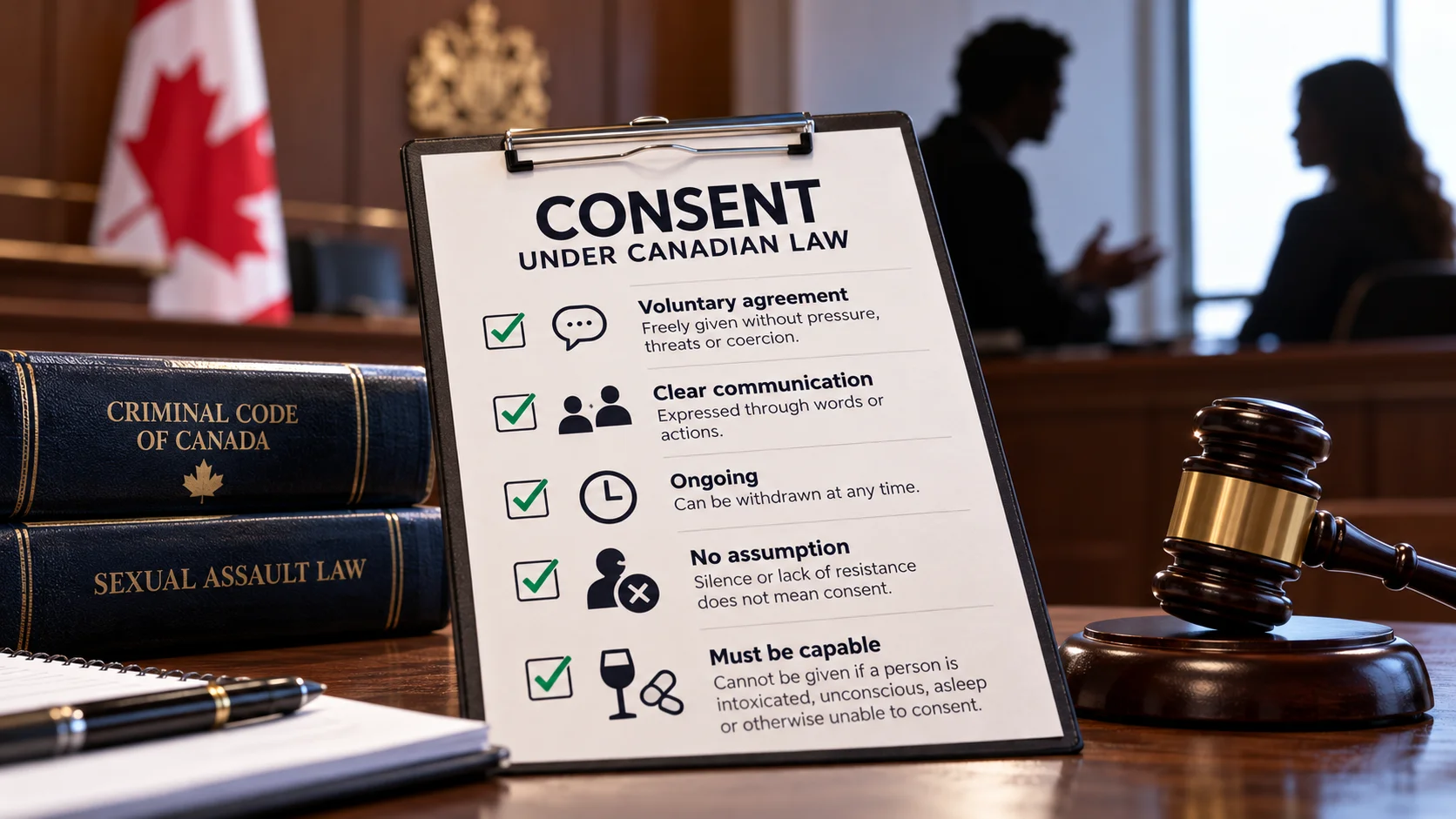

What counts as consent under Canadian law is a voluntary agreement to the specific sexual activity taking place at that time. Consent must come from the person involved, that person must have the capacity to choose, and the agreement can be withdrawn through words or conduct.
These rules apply across Canada through the Criminal Code. For an Ontario sexual assault allegation, Kazandji Law examines the words, actions, circumstances, and records connected to each alleged act rather than treating consent as a single yes or no from earlier in the encounter.
Key Takeaways About Sexual Consent
The legal test is specific and time-sensitive. A relationship, previous sexual activity, silence, or the absence of physical resistance does not create consent for a later act.
- Consent must exist when the sexual activity occurs and relate to that particular act.
- An unconscious person cannot consent, and another person cannot agree on their behalf.
- Capacity requires the ability to understand the act, its sexual nature, the partner’s identity, and the choice to refuse.
- Consent can be withdrawn after sexual activity has started.
- A claimed mistake about consent must rest on communicated agreement and reasonable steps, not assumption.
What Counts as Consent Under Canadian Law
The shortest answer is voluntary agreement to the sexual activity in question. Section 273.1 of the Criminal Code adds that the agreement must be present when the activity happens.
The law separates three questions that everyday conversation often blends together. Keeping them separate is the clearest way to understand what counts as consent under Canadian law.
| Legal Question | What the Court Examines | Important Limit |
| Did the complainant consent | The complainant’s actual state of mind about the specific sexual act | Consent is not implied by silence, passivity, or a relationship |
| Did the complainant have capacity | Whether the person could understand the act and choose whether to participate | Unconsciousness always prevents consent, while intoxication requires a fact-specific assessment |
| Did the accused honestly but mistakenly believe consent was communicated | Words or conduct that affirmatively communicated agreement and the steps taken to check | Self-induced intoxication, recklessness, wilful blindness, or failing to take reasonable steps bars the defence |
The first question concerns whether consent actually existed. The third concerns what the accused honestly believed had been communicated. The Supreme Court rejected implied consent in R. v. Ewanchuk and confirmed in R. v. J.A. that consent must exist during the activity, not in advance of activity while unconscious.
When Consent Does Not Exist in Law
Consent does not exist merely because a person submitted, did not resist, or appeared to go along with an act. Sections 265(3) and 273.1(2) identify situations in which the law treats consent as absent.
No consent is obtained when:
- Someone other than the complainant expresses the agreement.
- The complainant is unconscious or otherwise incapable of consenting.
- Agreement is induced through an abuse of trust, power, or authority.
- The complainant communicates a lack of agreement by words or conduct.
- The complainant agrees at first but then communicates that they do not want to continue.
- Submission or non-resistance results from force, threats, fear of force, fraud, or the exercise of authority.
The list is not exhaustive. Section 273.1(3) says other circumstances may also mean no consent was obtained.
How Capacity to Consent Is Decided
Capacity is a precondition to consent. In R. v. G.F., the Supreme Court of Canada explained that a person must be capable of understanding the physical act, its sexual nature, the specific identity of the partner, and the choice to refuse.
The test does not ask whether the person made a wise decision. It asks whether the person had the operating mental ability needed to make the choice. A person who lacks any one of the required abilities cannot give valid consent to that activity.
This makes capacity to consent different from memory. Someone may forget an event but have had capacity at the time, or retain fragments of memory while lacking capacity. The full evidence matters when a court decides what counts as consent under Canadian law.
How Alcohol and Memory Gaps Affect Consent
Drinking or drug use does not automatically prove either consent or incapacity. The question is whether the person could understand and choose at the relevant time, assessed from all admissible evidence.
The Supreme Court clarified this point in R. v. Rioux, 2025 SCC 34. When a complainant has a memory gap, a judge must consider the full picture, including direct evidence and surrounding facts about the person’s mental and physical state before, during, and after the activity. Lack of memory is not the same as lack of evidence.
Signs of impairment, confusion, loss of bodily control, coherent speech, purposeful actions, witness observations, recordings, and timing may all become relevant. No single sign answers the legal question on its own.
Can Consent Depend on Condom Use
Yes. Consent may be limited to a particular physical sexual act, including intercourse with a condom.
In R. v. Kirkpatrick, 2022 SCC 33, the Supreme Court held that a person who agrees to intercourse only with a condom does not agree to intercourse without one. The condition helps define the physical act to which the person agreed.
Consider a hypothetical example. Two adults agree to intercourse only if a condom is used, but one person deliberately proceeds without it. The agreement covered intercourse with a condom, not the different physical contact that occurred. The legal result in any real case still depends on the admissible evidence and the court’s findings.
What Is Honest but Mistaken Belief
An honest but mistaken belief in communicated consent is separate from actual consent. It asks whether the accused honestly believed the complainant had communicated agreement by words or conduct, and whether the evidence can legally support that belief.
Section 273.2 of the Criminal Code removes the defence when the belief arose from self-induced intoxication, recklessness, wilful blindness, or a circumstance in which the law says no consent was obtained. It also requires reasonable steps in the circumstances known to the accused and some evidence of affirmatively expressed agreement.
Assuming that a partner agreed because they did not say no is not enough. Neither is relying only on flirting, a past relationship, or earlier sexual activity. Those limits are central to consent in sexual assault cases and to understanding what counts as consent under Canadian law.
What Evidence Can Matter in Court
Consent cases are decided on admissible evidence, not a checklist of behaviours that always proves one side. Relevant material may include contemporaneous messages, recordings, witness observations, timelines, location records, statements, and evidence about each person’s words and conduct.
Past sexual activity is subject to special rules. Section 276 of the Criminal Code prohibits using it to argue that the complainant was more likely to have consented on this occasion or is less worthy of belief. Other proposed uses require judicial screening and must satisfy the statutory test.
At Kazandji Law, we review police disclosure, messages, recordings, timelines, potential witnesses, and release conditions when those materials are part of the file. A careful review connects the evidence to the correct legal question instead of assuming that one message or one moment decides what counts as consent under Canadian law.
What to Do After a Consent Allegation
Protect the record and follow every court order. Early, avoidable actions can create a new problem or destroy context that counsel may need.
- Follow all release, no-contact, and location conditions exactly.
- Do not contact the complainant directly or through another person.
- Preserve complete messages, call logs, photographs, videos, receipts, and location records without editing or deleting anything.
- Keep the original devices and accounts connected to the records.
- Get legal advice before giving a detailed statement to police, an employer, a school, or another investigator.
- Give your lawyer the complete timeline, including facts that seem unhelpful or embarrassing.
Our guide to workplace sexual assault defence in Ontario explains why deleting chats or trying to resolve an allegation informally can damage a case. The broader Ontario sexual assault defence page outlines how disclosure, communications, and timelines may be reviewed.
Common Questions About Sexual Consent
These short answers address practical questions that often arise when consent is disputed. Each case still depends on the evidence and the precise charge.
Is Silence the Same as Consent
No. Silence or a lack of physical resistance does not by itself establish voluntary agreement. Actual consent concerns the complainant’s state of mind, while a mistaken-belief defence requires affirmative communication through words or conduct. The surrounding circumstances at the relevant time matter, but the law does not recognize implied consent.
Can Someone Consent After Drinking
Possibly. Alcohol or drug use does not automatically remove capacity, but a person cannot consent if intoxication leaves them unable to understand the physical act, its sexual nature, the partner’s identity, or the choice to refuse. Courts consider all admissible direct and circumstantial evidence about the person’s condition at the relevant time.
Can Consent Be Withdrawn During Sex
Yes. A person who initially agrees can withdraw consent through words or conduct at any point. Section 273.1 says no consent is obtained after the complainant expresses a lack of agreement to continue, so activity must stop when withdrawal is communicated even if the parties agreed earlier during that encounter.
Does a Past Relationship Prove Consent
No. Marriage, dating, flirting, or earlier sexual activity does not establish consent to the act in question. Section 276 bars using past sexual activity to suggest that a complainant was more likely to consent or is less believable, so the court focuses on admissible evidence tied to the alleged event.
Is the Age of Consent Always Sixteen
Sixteen is the general age of consent, but the Criminal Code has close-in-age exceptions for some younger people and additional protections for 16 and 17 year olds in relationships of trust, authority, dependency, or exploitation. Our Toronto sexual exploitation guide explains why age alone may not answer whether consent is legally effective.
Can Text Messages Prove Consent
Messages can be relevant, but one text rarely answers every issue. Courts consider what it referred to, when it was sent, whether consent changed, and how it fits other admissible evidence. Preserve the complete conversation because cropped screenshots or deleted context may make the record harder to assess and raise separate concerns.
Get Advice Before You Explain the Case
If what counts as consent under Canadian law is disputed in your case, avoid trying to settle the issue through direct contact or a rushed explanation. Preserve the record, obey every release condition, and get advice based on the exact allegation and evidence.
Our Ontario sexual offence lawyers can assess how consent, capacity, communication, and the available records fit together. Call Kazandji Law at 647-588-3234 in Toronto or 647-697-5975 in Thornhill, or use our contact page to request a free, confidential consultation.
This article provides general legal information for Ontario, not legal advice for an individual matter. Reading it or contacting the firm through this page does not, by itself, create a lawyer-client relationship.