

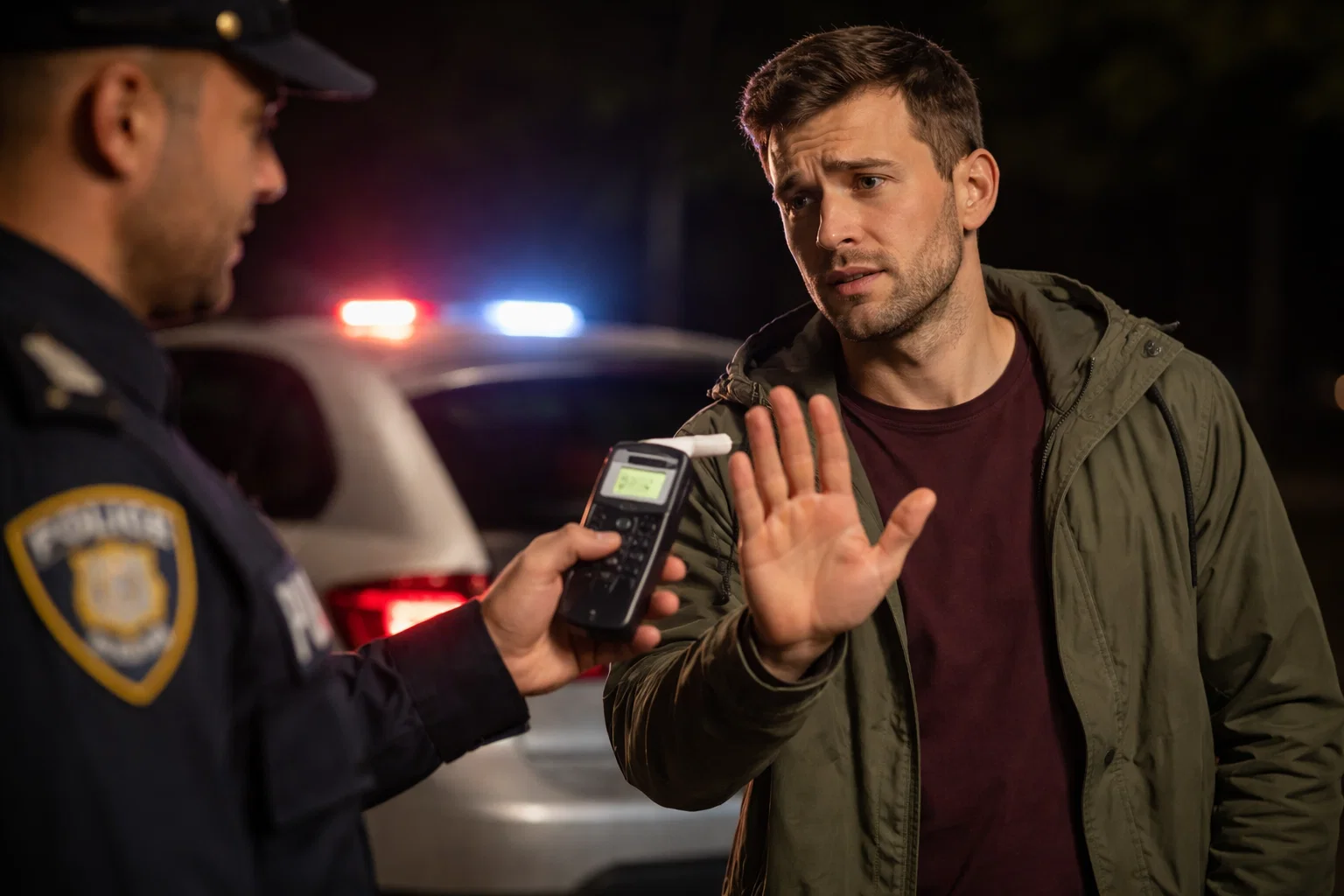

A traffic stop can flip your life in minutes. One decision can lead to arrest, a tow, a suspended licence, and missed work the next morning. Fear makes people hesitate, argue, or stay silent when an officer asks for a sample.
When you refuse a breath test in Ontario, it often feels like a way to “avoid giving evidence,” but the law treats refusal as its own criminal offence. Ontario also adds fast roadside penalties that can hit before any court date.
What officers can demand at the roadside
Police can demand a roadside breath sample in more than one way. Under Canada’s Mandatory Alcohol Screening rules, an officer who lawfully stops a driver and has an approved screening device can demand breath samples even without suspicion. Criminal Code section 320.27(2) sets that power out.
Ontario drivers saw this show up in headlines when the OPP announced it would demand breath samples at traffic stops on OPP-patrolled highways in the GTA, using Mandatory Alcohol Screening.
When you refuse a breath test in Ontario — why the charge hits fast
When an officer makes a lawful demand, the Criminal Code makes “failure or refusal to comply” a separate offence. Section 320.15(1) covers a refusal or failure to comply with a demand made under sections 320.27 or 320.28, unless a “reasonable excuse” applies.
That charge does not require a “fail” reading. The Crown can focus on what you did or did not do after the demand, including delay, argument, or partial attempts that look like stalling.
What counts as a refusal in real life
People imagine refusal as a clear “no.” In practice, officers often describe refusal as conduct.
A refusal allegation can come from:
- “No” or “I won’t” after the demand
- Delaying on purpose until the device times out
- Not providing enough breath despite coaching, when the officer believes you could comply
- Trying to leave, call someone, or bargain instead of providing the sample
Body-worn video, cruiser video, and station video often shape how the Crown tells this story.
Immediate Ontario consequences before court
Ontario applies roadside administrative consequences that start right away. Ontario’s impaired driving page lists an immediate roadside 90-day suspension and a 7-day vehicle impoundment among the penalties.
Ontario also runs the Administrative Driver’s Licence Suspension process through regulation under O. Reg. 499/96, which references suspensions under Highway Traffic Act section 48.3 for alcohol-related failures or refusals.
Many people call the paperwork an Ontario bail release order equivalent for driving, but driving suspensions follow a different process. A refusal charge still goes through criminal court.
Why police and courts take refusal seriously
Police-reported impaired driving includes both “operation while impaired” and “failure or refusal to comply with a demand.” Statistics Canada reported 71,602 impaired driving incidents in 2023, and it noted the fourth straight annual decline and the lowest rate on record.
Those numbers still represent tens of thousands of police interactions across Canada, and Ontario sees a large share because of population and roadway volume. That context helps explain why enforcement agencies push Mandatory Alcohol Screening and why refusal allegations show up often.
The OPP “every stop” news story and what it means for GTA drivers
In May 2024, Global News reported that the OPP planned to demand a breath sample any time officers conducted a traffic stop on OPP-patrolled highways in the Greater Toronto Area, using Mandatory Alcohol Screening.
That coverage matters for drivers who travel the 401, the 427, the QEW, and other routes where OPP patrol overlaps daily commuting. A stop for speed or a lane change can still lead to a breath demand if the officer has the device.
A “reasonable excuse” exists, but it needs proof
Section 320.15(1) allows a defence where a “reasonable excuse” applies.
Courts do not treat nerves or anger as a reasonable excuse. Medical issues can matter, but they need real documentation and a clear link between the condition and the inability to provide a sample.
Refusing a breathalyser vs “failing” and why people get confused
Many drivers assume a refusal helps because it blocks a BAC number. That logic misses the point that the Criminal Code treats refusal as its own offence.
Ontario also stacks administrative penalties on top, which means refusing a breathalyser can still lead to a roadside suspension and an impound, even before any trial.
Where Toronto cases often go next
A refusal charge often leads to a first appearance at the Ontario Court of Justice in Toronto. The province lists the Toronto criminal courthouse at 10 Armoury Street.
Some cases involve bail or early release issues, especially when police arrest and hold the driver for a hearing. Many adult bail matters connect to the Toronto Regional Bail Centre at 2201 Finch Avenue West.
What can be challenged after a refusal charge
A strong defence often focuses on the demand and what happened around it. The law requires a lawful stop and a lawful demand under the Criminal Code provisions.
Common litigation issues include:
- Whether the officer had legal authority for the stop and demand under section 320.27(2)
- Whether you understood the demand and had a real chance to comply
- Whether the officer and device process created unfairness or confusion
- Whether a medical reason prevented compliance and supports “reasonable excuse”
A defence strategy also needs the disclosure early, because video and officer notes often decide the tone of the case.
What to do immediately if police charge you
A refusal file moves quickly and punishes delay. A smart first week often focuses on damage control and evidence.
Two steps usually help right away:
- Document everything you remember about the demand, your responses, your health, and timing, while details stay fresh
- Gather medical records if a health issue affected breathing, coughing, panic, or coordination, then connect those records to the time of the demand
A criminal defence lawyer who specialises in driving offences can also explain what police can demand under Mandatory Alcohol Screening and what the Crown must prove in court.
A clear decision point that protects your future
Refusal charges can affect work, family life, and the ability to move around the GTA. Ontario’s roadside penalties can start the same night, and the criminal process can follow for months.
Clear advice early often prevents avoidable mistakes, especially when one conversation with counsel can shape disclosure requests, court timing, and the plan for driving, employment, and travel.