
The coercive control offence in Canada has been enacted, but it is not yet in force. Parliament added section 264.01 to the Criminal Code through the Protecting Victims Act, which received royal assent on June 18, 2026. As of October 28, 2026, the federal Justice Laws website still lists the amendment as not in force.
The new offence is designed to address a pattern of coercive or controlling conduct between intimate partners. Its scheduled start date is June 18, 2028, although the Governor in Council may bring it into force earlier by order, provided the date is at least 30 days after royal assent.
This timing distinction is essential. Conduct alleged today may still lead to charges under existing offences, but a person cannot presently be charged under section 264.01 itself.
Key Points About The New Offence
The law creates a future criminal offence focused on a pattern of conduct, not merely one isolated disagreement.
- The coercive control offence in Canada is enacted but remains outside the law currently in force.
- Section 264.01 will apply to current and former spouses, common-law partners, and dating partners.
- The listed conduct includes violence, sexual coercion, monitoring, isolation, financial control, threats of self-harm, and damage to property.
- The Crown will still have to prove every element beyond a reasonable doubt.
- Existing offences may apply before section 264.01 begins, and family courts can already consider coercive and controlling behaviour under the Divorce Act.
When The Coercive Control Offence In Canada Takes Effect
The coercive control offence in Canada is scheduled to take effect on June 18, 2028, unless the Governor in Council selects an earlier date. Section 205(2) of the Protecting Victims Act states that the provision creating the offence starts on the second anniversary of royal assent or on an earlier day fixed by order.
Royal assent occurred on June 18, 2026. The Act also prevents an order from setting a commencement date earlier than the thirtieth day after royal assent.
The Justice Canada backgrounder says the delayed start allows time for training, resources, and preparation. Publishers and readers should therefore distinguish between an offence that Parliament has enacted and an offence that police can currently charge.
The Criminal Code amendments not in force page should be checked again before publication and whenever this article is updated. An earlier order could change the operative date.
What Section 264.01 Will Require The Crown To Prove
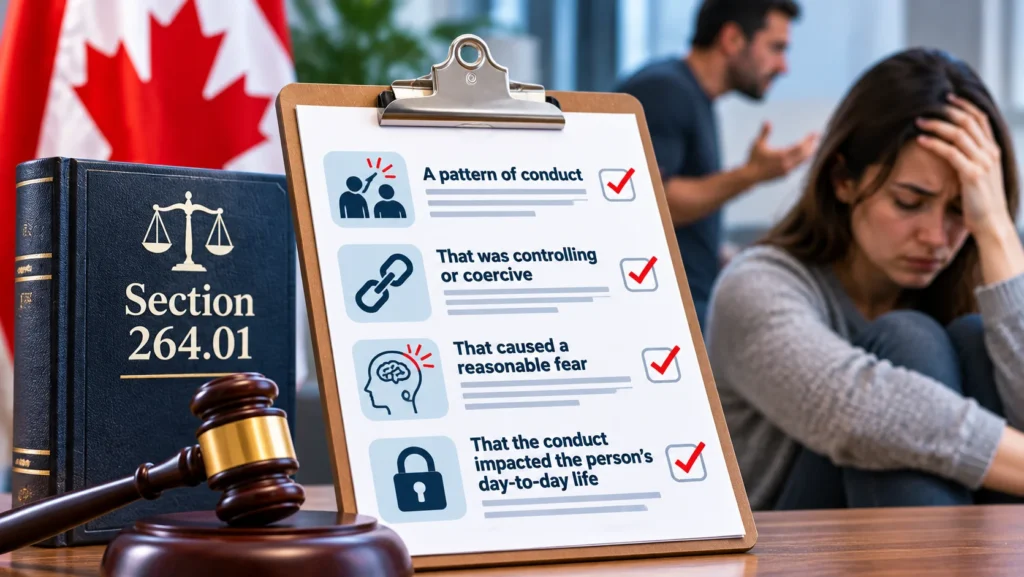
The coercive control offence in Canada will require proof of a prohibited pattern, the accused person’s state of mind, and the relationship identified in the section. Under section 264.01 as enacted, the Crown must prove that the accused engaged in a pattern of coercive or controlling conduct toward an intimate partner.
The prosecution must also prove one of two mental elements. The accused must have intended to cause the partner to believe that their safety was threatened, or must have known that or been reckless as to whether the pattern could cause that belief.
The Criminal Code definition of intimate partner includes a current or former spouse, common-law partner, or dating partner. That means the future offence is not limited to people who are married or living together, and it can extend to post-separation conduct.
The section defines safety to include psychological safety. In deciding whether conduct could reasonably be expected to create the required belief, a court must consider all the circumstances, including the nature of the relationship, any vulnerability of the partner, and whether the accused exploited that vulnerability.
Conduct The New Offence Will Cover
The new offence will cover repeated conduct or a combination of different acts that together form the required pattern. The enacted provision identifies three broad categories.
First, the pattern may include using, attempting to use, or threatening violence against the partner, a child in the partner’s care, another person known to the partner, or an animal known to the partner. Second, it may include coercing or attempting to coerce the partner into sexual activity.
Third, it may include other conduct that could reasonably be expected to cause the partner to believe that their safety, or the safety of someone known to them, is threatened. The statutory examples include monitoring movements or communications, controlling access to money or property, interfering with work or education, restricting health care, isolating a person from their community, threatening self-harm, and damaging property.
The list supplies examples, not automatic findings of guilt. A court would assess the alleged conduct as a pattern, the surrounding relationship, the effect the conduct could reasonably have, and the required mental element.
A Hypothetical Example
Assume that, after a separation, one partner repeatedly tracks the other person’s location, controls access to a shared account, threatens to harm a pet, and sends messages threatening self-harm if the person speaks with friends. This is a hypothetical illustration of conduct listed in the enacted section.
It does not establish that an offence occurred. Once section 264.01 is in force, a court would still have to decide whether the acts formed the required pattern and whether the Crown proved the safety and mental elements beyond a reasonable doubt.
How The New Offence Compares With Current Law
The new offence will address a course of controlling conduct, while existing criminal offences generally focus on particular prohibited acts and their own elements.
| Legal Route | Present Status | Main Focus |
| Criminal Code section 264.01 | Enacted but not yet in force as of October 28, 2026 | A pattern of coercive or controlling conduct toward an intimate partner, combined with the required safety impact and mental element |
| Criminal harassment under section 264 | In force | Prohibited conduct such as repeated communication, following, watching, or threatening conduct that causes reasonable fear for safety |
| Uttering threats under section 264.1 | In force | Knowingly communicating specified threats involving bodily harm, property, or an animal |
| Assault and related offences | In force | The intentional application of force without consent, attempts or threats involving a present ability to carry them out, and related aggravated forms |
| Divorce Act family violence provisions | In force for family-law decisions | Conduct that may include a pattern of coercive and controlling behaviour, whether or not it is a criminal offence |
The table is a high-level comparison, not a substitute for applying the full statutory elements. A single incident may engage an existing offence, several incidents may be assessed together, and the same evidence may arise in both criminal and family proceedings.
What The Law Means Before Section 264.01 Starts
The coercive control offence in Canada cannot support a section 264.01 charge until the provision comes into force. That does not make violence, threats, harassment, confinement, sexual offences, or property damage lawful in the meantime.
Justice Canada’s family violence laws overview explains that many acts associated with family violence are already crimes. Depending on the facts, police and prosecutors may consider assault, sexual assault, forcible confinement, criminal harassment, uttering threats, mischief, or another existing offence.
Each offence has distinct legal requirements. A pattern described as controlling in everyday language does not automatically satisfy those requirements, and a criminal charge does not establish guilt.
Readers looking for the broader process after an intimate-partner allegation can review Kazandji Law’s guide to domestic violence in Canada. The firm’s Ontario criminal defence overview explains the defence process across a wider range of charges.
How Coercive Control Already Matters In Family Law
Coercive and controlling behaviour can already be relevant in family proceedings even though section 264.01 is not yet operative. The Divorce Act definition of family violence expressly includes a pattern of coercive and controlling behaviour and says conduct need not constitute a criminal offence.
That family-law definition serves a different purpose from the future criminal offence. Family courts may consider family violence when determining parenting arrangements and the best interests of a child, while a criminal court decides whether the prosecution has proved a specific offence beyond a reasonable doubt.
Where both proceedings exist, statements, documents, release conditions, and findings in one matter can affect decisions in the other. Kazandji Law’s page on criminal and family proceedings in Markham provides more context on that overlap.
What To Do After Police Contact Or A Charge
The safest immediate approach is to preserve evidence, follow every court or release condition, and obtain legal advice before responding to allegations. A calm, documented response can prevent a difficult situation from becoming worse.
- Do not contact the complainant if police, a release order, an undertaking, or a court order prohibits contact. Do not use relatives, friends, or new online accounts to communicate indirectly.
- Preserve messages, call logs, location records, financial documents, photographs, and social-media material in their original form. Do not delete or edit material, even if it appears unhelpful.
- Obtain and read every document provided by police or the court. Confirm the exact boundaries of any no-contact, residence, weapons, or device condition with counsel.
- Ask to speak with a criminal defence lawyer before giving a statement. Do not obstruct an investigation or ask another person to change, hide, or create evidence.
- Prepare a private chronology for counsel that identifies dates, witnesses, devices, accounts, and relevant proceedings. Separate what you personally remember from what another person told you.
- Tell counsel promptly about any related parenting case, protection order, immigration issue, workplace requirement, or professional licence.
Kazandji Law represents people facing domestic assault and related allegations. A lawyer can review the current charge, disclosure, release terms, and any related family case without assuming that the future offence governs today’s allegation.
Common Misunderstandings About The New Law
The most common error is treating royal assent as the date on which every provision became enforceable.
- It is already a charge available to police. It is not. Section 264.01 remains listed as an amendment not in force as of October 28, 2026.
- Only physical violence can form the pattern. The enacted text also lists psychological, sexual, financial, technological, social, and property-related conduct.
- Any controlling act will prove the offence. The Crown will need to prove the statutory pattern, relationship, safety component, and mental element beyond a reasonable doubt.
- The offence applies only to married partners. The Criminal Code definition also includes current and former common-law and dating partners.
- No criminal law applies until 2028. Existing offences may apply now when their individual elements are met.
- The criminal and family-law tests are the same. They are not. The proceedings have different purposes, standards, and statutory tests.
Frequently Asked Questions
The short answers below address timing, scope, penalties, and the relationship between the new provision and current law.
Is Coercive Control A Crime In Canada Right Now
Section 264.01 has been enacted but is not yet in force as of October 28, 2026. Police cannot currently lay that specific charge. Particular acts within an alleged pattern may still constitute existing offences, including assault, criminal harassment, uttering threats, forcible confinement, sexual offences, or mischief when the applicable legal elements are present.
When Does The Coercive Control Offence Take Effect
The scheduled date is June 18, 2028, the second anniversary of royal assent. The Governor in Council may set an earlier date by order, but the Act barred any date within the first 30 days after assent. Because an earlier order remains possible, the official Justice Laws pages should be checked before relying on the date.
What Is A Pattern Of Coercive Or Controlling Conduct
The enacted section describes a pattern as repeated instances or a combination of listed conduct. It can include violence, sexual coercion, monitoring, isolation, financial restrictions, control over work or health care, threats involving self-harm, and property damage. Context matters because the Crown must connect the pattern to the safety and mental elements.
Does Section 264.01 Apply After A Relationship Ends
It can once the section is in force. The Criminal Code definition of intimate partner includes a current or former spouse, common-law partner, or dating partner. The future provision is therefore capable of covering post-separation conduct, but the Crown must still prove the required pattern, threatened-safety belief, and state of mind in the particular case.
What Is The Maximum Penalty Under Section 264.01
The enacted provision makes the offence hybrid. If prosecuted by indictment, the maximum term is ten years. The Crown may instead proceed summarily. A maximum is not an expected sentence, and sentencing depends on the facts, the offender’s circumstances, applicable principles, and whether the prosecution proves the offence after it comes into force.
Can The Same Conduct Affect A Family Court Case
Yes. The Divorce Act already defines family violence to include a pattern of coercive and controlling behaviour, whether or not the conduct is criminal. Family courts use that definition in decisions such as parenting arrangements and child-focused risk assessment. A family-law finding is not automatically proof of a criminal offence, since the tests and standards differ.
Speak With Kazandji Law About An Intimate-Partner Allegation
The coercive control offence in Canada creates a significant future change, but an allegation arising now must be assessed under the law currently in force. Kazandji Law can review the alleged conduct, the available evidence, release conditions, and any interaction between criminal and family proceedings.
To request a free, confidential consultation, call the Toronto office at 647-588-3234 or the Thornhill office at 647-697-5975. You can also contact Kazandji Law online.
This article provides general legal information for Ontario, not legal advice for an individual matter. Reading it or contacting the firm through this page does not, by itself, create a lawyer-client relationship.