

Markham Arson Lawyer: Defence for Arson and Fire-Related Charges
Home › Markham Criminal Defence › Markham Arson Lawyer
Before anyone is charged after a suspicious Markham fire, three separate investigations are usually already moving: the fire service's, the Ontario Fire Marshal's, and the police's. If the property was insured, add a fourth, your insurer's. Each one produces paper the Crown can later use, and much of it is generated before you have spoken to a lawyer. Arson charges under ss. 433 to 436.1 of the Criminal Code run from summary-eligible negligence to a life maximum. Kazandji Law defends fire cases across York Region from our Thornhill office, minutes from Markham.
Facing an arson investigation or charge in Markham?
Call 647-588-3234Free, confidential consultation. Available 24 hours a day, 7 days a week.
Results matter. See our recent case successes and read our client reviews on Google, then call 647-588-3234 for a free, confidential assessment of yours.
- Four investigators at one Markham fire
- Actor one: Markham Fire and Emergency Services
- Actor two: the Ontario Fire Marshal
- Actor three: York Regional Police #5 District CIB
- Actor four: your insurer and the s. 435(2) trap
- One fire, five possible charges
- What the Crown must prove
- Why intoxication is not a way out
- Fires on your own property
- When the fire-setter is a teenager
- Bail and the Newmarket process
- Why Kazandji Law
- Arson charge FAQ
- Taking apart a fire opinion
- The first days after a fire
- How fire charges get reframed
Four investigators can be working one Markham fire before anyone is charged
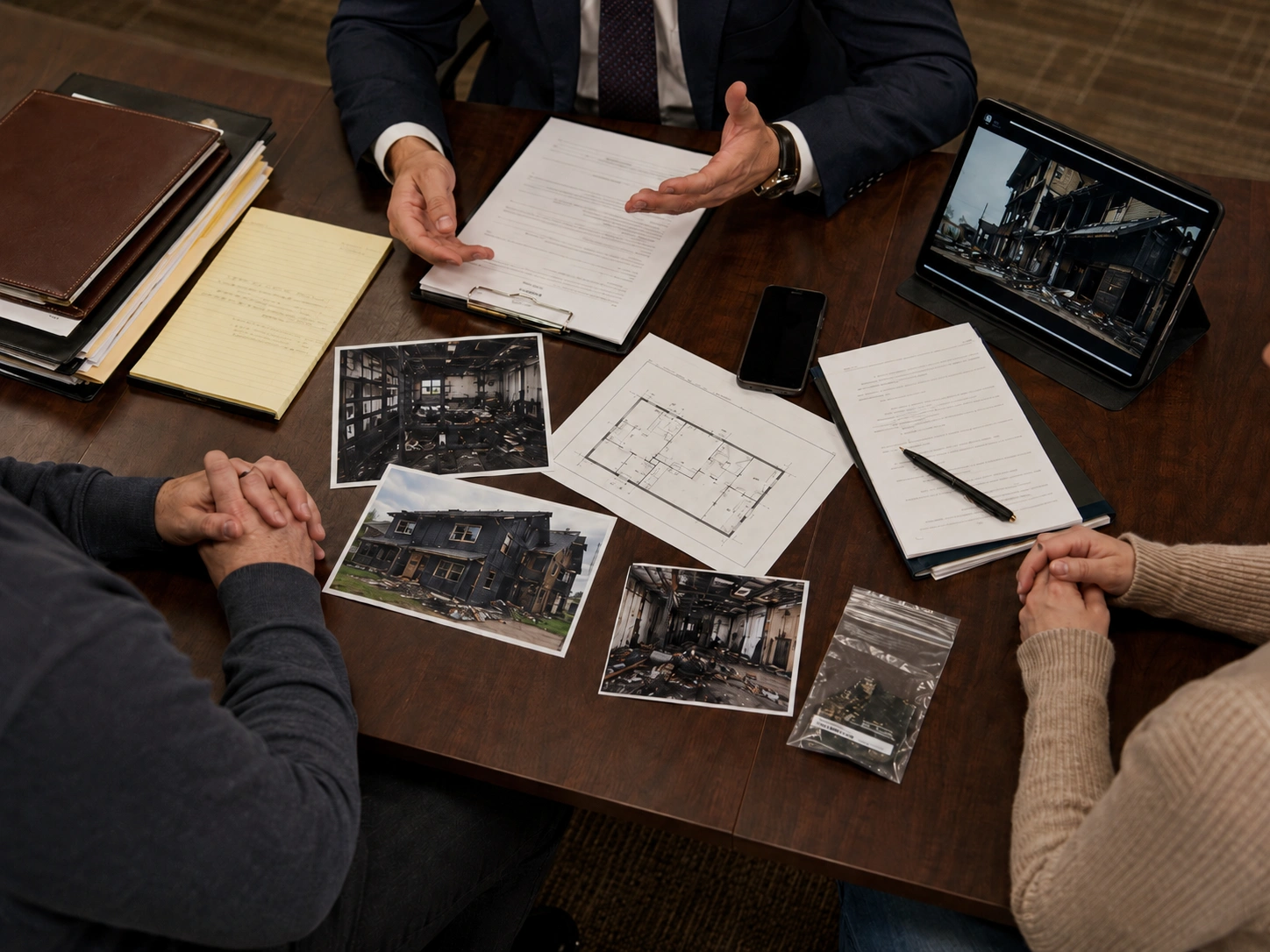
People charged with arson are often stunned to learn how much investigation happened before their first police interview. A fire on a Markham street is not one inquiry. It can be four, each with its own mandate, its own file, and its own use for anything you say.
The fire service attends and knocks the fire down, and its crews form the first views on where and how the fire started. The Ontario Fire Marshal holds a statutory duty to investigate the cause, origin and circumstances of certain fires, including suspected deliberate ones. York Regional Police run the criminal investigation and lay any charge. And if there is a policy on the property, the insurer opens its own claim investigation, with statutory consequences most policyholders have never heard of.
Defending an arson charge means understanding what each of these actors produced, in what order, and where their opinions can be tested. That is how this page is organized. The criminal charges themselves come after, because in a real file the investigators come first.
Actor one: Markham Fire and Emergency Services, and the call made at the scene
The first official conclusion about a Markham fire is often reached at the curb. A recent example: after a vehicle fire on Chant Crescent in the early morning of June 21, 2026, York Regional Police reported that Markham Fire and Emergency Services extinguished the blaze and determined the fire was the result of arson. One vehicle was engulfed, a second was damaged, and the file moved to police investigators the same day.
That sequence matters. A scene-level arson determination is the starting gun for the criminal process, not the end of the science. Fire dynamics are a genuinely contested field; conclusions about origin points, accelerant use and burn patterns rest on methodology that can be reviewed, and in serious cases answered with a defence expert. When a client tells us 'the fire department already called it arson,' our answer is that this is precisely the opinion the defence gets to examine: who reached it, with what training, on what physical evidence, documented how, and preserved where.
Nothing here is a criticism of firefighters, whose first job is saving lives and property. It is a reminder that the earliest opinion in the file is formed fastest, under the worst conditions, and courts know it.
Actor two: the Ontario Fire Marshal and its statutory mandate
The Office of the Fire Marshal is the provincial fire investigation authority. Under the Fire Protection and Prevention Act, 1997, the Fire Marshal has the duty to investigate the cause, origin and circumstances of specified fires and explosions, and the office investigates roughly 600 fires a year across Ontario.
Its mandate includes the categories that matter most on this page: fires suspected of being deliberately set where expert investigative help is needed, fatal and serious-injury fires, explosions, and large-loss fires of $500,000 or more. The province is candid about the purpose. OFM investigations serve, among other things, 'legal proceedings and prosecution of offenders.' In plain terms, the OFM file is built to be usable in a courtroom.
For the defence, an OFM investigation is both a threat and an opportunity. A threat, because a professional cause-and-origin opinion pointing at an intentional fire anchors the Crown's case. An opportunity, because a documented, methodical investigation creates a record that can be tested: the hypotheses that were considered and rejected, the physical samples taken or not taken, the photographs, the interview notes. Opinion evidence about fire origin is expert evidence, and expert evidence is challengeable on qualification, methodology and the limits of what the science can honestly support. In serious files the defence retains its own fire engineer; in every file, counsel should read the cause-and-origin report as closely as the Crown does.
Actor three: York Regional Police, and who actually lays the charge
Whatever the fire service and the Fire Marshal conclude, the criminal investigation belongs to the police. In Markham that means York Regional Police, and district files run through the #5 District Criminal Investigations Bureau; #5 District, at 8700 McCowan Rd., polices Markham and Whitchurch-Stouffville. In the Chant Crescent vehicle arson mentioned above, it was #5 District CIB investigators who appealed for witnesses and surveillance footage, reachable at 1-866-876-5423, extension 7541. There is no standing YRP arson squad to point to; district detectives carry these files.
The police layer adds the familiar criminal evidence: neighbourhood camera canvasses (York Region runs a voluntary security camera registry, so investigators often know which houses have footage), cell tower and vehicle data, gas station receipts, statements from neighbours and exes, and, above all, any statement from you. An arson file can sit quiet for weeks while this layer is assembled, then move to an arrest quickly. If investigators invite you in 'just to explain what happened,' that is the moment to call counsel, not after.
Actor four: your insurer, and the trap written into s. 435(2)
Where the burned property was insured, a fourth investigation opens, and this one comes with a statutory sting most people have never heard of. Section 435 of the Criminal Code makes it an offence to cause fire or explosion damage with intent to defraud, the classic insurance-fire allegation. Then s. 435(2) adds the trap: where a person is charged under s. 435, the fact that they held or were named as a beneficiary under a fire insurance policy on the property 'is a fact from which intent to defraud may be inferred by the court.'
Read that again. The bare fact of being insured is statutory support for an inference of fraudulent intent on a s. 435 charge. It is an inference the court may draw, not one it must, and it can be answered. But it means the insurance file and the criminal file feed each other, and statements made to an adjuster or in an insurer's examination can surface in the prosecution.
Insurers investigating suspicious fires routinely require documentation, recorded statements and examinations, and they can deny claims while the criminal question hangs over the file. What follows is general information rather than insurance-law advice, but the practical rule in a suspected arson is simple: get criminal counsel before giving any statement to anyone, including your own insurance company, and let your lawyer coordinate what is said, when, and in what forum. The criminal jeopardy comes first; the claim can wait.
One fire, five possible charges
The Criminal Code grades fire-setting across five offences plus a possession charge. The same Markham fire can honestly be charged several different ways, and the choice drives everything: the maximum penalty, whether a summary route exists, and how much room there is to resolve the file.
| Charge | What it requires | Type | Maximum |
|---|---|---|---|
| s. 433, arson with disregard for human life | Intentional or reckless fire or explosion damage where the person knows or is reckless as to whether the property is inhabited or occupied, or the fire causes bodily harm; applies whether or not you own the property | Straight indictable | Life |
| s. 434, arson damaging property | Intentional or reckless fire or explosion damage to property not wholly owned by the accused | Straight indictable | 14 years |
| s. 434.1, arson to own property | Intentional or reckless fire or explosion damage to your own property that seriously threatens the health, safety or property of another person | Straight indictable | 14 years |
| s. 435, arson for fraudulent purpose | Fire or explosion damage caused with intent to defraud, whoever owns the property | Hybrid | 10 years |
| s. 436, arson by negligence | An owner or controller whose marked departure from reasonable fire-safety care causes a fire that harms someone or damages property | Hybrid | 5 years |
| s. 436.1, possession of incendiary material | Possessing incendiary material, an incendiary device or an explosive substance for the purpose of committing arson | Hybrid | 5 years |
Notice what is missing: mandatory minimums. There are none anywhere on the arson ladder. That leaves sentencing to the facts and gives skilled counsel real room, particularly on the hybrid counts, where the Crown can proceed summarily. The lateral moves matter too: fire files sometimes belong further down the ladder than they were charged, and sometimes outside it entirely, as mischief or a fraud allegation with no proven fire-setting at all.
What the Crown actually has to prove
Every true arson count (ss. 433 to 435) requires the Crown to prove damage to property caused by fire or explosion, and that you caused it 'intentionally or recklessly.' That mental element is where most fire cases are fought.
Accident is a full defence. Careless is not criminal either, unless it rises to s. 436, and that section has its own high bar: a 'marked departure' from the standard of care a reasonably prudent person would use to prevent or control the spread of fires. Ordinary negligence, a pot left on a stove, a cigarette misjudged, does not meet it. One caution though: s. 436(2) says failure to comply with fire-safety law is a fact from which that marked departure may be inferred, so Fire Code compliance history can become evidence in a criminal courtroom.
Because intent is rarely confessed, these prosecutions run on circumstantial inference: accelerant findings, burn patterns, financial pressure, timing, opportunity. Circumstantial cases are winnable cases. The inference has to be the only reasonable one, and a defence that supplies a competing innocent explanation, or dismantles the forensic premise underneath, defeats it.
Being drunk or high is not a way out
R. v. Tatton, 2015 SCC 33. Mr. Tatton started a fire while cooking, heavily intoxicated, and was acquitted at trial on the basis that he lacked intent. The Supreme Court set the acquittal aside and ordered a new trial, holding that s. 434 arson is a general intent offence for which intoxication falling short of automatism is not available as a defence.
The practical meaning: if the fire-setting act was intentional or reckless, being drunk or high will not rescue the defence, no matter how impaired. The genuine battleground stays where it was, on whether the fire was deliberately or recklessly set at all, not on the accused's sobriety while setting it.
Your own property, your own fire, still a crime?
Sometimes. Burning your own property is lawful in principle; three provisions take that comfort away fast.
First, s. 434.1: if a fire you set on your own property seriously threatens the health, safety or property of anyone else, you face up to 14 years. In a dense Markham subdivision, with houses a few metres apart, that threshold arrives quickly. Second, s. 435: burn anything, yours or not, with intent to defraud, and the insurance inference in s. 435(2) discussed above comes with it. Third, s. 433 applies 'whether or not that person owns the property' where occupation is known or likely or bodily harm results, and it carries life.
So the honest answer to 'can I burn my own shed?' is: the ownership matters less than the neighbours, the occupants and the policy. The charges here turn on risk to others and purpose, not title.
When the fire-setter is a teenager
A real share of fire files involve young people: a group in a park, a dare, a small fire that spread. Parents call us frightened by the word arson, and the first thing to understand is that the framework changes completely for youth.
Accused aged 12 to 17 proceed under the Youth Criminal Justice Act, in the criminal youth court at the same Newmarket courthouse. The YCJA is built on diminished moral blameworthiness, favours out-of-court measures for less serious first offences, imposes distinct youth sentences, and protects the young person's identity from publication. A caution: where a youth fire endangered people, the YCJA can treat the matter as a violent offence, which narrows the softer exits. Even then, youth files leave far more room for outcomes that protect a teenager's future than the adult ladder above, and they should be defended by counsel who use that room deliberately. Our Markham youth criminal defence page covers the youth process in full.
Bail and the Newmarket process: one address, start to finish
No arson offence appears on the s. 469 list, so bail belongs to the Ontario Court of Justice, and in York Region that means the Newmarket courthouse at 50 Eagle St. W., the OCJ courthouse serving the region. In the ordinary arson case the Crown bears the onus of showing why detention is justified; there is no automatic reverse onus of the kind firearm robbery carries, although individual triggers (like allegedly offending while on release) can still flip it on the facts. The OCJ runs weekend and statutory holiday bail courts, and sureties can attend by audio or video under the current bail practice direction.
The Toronto contrast. A Toronto arson charge would route through the Toronto Regional Bail Centre at 2201 Finch Ave. W. for bail and other buildings for everything else. York Region has no separate bail centre: bail, case management, any preliminary inquiry, and trial, OCJ or Superior Court, all run through the one Newmarket courthouse. Our Toronto arson lawyers page maps the downtown version.
After bail, the file settles into disclosure and case management, much of it through Newmarket's virtual case-management courts, so counsel can often appear without you taking the day off work in Markham. The straight indictable counts (ss. 433, 434, 434.1) carry an election: trial in the OCJ, or in the Superior Court by judge or judge and jury, with the SCJ sitting in the same building. The hybrid counts (ss. 435, 436, 436.1) can proceed summarily, which matters both for exposure and for timing, since R. v. Jordan sets presumptive ceilings of 18 months for OCJ trials and 30 months for SCJ trials. Fire cases are expert-heavy, disclosure is slow, and the delay clock is a defence tool that should be tracked from day one. For the bail stage itself, including sureties and release plans, see our Markham bail lawyer page. In short: proposed sureties should bring identification and proof of savings or property, be ready to describe a supervision plan, and expect questions about the fire itself to be off limits until counsel says otherwise.
Why Markham clients call Kazandji Law on fire cases
Arson defence is expert-evidence defence. The Crown's case usually stands on a cause-and-origin opinion plus circumstantial inference, and it is answered by counsel who know how to cross-examine fire science, not just recite it. Fadi Matthew Kazandji leads every file personally and briefs defence experts early, before positions harden.
Our Thornhill office at 7191 Yonge St., Suite 310 is our closest to Markham and serves all of York Region; we appear at Newmarket routinely. Clients can also meet us at our Toronto head office at 180 John St., Unit 320, or at our North York and Oakville offices. Consultations are free and confidential. If the allegation grew out of a threat to burn property rather than an actual fire, that is a different charge with different defences; see our Markham uttering threats page, or start from the Markham criminal defence hub.
Fire investigators started building their file the night of the fire. Start building yours.
Call 647-588-3234Free consultation. Thornhill office at 7191 Yonge St., Suite 310, minutes from Markham.
Moving down the ladder: how fire charges get reframed
Because the arson provisions grade by risk and purpose, the space between counts is where a lot of real defence work happens. Three moves come up constantly in York Region fire files.
From s. 433 to s. 434. The life-maximum count requires proof that you knew the property was inhabited or occupied, or were reckless about it, or that the fire caused bodily harm. Take that element away, a genuinely empty building, no injuries, no basis for knowledge of occupation, and the same fire belongs under s. 434, with a 14-year ceiling instead of life. Occupation knowledge is a real, litigable element, not a formality.
From intentional to negligent. Where the evidence honestly shows a badly managed fire rather than a deliberately set one, s. 436 is the accurate charge, and it is hybrid, meaning the Crown can proceed summarily. The distance between an intentional arson count and a summary negligence count is the difference between a penitentiary case and something a working person can survive.
Out of the fire sections entirely. Small fires with trivial damage sometimes fit better as mischief, and alleged burn-for-money schemes with weak fire attribution can collapse into pure fraud territory, or into nothing. Each reframing changes the penalty structure, the election, and the resolution posture of the Crown's office at Newmarket.
One nearby offence deserves its own mention: threatening to burn, destroy or damage property is a separate crime under s. 264.1(1)(b), even if no match is ever struck. Heated texts about burning someone's belongings during a breakup generate exactly this charge, and it is defended very differently from a fire case; see our Markham uttering threats page.
None of this happens automatically. Crown counsel screen fire files on the paper in front of them, and the paper at the start is the fire service's call, the OFM opinion and the police synopsis. Getting the competing account, the engineering review, the occupation evidence, the financial reality, in front of the Crown early is how the label changes before trial rather than at one.
How a defence actually takes apart a fire opinion
Because so much of an arson prosecution rests on the cause-and-origin conclusion, the defence work is concrete and technical. It looks like this.
Start with the method, not the conclusion. A defensible fire investigation works through a recognized process: document the scene, develop hypotheses about origin and cause, and test each one against the physical evidence. Cross-examination asks whether that discipline actually happened. Which alternative causes were considered? Electrical faults, appliance failures, smoking materials, spontaneous ignition? What was done to rule each one out, and where is that reasoning recorded?
Chase the physical record. Fire scenes are destroyed twice, once by the fire and once by suppression and demolition. What samples were taken, from where, and what did the lab actually find? A negative lab result on suspected accelerants is disclosure gold. So are the photographs that show what the scene looked like before opinions formed.
Test the human inputs. Fire opinions lean on witness timelines: who saw smoke when, which door was open, where the fire seemed brightest. Those recollections are gathered in chaos and often conflict. When the timeline shifts, origin opinions built on it shift too.
Bring your own expert when the stakes justify it. A qualified fire engineer reviewing the same materials can expose overreach, and sometimes the honest answer, that the cause is undetermined, is itself a defence. Undetermined is not proof beyond a reasonable doubt of a deliberate fire.
None of this requires attacking anyone's good faith. It requires insisting that an opinion formed in the first days carries only the weight the underlying work can support.
The first days after a fire: protect yourself while everyone else investigates
If you own or occupy a Markham property that just burned and you sense suspicion forming, a few early decisions matter more than anything a lawyer can do later.
Give no account of the fire yet. Not to police, not to fire investigators, not to your insurer, not to neighbours. You can be polite and cooperative about logistics while declining to discuss cause until you have advice. One consistent, informed statement later beats three improvised ones now.
Keep your own record. Photograph what remains, keep receipts, note who attended the scene and when, and save the messages and utility records that establish where you were. Innocent timelines get lost while official ones get written.
Do not sign broad releases or authorizations handed to you in the first days without review. Insurance processes have their own deadlines and duties, and those are real, but the order of operations is criminal advice first, then a coordinated response to the insurer.
Get counsel before any interview. If #5 District investigators or the Fire Marshal's office ask you to come in, that request is the clearest possible signal that the file has a target. The interview can wait until your lawyer is beside you; the right to counsel exists for exactly this moment.
Markham arson charges: questions we hear every week
What is arson in Canadian law?
Intentionally or recklessly causing damage to property by fire or explosion. The Criminal Code grades it: disregard for human life (s. 433), damage to another person's property (s. 434), your own property where others are seriously threatened (s. 434.1), fraudulent purpose (s. 435), negligence (s. 436), plus possessing incendiary materials for the purpose of arson (s. 436.1).
What is the maximum penalty for arson?
Life imprisonment under s. 433, which applies where the person knows or is reckless as to whether the property is inhabited or occupied, or where the fire or explosion causes bodily harm to another person. No arson offence carries a mandatory minimum.
Who investigates a suspicious fire in Markham?
Typically three bodies. Markham Fire and Emergency Services attends and extinguishes, and initial arson determinations can be made at the scene. The Ontario Fire Marshal has a statutory duty under the Fire Protection and Prevention Act to investigate the cause, origin and circumstances of specified fires, including suspected deliberately set fires and losses of $500,000 or more. And York Regional Police, in Markham the #5 District Criminal Investigations Bureau, conducts the criminal investigation and lays any charge.
Can I be charged for a fire on my own property?
Yes, three ways: s. 434.1 (up to 14 years) if the fire seriously threatens another person's health, safety or property; s. 435 if it was set with intent to defraud, the classic insurance allegation; and s. 433 applies whether or not you own the property where occupation is known or likely, or where bodily harm results.
Does having fire insurance matter?
By statute, yes. Under s. 435(2), the fact that you held or were named as a beneficiary under a fire insurance policy on the property is a fact from which the court may infer intent to defraud on a s. 435 charge. Insurer investigations also run parallel to the criminal case, so get legal advice before giving any statement to either.
What if the fire was an accident or carelessness?
Accident is a defence: the Crown must prove intentional or reckless fire-setting. Carelessness is only criminal under s. 436 where it amounts to a marked departure from what a reasonably prudent person would do to prevent or control fire, and non-compliance with fire-safety law is a fact from which that departure may be inferred (s. 436(2)).
Is being drunk or high a defence to arson?
Not for s. 434-type arson. In R. v. Tatton, 2015 SCC 33, the Supreme Court held that s. 434 is a general intent offence for which intoxication short of automatism is not available as a defence.
Can you be charged just for possessing fire-starting materials?
Yes. Section 436.1 makes it an offence to possess incendiary material, an incendiary device or an explosive substance for the purpose of committing arson. It is hybrid, with up to 5 years on indictment.
Where does bail happen for a Markham arson charge?
Arson is not a s. 469 offence, so bail is heard by the Ontario Court of Justice at the Newmarket courthouse, 50 Eagle St. W., with the Crown ordinarily bearing the onus. York Region has no separate bail centre, unlike Toronto, where adult bail runs through 2201 Finch Ave. W.
Which court will hear the case?
The Newmarket courthouse at every stage: OCJ case management (much of it virtual), an election for the straight indictable counts (ss. 433 to 434.1), and Superior Court trials in the same building. The hybrid counts (ss. 435, 436, 436.1) can also proceed summarily.
My teenager was charged after setting a fire. What happens?
Youth aged 12 to 17 are dealt with under the Youth Criminal Justice Act in the Newmarket courthouse's youth court: diminished moral blameworthiness, a preference for out-of-court measures in less serious first offences, distinct youth sentences and publication protections. See our Markham youth defence page.
What should I do first if investigators contact me about a fire?
Say nothing about the fire, to police, fire investigators or your insurer, until you have legal advice. Cause-and-origin opinions can be challenged; early statements are the hardest evidence to undo. Free consultation: 647-588-3234, through our Thornhill office at 7191 Yonge St., serving all of Markham.
This page is general legal information for people facing arson and fire-related charges in Markham and York Region, current to July 2026. It is not legal advice, and insurance-related passages are general information only. Reading this page does not create a lawyer-client relationship. For advice on your case, call Kazandji Law at 647-588-3234.