

Drug Trafficking Lawyer in Markham
Home › Markham Criminal Defence › Markham Drug Trafficking Lawyer
A Markham drug trafficking lawyer defends charges under s. 5 of the Controlled Drugs and Substances Act, trafficking and possession for the purpose of trafficking, investigated by York Regional Police, prosecuted by the federal Public Prosecution Service of Canada, and heard at the Newmarket courthouse (50 Eagle St. W.), where both the Ontario Court of Justice and the Superior Court sit. For Schedule I substances such as fentanyl, cocaine and methamphetamine, the maximum penalty is imprisonment for life, these files demand serious defence work from day one. Call 647-588-3234 for a free, confidential consultation.
Charged with trafficking or possession for the purpose?
Call 647-588-3234. Free ConsultationNewmarket court · PPSC prosecutions · Search, seizure and entrapment defences
- The two charges: s. 5(1) and s. 5(2)
- How broad “trafficking” really is
- Penalties: the schedule drives everything
- No mandatory minimums, what that changes
- Fentanyl, cocaine and meth: the serious end
- Courier, middleman, principal
- How much makes it trafficking?
- Cannabis is charged differently
- Who prosecutes, and where
- How investigations start
- Phones and the digital file
- The life of a CDSA file
- Where trafficking cases are won
- Bail on trafficking charges
- Immigration, travel & property
- Your first days after the charge
- Why Kazandji Law
- Frequently asked questions
The two charges: trafficking, and possession for the purpose
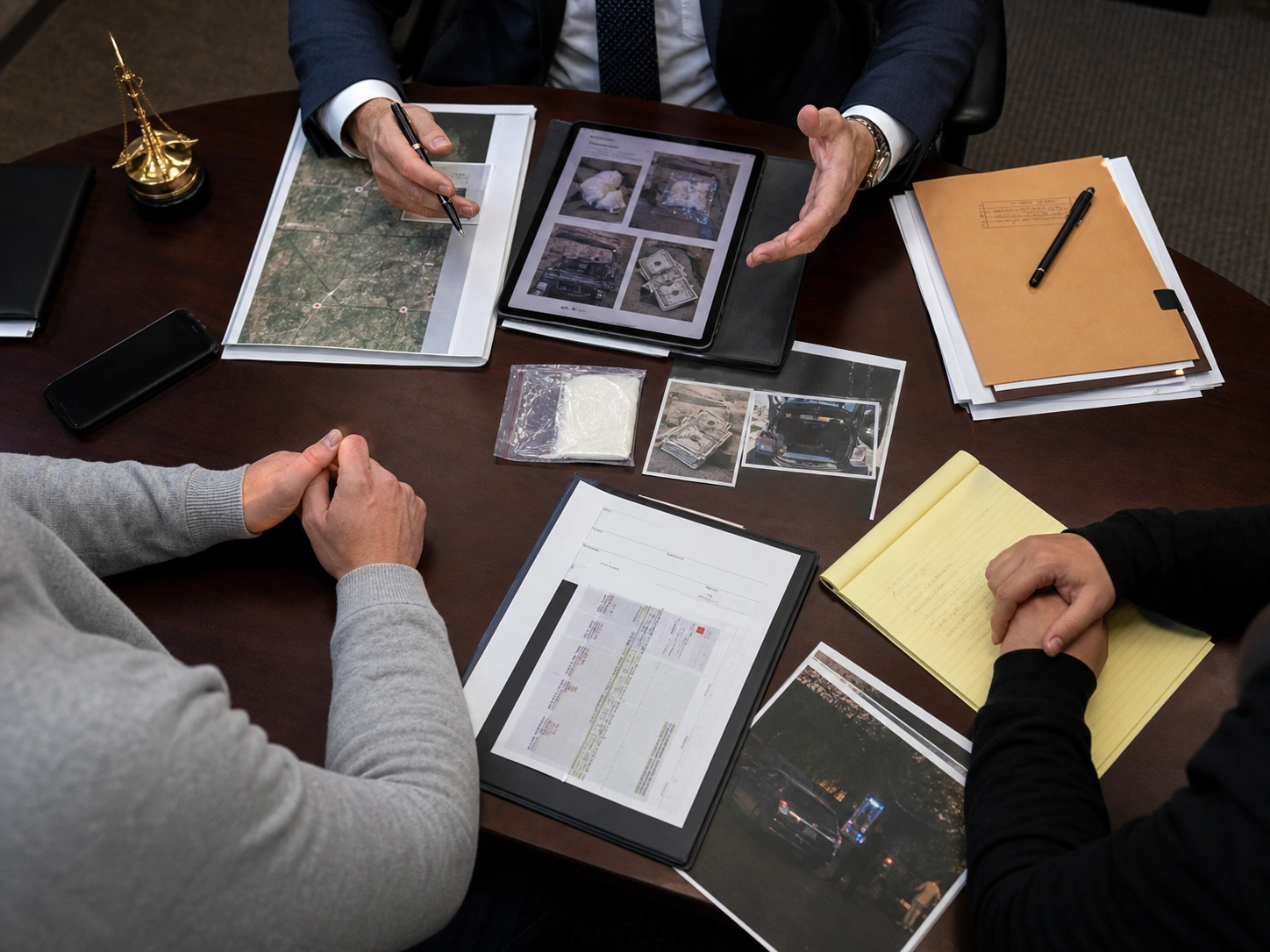
The CDSA creates two distinct offences. Trafficking (s. 5(1)) is the act itself, and it applies even to a substance merely represented or held out to be a drug, so selling fake product is not a defence. Possession for the purpose of trafficking (s. 5(2)) is having a controlled substance with intent to traffic, no transaction required. Most Markham files are s. 5(2) charges built on inference: quantity, packaging, scales, cash, messages.
That structure matters for the defence. A s. 5(1) case turns on proving the act, often through surveillance, agents or intercepted communications. A s. 5(2) case turns on two battles: possession (did you knowingly have control of the substance, the Criminal Code definition includes constructive possession, things stored elsewhere under your control, and joint possession) and purpose (does the evidence really prove intent to traffic rather than personal use?). Each is contestable, and cases regularly resolve down to simple possession when the purpose inference weakens.
How broad “trafficking” really is
People assume trafficking means selling. The CDSA definition is far wider: to sell, administer, give, transfer, transport, send or deliver, or to offer to do any of those. No money needs to change hands. Passing a pill to a friend at a party is, on the statute’s words, trafficking; so is offering to source drugs, even if nothing is ever delivered. “Sell” itself includes exposing for sale and distributing with or without payment.
This breadth is why charges sometimes land on people who never considered themselves dealers, the friend who shared, the roommate who transported a package, the person whose texts said more than their conduct did. The breadth cuts both ways at trial: what the Crown reads as an “offer” is often, on a full reading of the messages, banter, bravado or ambiguity, and offers require an intention behind the words.
Penalties: the schedule drives everything
The maximum penalty depends on which schedule the substance sits in:
| Substance (examples) | Schedule | Maximum penalty |
|---|---|---|
| Fentanyl and analogues, cocaine, heroin, methamphetamine, ketamine, GHB | Schedule I | Imprisonment for life |
| LSD, psilocybin (mushrooms), DMT, mescaline | Schedule III | 10 years (indictment) / 18 months (summary) |
| Diazepam-type and other listed pharmaceuticals | Schedule IV | 3 years (indictment) / 1 year (summary) |
Schedule I is the serious end, trafficking fentanyl, cocaine or meth carries a potential life sentence, and even first-time offenders in that lane face real jail exposure when quantities are commercial. Below the maxima, though, sentencing is individualized (see the next section), and the difference between a “commercial” and a “social supply” characterization is often the whole case.
No mandatory minimums, and what that changes
Since November 2022, the CDSA’s mandatory minimum sentences are gone. Parliament repealed them all (S.C. 2022, c. 15). Sentences for trafficking are now fully individualized: the court weighs the substance, the quantity, your role, your record and your circumstances, with no statutory floor forcing a number.
The CDSA still tells courts what makes a case worse: using or threatening violence or a weapon, trafficking near schools or places frequented by minors, trafficking to a minor or using one, and a prior record. And it preserves a genuine off-ramp: the court may delay sentencing so an offender can complete an approved drug treatment court program, for people whose offending is driven by their own addiction, that path can change the outcome entirely.
Fentanyl, cocaine and meth: how courts treat the serious end
Sentencing for hard-drug trafficking has hardened, and fentanyl sits at the top of the concern list. In R. v. Parranto (2021), the Supreme Court upheld penitentiary sentences of 10 and 14 years for wholesale fentanyl trafficking and confirmed that appellate courts may set sentencing “starting points” for such offences. The message for anyone charged at the commercial end of Schedule I is simple: these files are contested on the evidence and on role, courier versus principal, one transaction versus an operation, because those findings, more than anything, set the range.
Courier, middleman, principal: why “role” is the sentencing war
When trafficking cases end in findings of guilt, the sentencing fight is rarely about the maximum, it is about role. A street-level or social supplier, a paid courier moving a package, and a principal running an operation face very different ranges, even for the same substance. Parranto shows the top of the scale: double-digit penitentiary sentences for wholesale fentanyl. The evidence that fixes role, who directed whom, whose money, whose supply, how often, is the same evidence the defence tests at trial, which is why role concessions are never made casually and why the difference between “trafficker” and “addict who shared” is litigated, not assumed.
“How much makes it trafficking?”, the question with no number
There is no statutory threshold. The CDSA does not say that a certain number of grams equals trafficking, the s. 5(2) charge turns on purpose, and purpose is proven by inference from the whole picture: the amount, how it was packaged, the presence of scales or score sheets, cash and its denominations, the messages on the phone, and an officer’s expert opinion stitching it together.
That is why the same quantity can be a personal-use possession file for one person and a possession-for-the-purpose file for another, and why the inference is attackable. Heavy users buy in bulk because it is cheaper; tolerance makes “too much for one person” a naive measure; cash has lawful explanations; and packaging arguments often assume the conclusion. The defence answer to “how much makes it trafficking?” is that the Crown must prove what was in your head beyond a reasonable doubt, from circumstances that usually admit more than one reading.
Cannabis is charged differently
Cannabis left the CDSA when legalization arrived. Unauthorized distribution and selling are offences under the Cannabis Act (ss. 9 and 10), including distributing more than the legal limit, any distribution to a minor, and dealing in illicit cannabis, each carrying up to 14 years on indictment. Different statute, different framework, same seriousness at the top end. If your charge involves cannabis, make sure your lawyer is running the Cannabis Act analysis, not a reflexive CDSA one.
Was the search even lawful?
Call 647-588-3234, we start with the warrantMost trafficking defences begin with how the evidence was obtained
Who prosecutes, and where
CDSA charges in Ontario are prosecuted by the federal Public Prosecution Service of Canada, not the provincial Crown, no matter which police service laid the charge, and drug files make up the largest share of the PPSC’s caseload. The PPSC applies its own screening test: a reasonable prospect of conviction, and the public interest.
Locally, the investigating force is York Regional Police, whose Guns, Gangs and Drug Enforcement Unit and Organized Crime Bureau run the proactive files, and everything lands at the Newmarket courthouse, 50 Eagle St. W., where the Ontario Court of Justice handles the bulk of matters and the Superior Court sits in the same building for the cases that go up. Serious trafficking allegations frequently travel with bail complications, the most serious CDSA charges are reverse-onus at bail, which is covered on our Markham bail page.
How these investigations start
Almost no trafficking file begins at the arrest. By the time York Regional Police execute a warrant, there is usually weeks or months of groundwork, and every stage of it is reviewable later:
- Tips and confidential informants, the starting point of many ITOs, and a classic weak point: an informant’s reliability, track record and level of detail are exactly what a court scrutinizes when a warrant is challenged.
- Surveillance, physical observation, vehicle follows, sometimes tracking authorizations. The logs get disclosed, and gaps in them matter.
- Dial-a-dope stings, an officer calls a number and orders. The Supreme Court’s rule in Ahmad: police need reasonable suspicion about the person or the number before offering the opportunity, though suspicion can crystallize from what is said during the call itself. The transcripts of those calls repay close reading.
- Traffic stops that become drug files, a stop for a licence plate becomes a search, becomes a seizure. Whether each escalation was lawful is a s. 8/s. 9 analysis, not a formality.
- Project-style takedowns. YRP’s Guns, Gangs and Drug Enforcement Unit runs long-arc operations (its 2024 reporting describes projects like Alchemy, a fentanyl-and-cocaine network investigation producing 14 arrests). Project files mean enormous disclosure, and enormous surface area for Charter litigation.
Phones, messages and the digital file
Modern trafficking prosecutions are message-driven. The Crown’s theory of “purpose” usually lives in text threads: quantities, prices, meet-ups, slang an officer then interprets as drug code in an expert report. Two things about that. First, the interpretation is contestable, abbreviations and banter get read in the most incriminating light, and defence work often shows the innocent or ambiguous reading is at least reasonable. Second, getting into the phone at all has rules: devices attract a very high expectation of privacy, the Supreme Court in Morelli treated personal computers as among the most private places the law knows, and how the phone was seized, held and searched is its own Charter battleground.
Practical corollary: never volunteer a password, and never consent to a device search without advice. Consent fills the gaps in a weak warrant.
The life of a CDSA file at the Newmarket courthouse
Trafficking files are slower and heavier than most criminal cases, and knowing the shape helps. After the first appearance, disclosure arrives in waves: the ITO behind any warrant, surveillance logs, officer notes, seizure and continuity records, analyst certificates for the substances, phone extractions, and the police expert’s opinion on trafficking indicia. Reviewing it properly takes real time, and it is where the defence issues are found.
From there the file moves through Crown and judicial pre-trials with PPSC counsel, where issues get narrowed and resolution positions tested. Charter applications, the search, the stop, the detention, the device, are typically litigated as scheduled motions before or at trial, and in many files the case effectively ends at the motion stage: if the drugs are excluded, there is usually nothing left. More serious matters can proceed to the Superior Court in the same building. Throughout, the Jordan clock runs, 18 months to the end of trial in the OCJ, 30 in the SCJ, which disciplines scheduling on both sides.
Where trafficking cases are won
- The search. Drug cases live and die on s. 8 of the Charter. CDSA searches generally require a warrant issued on reasonable grounds; warrantless searches are lawful only where the warrant conditions exist but exigent circumstances make getting one impracticable. Every warrant rests on an information to obtain (ITO), and the Supreme Court in R. v. Morelli (2010) demands full and frank disclosure in ITOs. Misleading, thin or stale ITOs get warrants quashed.
- Exclusion of evidence. Where the search or detention breached the Charter, the drugs themselves can be excluded under s. 24(2) (R. v. Grant, 2009 SCC 32). In a possession-based prosecution, excluded drugs usually end the case.
- Entrapment. In dial-a-dope stings, police must have reasonable suspicion, about the person or the phone number, before offering an opportunity to traffic (R. v. Ahmad, 2020 SCC 11). Where they fished first and suspected later, the remedy is a stay of proceedings.
- Possession itself. Knowledge and control are elements, not assumptions. Shared apartments, borrowed cars, jointly used phones and packages in common areas all raise real doubt about who possessed what.
- The purpose inference. Quantity, packaging, scales and cash are circumstantial. The Crown’s expert reads them one way; the defence tests that reading, personal-use quantities, tolerance, buying in bulk, and innocent explanations for cash all matter.
- Continuity and the substance. From seizure to analysis, the exhibits must be what the certificate says they are, chain-of-custody and analysis records are checked, not assumed.
Bail on trafficking charges
The most serious CDSA charges, those punishable by life, which includes Schedule I trafficking and possession for the purpose, are reverse-onus at bail: you must show why release is justified, rather than the Crown showing why detention is. That is winnable with a real plan, sureties, residence, conditions that answer the risk, but it is not a walk-in exercise. The full playbook is on our Markham bail page; the short version is that preparation before the first hearing is worth more than anything that can be done after it.
Beyond the sentence: what a CDSA finding follows you with
The conviction is not the whole cost. For non-citizens, drug findings are among the most serious immigration events in Canadian law, permanent residents and visa holders need criminal and immigration advice working together before anything resolves. Travel gets harder: drug offences can bar entry to other countries, including the United States. Employment and licensing consequences follow record checks in finance, health care, security and the trades. And property tied to the allegations, cash, vehicles, devices, may be pursued through forfeiture even as the criminal case runs.
All of which feeds one strategic point: in trafficking files, how a case resolves matters as much as whether it does. A resolution that protects immigration status, or a trial that excludes the search, is worth planning for from the first week.
Your first days after the charge
- Say nothing about the allegations, to police, cellmates, or anyone on a jail phone. Calls are recorded.
- Do not volunteer passwords or consent to searches. Ask for counsel first, device searches are a battleground, and consent given casually cannot be un-given.
- Write down the search, when, where, who, what was said, what was seized, whether a warrant was shown.
- Expect property consequences, money and property connected to the allegations may be seized and pursued; tell your lawyer everything that was taken.
- Follow release conditions strictly. CDSA files often carry no-contact and device-related terms, and a breach is a new charge with reverse-onus consequences.
- Get counsel before the first appearance, disclosure in trafficking files is voluminous, and the warrant/ITO review should start immediately.
Why Kazandji Law for a Markham trafficking charge
Trafficking files are document wars: the ITO behind the warrant, the surveillance logs, the intercepts, the expert opinion, the continuity records. The defence that wins is the one that actually reads them, and litigates the Charter issues they reveal. Our criminal defence lawyers, licensed by the Law Society of Ontario, defend CDSA prosecutions at the Newmarket courthouse for clients across Markham and York Region, from possession-for-the-purpose files to commercial Schedule I allegations, alongside the full Markham criminal defence practice.
It starts with a free, confidential consultation: what was seized and how, what the realistic exposure is given the substance and alleged role, and where the pressure points in the Crown’s case will be. Call 647-588-3234 before your first appearance.
Frequently asked questions
Is giving drugs to a friend really “trafficking”?
Under the CDSA definition, yes, trafficking includes giving, transferring, transporting, delivering and even offering, with no payment required.
What is the maximum sentence for trafficking fentanyl or cocaine?
They are Schedule I substances: trafficking or possession for the purpose carries a maximum of imprisonment for life.
Are there mandatory minimum sentences for drug trafficking?
No. All CDSA mandatory minimums were repealed in November 2022, sentencing is individualized, though serious cases still attract serious sentences.
Who prosecutes drug charges in Markham?
The federal Public Prosecution Service of Canada prosecutes CDSA charges in Ontario, even when York Regional Police lay the charge.
Is cannabis trafficking a CDSA charge?
No, unauthorized cannabis distribution and selling are Cannabis Act offences (ss. 9 and 10), carrying up to 14 years.
Can police search my home for drugs without a warrant?
Generally no. CDSA searches require a warrant issued on reasonable grounds; warrantless entry is reserved for exigent circumstances where getting a warrant is impracticable.
What if the police set up the deal themselves?
In dial-a-dope operations, police need reasonable suspicion about the person or phone number before offering the opportunity (R. v. Ahmad, 2020 SCC 11). Entrapment leads to a stay of proceedings.
What is “possession for the purpose”?
Possessing a controlled substance with intent to traffic, proven by inference from quantity, packaging and context. Both the possession and the purpose can be contested.
Where will my case be heard?
At the Newmarket courthouse, 50 Eagle St. W., the OCJ handles most matters and the Superior Court sits in the same building for cases that proceed there.
Is treatment ever an alternative?
The CDSA lets a court delay sentencing while an offender completes an approved drug treatment court program, a real path where addiction drives the offending.
Can a trafficking charge be reduced to simple possession?
Sometimes. Where the “purpose” inference weakens, quantities consistent with personal use, no trafficking indicia that survive scrutiny, files resolve down. Simple possession also now has statutory diversion pathways that trafficking does not.
Can police keep my phone, cash or car?
Property alleged to be connected to the offence can be seized and pursued through forfeiture processes. Tell your lawyer everything that was taken, property issues run alongside the criminal case and have their own timelines.
Results matter. See our recent case successes and read our client reviews on Google, then call 647-588-3234 for a free, confidential assessment of yours.
Life-maximum charges deserve trial-grade defence.
Call Kazandji Law, 647-588-3234Free consultation · CDSA defence across Markham & York Region
This page provides general legal information about drug offences in Canada and is not legal advice. The law changes and every case is different; for advice about your specific situation, contact a lawyer. Contacting Kazandji Law does not create a solicitor-client relationship.