
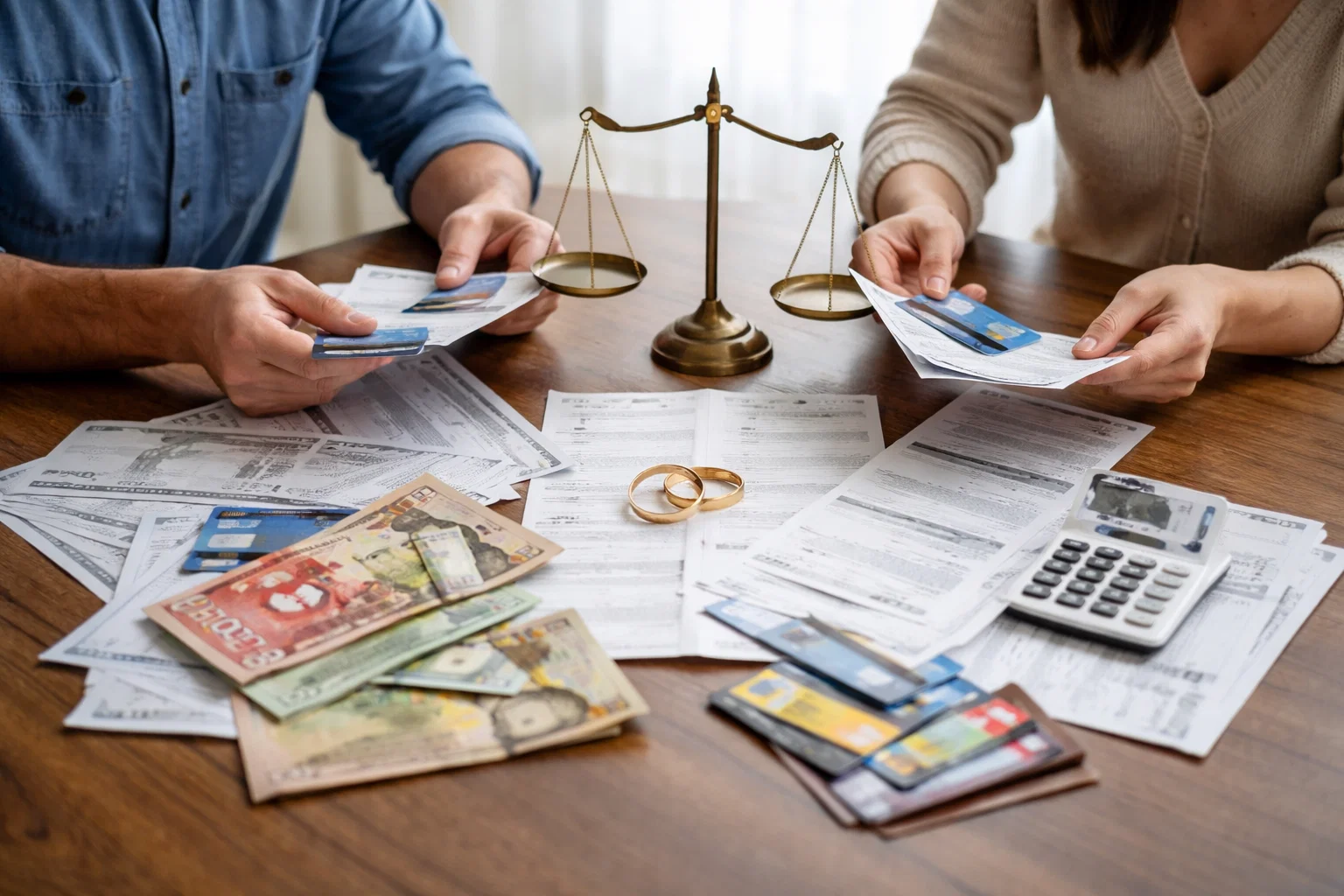

Divorce can feel like a financial fog, especially when you are staring at credit card balances, a line of credit, or a mortgage that still needs paying. Splitting debts during divorce in Ontario is not usually a simple “you take this bill, I take that one” exercise.
For married spouses, Ontario’s system focuses on equalizing the growth in each spouse’s net worth during the marriage, and debts are a key part of that math. Understanding the framework can help you make clearer, calmer decisions.
Splitting Debts During Divorce in Ontario: The Core Rule Most People Miss
A lot of people assume divorce law automatically splits every debt down the middle. In Ontario, the starting point for married spouses is usually an equalization calculation under the Family Law Act, not a line-by-line division of each bill.
In simple terms, each spouse’s “net family property” is calculated as of the valuation date, and the spouse with the lower net family property is generally entitled to one-half of the difference.
Debts reduce net family property, so a larger debt load can change who pays an equalization payment, and how much — even if the debt is only in one spouse’s name. The key timing is also defined by law: the “valuation date” is typically the separation date when there is no reasonable prospect of resuming cohabitation (though the statute lists several possibilities).
Do We Split Debts 50/50, or Does It Depend?
If you are googling how debts are divided in divorce, the most accurate answer in Ontario is: it depends on the equalization result and the facts behind the debt. Equalization aims to share the net increase in wealth during the marriage, and debts influence that net number.
That said, many separating couples choose to allocate specific debts in a separation agreement because it is practical. For example, you might agree that one person keeps the car and the car loan, or that a joint line of credit is paid off using the proceeds from the sale of the home. Those agreements can make day-to-day life easier while still respecting the equalization framework.
What Counts as a Debt for Equalization Purposes?
Think broadly. Debts and liabilities that exist on the valuation date can affect the calculation. Common examples include:
- Credit cards and lines of credit
- Personal loans and payday loans
- Car loans and leases
- Mortgage balances
- Income tax debts
- Business-related debts (depending on structure and evidence)
Ontario’s legislation also explicitly notes that “liabilities” in net family property can include applicable contingent tax liabilities connected to property, which can matter for investments, real estate, or certain registered assets.
A practical takeaway: it is often worth gathering documents early (statements, loan contracts, CRA notices, closing documents) so you are not negotiating from guesses.
What Is the Valuation Date, and Why Does It Matter for Dividing Debt?
The valuation date is the anchor point for valuing property and capturing debts in the net family property calculation. The Family Law Act defines “valuation date” and puts separation (with no reasonable prospect of reconciliation) at the top of the list.
In real life, this can raise common pressure points:
- Debts incurred after separation: sometimes these are clearly “post-separation” living costs; sometimes they are tied to family assets (like keeping the home afloat).
- Cash advances and new credit use near separation: these often get intense scrutiny because they can look like an attempt to shift the numbers.
If timing is disputed, legal advice is especially helpful because the valuation date can move the whole analysis.
What If One Spouse Hid Debt or Ran It Up Recklessly?
Ontario law gives courts discretion to order an unequal result in specific, serious situations. Under the Family Law Act, a court may award more or less than half the difference between net family properties if equalizing would be “unconscionable,” and the statute lists factors that include failing to disclose debts existing at the date of marriage and debts incurred recklessly or in bad faith.
Translation: if one spouse secretly piled on debt, or deliberately created liabilities to manipulate the outcome, that conduct can matter. But “unconscionable” is a high bar, and evidence is everything (statements, emails, proof of spending patterns, and financial disclosure).
Are Joint Debts Automatically Shared With the Lender?
This is where people get blindsided. Even if you and your ex agree that “you will pay the Visa,” a lender is not automatically bound by your separation agreement. If both names are on the debt, the creditor may still pursue either borrower if payments stop.
So, splitting debts during divorce in Ontario often requires two tracks at once:
- Family-law track: equalization and the fairness of who should be responsible.
- Creditor track: what the contract says, and how to protect your credit if the other person does not pay.
Practical tools sometimes include paying out and closing joint accounts, refinancing, or using the sale of an asset to clear a joint balance.
Married vs Common-Law in Ontario: Is Debt Sharing the Same?
Not necessarily. Ontario’s equalization framework in the Family Law Act applies to “spouses” as defined in the Act, which is tied to marriage (including certain void or voidable marriages in good faith).
For common-law partners, the analysis can be very different, and the legal routes may involve ownership claims, unjust enrichment, or contract-based arguments rather than automatic equalization. This is another spot where people searching how debts are divided in divorce can get misleading answers, because many online explanations blend married and common-law rules together.
Does Federal Divorce Law Decide Debt Division?
Federal law governs divorce in Canada, but property division is generally handled by provincial law. The federal Department of Justice explains that provinces and territories are responsible for laws setting out the rules for dividing property when couples divorce or separate, and that rules vary across Canada.
If you want a reliable federal starting point for divorce basics, the Department of Justice’s “Divorce and Separation” hub is a helpful reference point for the overall process and where federal versus provincial rules fit.
Can Support Decisions Take Debts Into Account?
Sometimes. As a general idea, debt is often addressed through property division, but large debt payments can affect cash flow and may be relevant when assessing ability to pay support in certain situations.
The federal Spousal Support Advisory Guidelines materials note that in most cases, marital debts are dealt with in property division, and debt-payment issues tend to matter most when debts exceed assets and payments are so large they impact ability to pay.
This is very fact-specific, but it is one reason divorce lawyers often look at the full financial picture instead of treating support and debt as separate silos.
Bringing Clarity to Debt and Separation Decisions
If you are trying to make sense of balances, statements, and who “should” pay what, start by remembering this: Ontario’s approach for married spouses usually runs through equalization, and debts can shift the outcome as much as assets do.
The valuation date, full financial disclosure, and the reason a debt exists all matter. With the right documents and a clear framework, splitting debts during divorce in Ontario becomes less about panic and more about solving a defined financial puzzle, step by step.