

Thornhill Driving Offence Lawyer
Driving charges in Thornhill go to two completely different courts, and knowing which one you are in changes everything about what happens next. Criminal charges like impaired driving are heard at the Ontario Court of Justice at 50 Eagle Street West in Newmarket. Highway Traffic Act charges like speeding, careless driving, and stunt driving go to a Provincial Offences court instead, and York Region runs two of them.
The paperwork tells you which. On a provincial offences ticket, the first four digits of the offence number are the location code: 4960 is the Newmarket court, 4961 is the Richmond Hill court. That one detail saves people from turning up at the wrong building, which happens more than it should.
The advice that matters most is the same in both systems. Do not simply pay the ticket to make it go away. Paying is a guilty plea, and the fine is almost never the expensive part. A Thornhill Driving Offence Lawyer can usually tell you in one call whether your charge is worth fighting and what a conviction will actually cost you over the next three years.
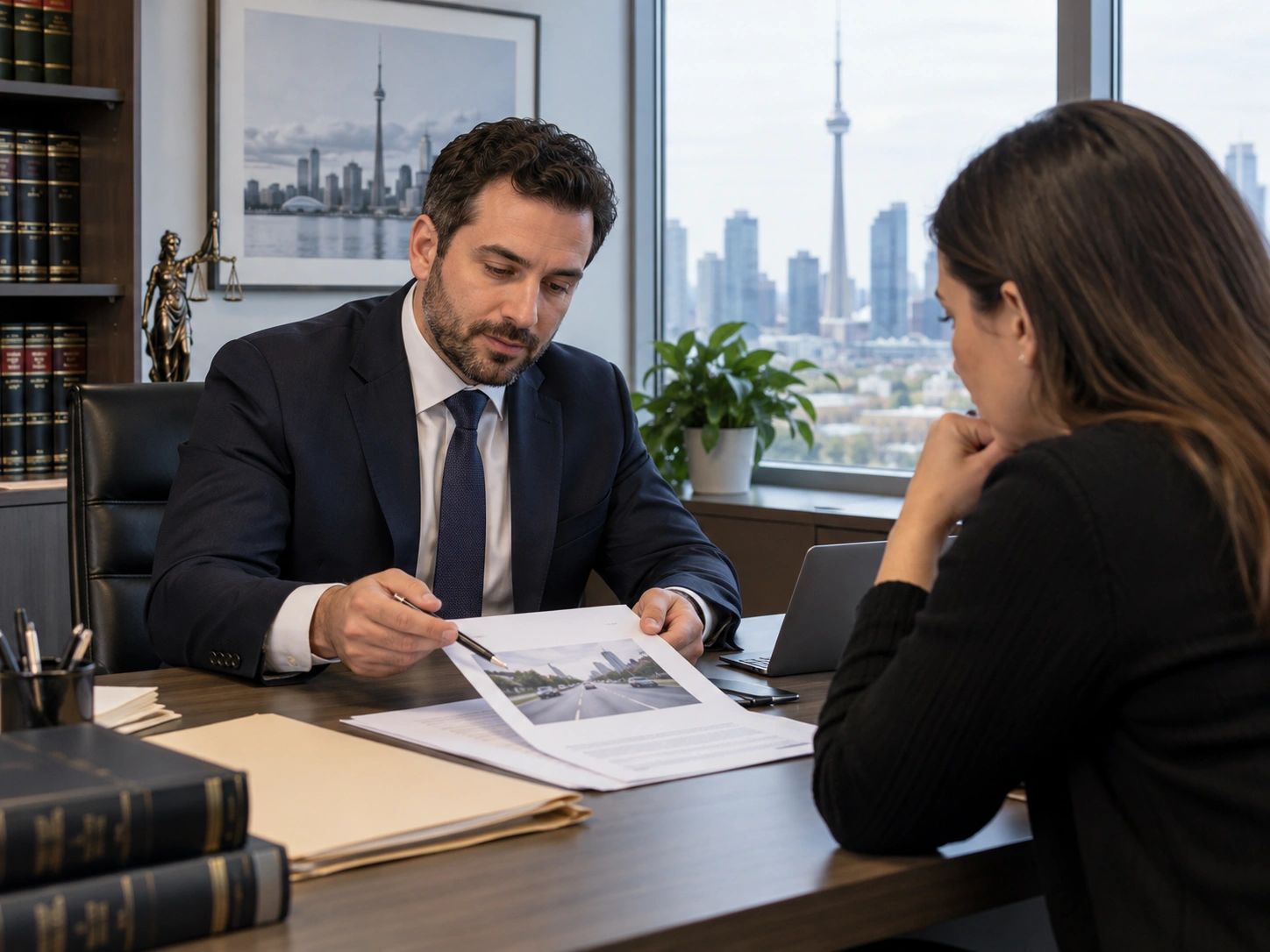
Which Court Will Your Thornhill Driving Charge Go To?
It depends on whether you were charged under the Criminal Code or the Highway Traffic Act. Thornhill’s position inside York Region settles the region; the statute settles the building. A driving charge in Thornhill can therefore end up in one of three courthouses depending on what was written on the paperwork. Thornhill sits in York Region on both sides of Yonge Street, so the Vaughan side to the west and the Markham side to the east follow the same path, but the two statutes lead to different buildings.
Criminal driving charges are heard at the Ontario Court of Justice, 50 Eagle Street West, Newmarket. That covers impaired operation and over 80 under section 320.14 of the Criminal Code, dangerous operation under section 320.13, failure to stop after an accident under section 320.16, and flight from a peace officer under section 320.17. These are criminal matters with a criminal record attached, and the court process runs like any other criminal file: first appearance, disclosure, Crown discussions, then resolution or trial.
Provincial offences are a separate system with its own courts, run by York Region rather than the province. There are two locations:
- Newmarket Provincial Offences Court, 17150 Yonge Street, 2nd floor, location code 4960.
- Richmond Hill Provincial Offences Court, 50 High Tech Road, location code 4961.
Check your ticket rather than trusting a search result. The Newmarket POA court moved from its old Davis Drive address, and a number of pages online still list the previous location. The location code printed on your offence number is the reliable answer.
One more piece of local context. A police investigation in Thornhill runs through York Regional Police #2 District at 171 Major Mackenzie Drive West in Richmond Hill, which covers Thornhill on both sides of Yonge along with Richmond Hill itself. The officer’s notes and any in car video come from there, whichever court the charge ends up in, and a Thornhill Driving Offence Lawyer will request that material before advising you on anything.
What Is the Real Difference Between a Criminal Charge and a Traffic Ticket?
One leaves you with a criminal record and the other does not. That is the line, and it matters more than the size of the fine.
A Highway Traffic Act conviction goes on your driving record, adds demerit points, and is reported to your insurer. It does not make you a person with a criminal record, so it will not appear on a criminal record check, will not affect entry to the United States on that basis, and does not carry immigration consequences.
A Criminal Code driving conviction does all of those things. An impaired driving conviction is a criminal conviction, full stop, and it follows you into employment screening, professional licensing, border crossings, and immigration decisions. For anyone who is not a Canadian citizen, immigration status is often the most serious risk in the file, and it should shape the strategy from the first week rather than after a plea.
Some driving incidents produce more than a driving charge. A confrontation after a collision can add an assault charge to the file, and road rage allegations are prosecuted as assault rather than as anything to do with driving, and where someone is arrested for dangerous operation or flight from police they may be held for a bail hearing rather than released at the roadside. Those files stop being about the licence and start being about the record. The confusing part is that some conduct can be charged either way. Careless driving is a Highway Traffic Act offence, while dangerous operation is criminal, and the same set of facts can sometimes support either. Which one the officer chose is on your paperwork, and it is the first thing worth checking.
What Does an Impaired Driving Charge Actually Carry?
Mandatory minimum penalties and an immediate licence suspension that happens before you ever see a judge. Section 320.19 of the Criminal Code sets a minimum $1,000 fine for a first offence, rising to $1,500 where blood alcohol concentration is between 120 and 159 milligrams, and $2,000 at 160 or above. Refusing to provide a sample carries a $2,000 minimum. A first conviction also brings a minimum one year driving prohibition.
The administrative side runs in parallel and catches people off guard. A driver who registers over 80 or refuses a sample faces an immediate 90 day licence suspension and a seven day vehicle impoundment, imposed at the roadside by the province rather than by the court. That suspension is not the court’s to lift, and it continues regardless of how the criminal charge eventually resolves.
The Ignition Interlock Conduct Review Program can shorten the post conviction prohibition for eligible first offenders who plead guilty early, which is one of the few genuine reasons to move quickly rather than slowly on a file like this.
Can a Breach Be Resolved Without a Criminal Record?
Often, yes. Section 523.1 of the Criminal Code created the judicial referral hearing precisely for this, and it is the outcome to aim for in most first breach files.
The gateway is harm. Where a criminal offence in Thornhill involving failure to comply caused no harm to a victim, no property damage, and no economic loss, the Crown may direct the matter to a judicial referral hearing rather than prosecute it. At that hearing, a judicial official who is satisfied the person failed to comply reviews the bail conditions themselves, with attention to the individual’s circumstances, and then has three options: take no action, release the person on new conditions, or order detention.
Take no action is a real outcome, not a theoretical one. Parliament built this process because breach charges were flooding the courts and falling hardest on people dealing with poverty, addiction, and mental health, a pattern the Supreme Court acknowledged directly in Zora. A Thornhill Breach of Bail Lawyer will usually push for a referral early, before the Crown has committed to prosecuting, since the conversation is much easier at that stage than after a trial date is set.
Other routes exist alongside it. Some breaches resolve by withdrawal once disclosure shows the condition was ambiguous. Others fold into the resolution of the main charge, where it is often possible to negotiate a reduced charge or a withdrawal of the breach in exchange for a resolution on the substantive matter. A peace bond sometimes ends both together. Negotiation of that kind works best early, before a trial date and its deadlines lock the file into a more rigid path, and a favourable result is far more achievable while the Crown still has room to move.
How Serious Are Stunt Driving and Careless Driving Charges?
Far more serious than most people expect, and neither is an ordinary ticket. Both carry the possibility of jail and a long licence suspension, even though they are provincial rather than criminal offences.
Stunt driving under section 172 of the Highway Traffic Act starts at the roadside with an immediate 30 day licence suspension and a 14 day vehicle impoundment, before any court date. The threshold is 40 kilometres per hour over where the limit is under 80, and 50 over where the limit is 80 or higher, though the section also captures other conduct entirely unrelated to speed. On conviction the fine range runs from $2,000 to $10,000, with up to six months in jail and a further licence suspension.
Careless driving under section 130 carries a fine between $400 and $2,000, up to six months in jail, a licence suspension of up to two years, and six demerit points. Where the careless driving causes bodily harm or death, section 130(3) raises the ceiling dramatically, to a fine of up to $50,000, imprisonment of up to two years less a day, and a suspension of up to five years.
A careless driving conviction also sits on your record for three years and is treated by most insurers as a major conviction. That is usually where the real money goes.
Why Is Paying the Ticket Usually the Expensive Choice?
Because the fine is the smallest part of the cost. Paying a provincial offences ticket is a guilty plea, and the consequences that follow are the demerit points and the insurance increase, neither of which appears on the ticket itself.
The Ministry of Transportation records demerit points against your licence. For a fully licensed G driver, nine points brings a warning letter and fifteen points triggers a suspension. Novice G1 and G2 drivers face lower thresholds and lose their licence far sooner, which is why a single conviction matters much more for a young driver in Thornhill than for their parent.
Insurance is the larger cost in most cases. A major conviction such as careless driving or stunt driving can multiply a premium rather than nudge it, and it stays relevant to your rating for years. Ask a Thornhill Driving Offence Lawyer to price the conviction, not the ticket, before you decide. Run the arithmetic before you decide a ticket is not worth fighting:
- A minor speeding conviction may cost little beyond the fine, depending on your record and your insurer.
- A careless driving conviction is treated as major by most insurers and remains on the driving record for three years.
- Two or three convictions in a short period compound, both for points and for rating purposes.
- For a G1 or G2 driver, a single conviction can end the licence and restart the graduated licensing clock.
- Commercial drivers and anyone whose job requires driving face an entirely different level of exposure, since the licence is the livelihood.
What Does a Thornhill Driving Offence Lawyer Do First?
Gets the disclosure and reads the officer’s notes before deciding anything. A Thornhill Driving Offence Lawyer starts there because the strength of these cases lives in the details of how the reading was taken, how the stop was conducted, and what the officer actually wrote down at the time.
In a criminal driving file that means the breath technician’s certificate, the calibration and maintenance records for the instrument, the timing of the demand, and whether the right to counsel under section 10(b) of the Charter was properly given and facilitated. Impaired driving is a technical area, and cases turn on procedure at least as often as on the reading itself.
In a provincial offences matter it means requesting disclosure from the prosecutor’s office, reviewing the officer’s notes, and looking at whether the charge can be reduced to something without demerit points or resolved on terms that protect the insurance position. It is usually possible to negotiate an outcome with the prosecutor before a trial date, and early contact frequently achieves more than a hearing would.
The third job is expectation setting. Some charges support a strong defence and are worth taking to trial, some are worth negotiating, and some are genuinely best resolved quickly. The realistic outcome differs enormously between those three, and knowing which one you are in is the first useful piece of advice anyone can give you. A traffic offence lawyer in Thornhill who tells you every ticket is beatable is selling something.
Do You Need a Lawyer or a Paralegal?
It depends entirely on which court you are in, and this is worth being straight about. Licensed paralegals can represent you on Highway Traffic Act matters in Provincial Offences court, and for a straightforward speeding ticket that is often the sensible and cheaper choice.
Criminal charges arising from driving are different. Impaired driving, over 80, dangerous operation, and failure to stop are Criminal Code matters where a criminal record is on the line, and representation by a criminal lawyer is the sensible choice. The same is true where a provincial charge sits alongside a criminal one arising from the same incident, which happens constantly after a collision.
If your matter is a simple ticket, we will tell you so rather than open a file. Where the charge threatens your record, your licence for an extended period, or your ability to work, that is when a Thornhill driving charges lawyer earns the fee. Legal guidance at that point is worth more than the hourly rate suggests.
What Should You Do Right Now?
Note your deadline and request disclosure. Provincial offences tickets carry a short window to respond, and missing it can result in a conviction being entered without you.
- Read the ticket carefully and find the location code in the first four digits of the offence number, which tells you whether your matter is at Newmarket or Richmond Hill.
- Do not pay the fine as a way of resolving it quickly. Payment is a plea of guilty and it registers the conviction, the points, and the insurance consequence.
- Write down what happened while it is fresh: the weather, the road, what was said, how long everything took, and whether you were offered a phone call.
- If your licence was suspended at the roadside, do not drive. Driving under suspension under section 53 of the Highway Traffic Act carries a fine of $1,000 to $5,000 for a first offence, possible jail, and a further suspension on top of the one you already have.
- Say nothing about drinking or about your driving to anyone but a lawyer. Explanations offered at the roadside become evidence.
What Does a Thornhill Driving Offence Lawyer Cost?
Less than most people assume for a straightforward matter, and it is usually quoted before you commit. Provincial offences work is often handled on a flat fee because the scope is predictable, while criminal driving files are priced by stage.
Weigh it against the real number rather than the fine. Where a conviction would raise your insurance for three years or put your licence out of reach for a year, the cost of defending it is frequently smaller than the cost of accepting it. Where the charge is minor and your record is clean, we will say that too.
Our office is at 7191 Yonge Street in Thornhill, on the line between Vaughan and Markham, and we regularly appear at Newmarket. Most provincial offences appearances do not require you to attend at all once someone is acting for you.
How We Handle Driving Files for Thornhill Clients
You get one lawyer on the file and an honest read on whether it is worth defending. We are a criminal defence law firm in Thornhill, and driving matters sit alongside the rest of our criminal work rather than in a separate silo, which matters because a single incident can produce a Highway Traffic Act ticket, a criminal charge, and an assault allegation all at once.
Most of the work is disclosure and negotiation rather than courtroom argument. We read the officer’s notes, look for the procedural gaps, and approach the prosecutor early. Where the evidence is strong, we say so and focus on limiting the consequence instead of promising a fight we would lose. Experienced criminal defence counsel should be able to tell you which of those two situations you are in within a first meeting.
Our legal services here cover both systems: provincial offences at Newmarket or Richmond Hill, and Criminal Code driving charges at 50 Eagle Street West. Legal support extends to the connected problems as well, since an impaired driving charge often arrives with a bail question, an insurance problem, and a work problem attached. We serve Thornhill clients on both sides of Yonge Street, along with Vaughan, Markham, Richmond Hill, and the wider GTA from our second office in Toronto.
We advocate for the outcome that actually protects you, which is not always the one that feels like winning. Sometimes the right legal representation means resolving a criminal charge on a Highway Traffic Act offence and keeping your record clean, rather than running a trial for the principle of it. We work to protect your rights at every stage of the legal process, and we tell you plainly what each option costs.
Frequently Asked Questions
Where do Thornhill traffic tickets get heard?
At one of York Region’s two Provincial Offences courts: Newmarket at 17150 Yonge Street, location code 4960, or Richmond Hill at 50 High Tech Road, location code 4961. The first four digits of the offence number on your ticket tell you which. Criminal driving charges go to the Ontario Court of Justice at 50 Eagle Street West in Newmarket instead.
Is impaired driving a criminal offence in Ontario?
Yes. Impaired operation and driving over 80 are Criminal Code offences under section 320.14, and a conviction creates a criminal record. Section 320.19 sets a minimum $1,000 fine for a first offence with a minimum one year driving prohibition, rising with higher blood alcohol readings and for refusing a sample.
What happens if I just pay my ticket?
Paying registers a guilty plea and the conviction goes on your driving record along with any demerit points. Your insurer will see it at renewal. For a careless driving conviction, which most insurers treat as major, the premium increase over three years usually exceeds the fine several times over.
How long does a stunt driving suspension last?
The roadside suspension is 30 days with a 14 day vehicle impoundment, imposed immediately and separate from anything the court does. On conviction under section 172 of the Highway Traffic Act, the fine ranges from $2,000 to $10,000, with a possible jail term and a further licence suspension.
Can I get a criminal driving charge reduced to a traffic ticket?
Sometimes. Where the evidence has weaknesses, a Crown may agree to resolve a criminal driving charge on a Highway Traffic Act offence such as careless driving, which avoids a criminal record. Whether that is available depends on the disclosure, the reading, the driving pattern, and the record, so it is assessed case by case.
How do I choose the right lawyer for a driving charge in Thornhill?
Ask which court your matter is in, how often they appear there, and whether a paralegal would serve you better and cheaper. Be cautious of anyone advertising extensive experience or promising the best possible outcome, since Law Society of Ontario rules restrict such claims. A criminal defence lawyer in Thornhill should be able to explain the difference between a Criminal Code charge and a Highway Traffic Act offence in Thornhill without jargon. Many people search for a driving offence attorney, which is the American term; in Ontario you are looking for a lawyer or a licensed paralegal. Often the lawyer Thornhill drivers recommend is simply whoever explained the insurance consequence first.
Do I have to attend court in Newmarket myself?
Usually not for routine provincial offences appearances, since your representative can attend for you. Criminal driving matters are different: your attendance is generally required unless the court permits counsel to appear on your behalf, and it is always required for a trial or a guilty plea.
Find Out What the Conviction Would Actually Cost You
Call before your response deadline passes. Most people decide whether to fight a driving charge based on the fine printed on the ticket, which is the one number that does not matter much.
The free consultation is a real conversation, not an intake script. We will ask what you were charged with, which court the location code points to, whether your licence was suspended at the roadside, and what your record looks like. From there we can give you straight legal advice on whether the charge is worth defending, what a conviction would do to your insurance, and whether you need a lawyer at all. Clients facing charges in both systems at once get one plan covering both. Everything you tell us is protected by solicitor-client privilege whether or not you retain us, and the first conversation is free.
Thornhill: 647-697-5975. Toronto: 647-588-3234. Reach us through our contact page, or come to the office at 7191 Yonge Street, Suite 310, Thornhill, Ontario L3T 0C4, a short drive from Vaughan, Markham, and Richmond Hill. For the province wide picture, see our driving offence lawyer Ontario page. If the charge is criminal rather than a ticket, our Thornhill criminal defence lawyer page explains how those files run at Newmarket, and where you were held after the arrest, our Thornhill bail lawyer page covers what happens in the first 24 hours.
Talk it through with a lawyer today. No cost, no obligation, and the conversation stays confidential.