

Thornhill Driving Under Suspension Lawyer
If you’ve been charged with driving while suspended in Thornhill, stop driving and get the summons reviewed before your first appearance. A Thornhill driving under suspension lawyer can identify why the licence was suspended, check whether the prosecution can prove the charge, and explain the safest next step.
This is not a routine ticket with a preset fine. A conviction can extend the time you’re off the road, expose you to a substantial fine and possible jail, and interfere with work that depends on driving. Keep every document from the stop and confirm your licence status before you get behind the wheel again.
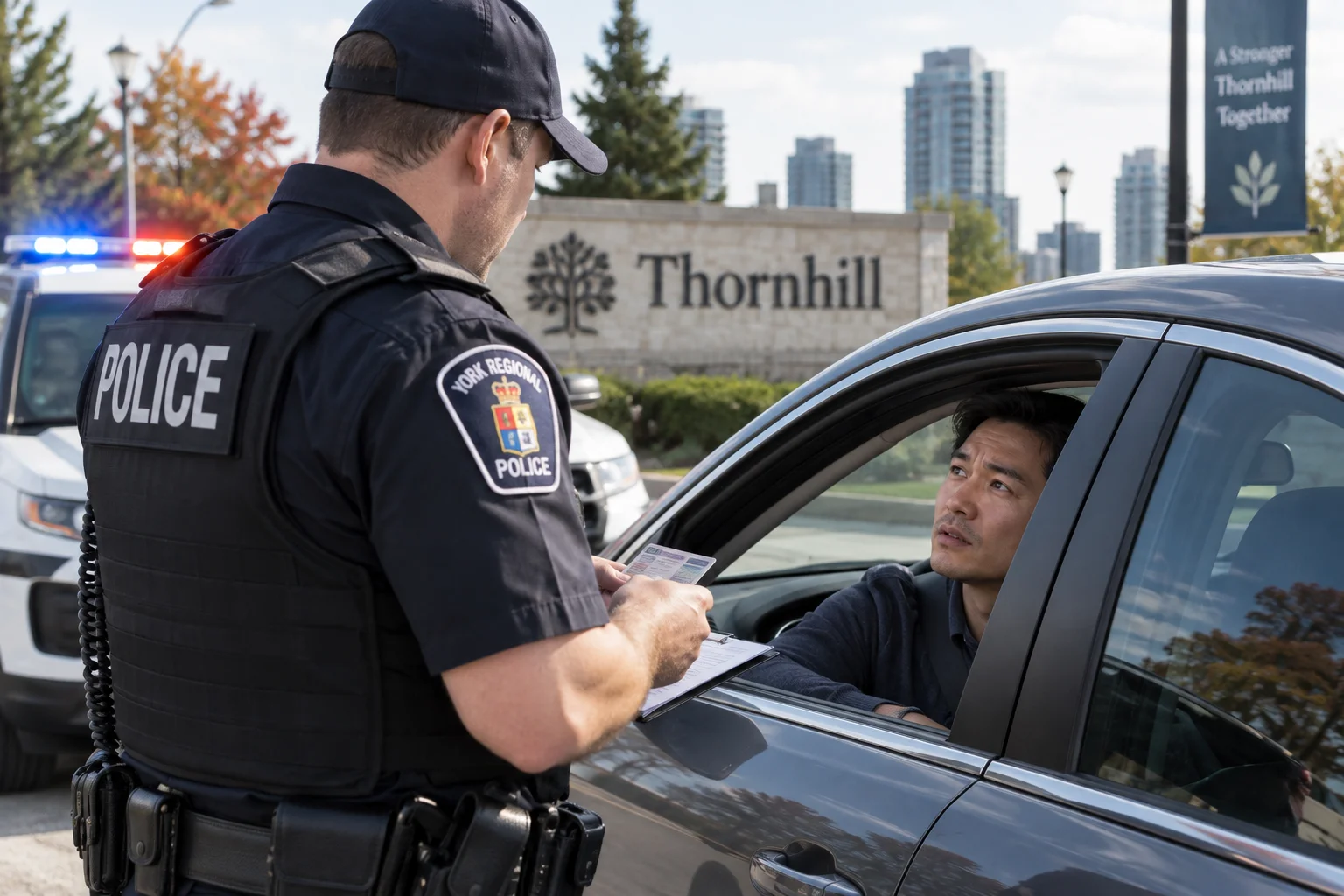
What Driving Under Suspension Means In Ontario
Driving under suspension means operating a motor vehicle or street car on a highway while your Ontario driver’s licence is suspended. The usual allegation is under section 53 of the Highway Traffic Act.
The reason for the suspension matters. A licence can be suspended because of unpaid fines, demerit points, a medical decision, a court order, or a driving-related conviction. The start date, legal authority, notice history, and any reinstatement requirements can change both the available defence and the penalty range.
The first task for a Thornhill driving under suspension lawyer is to read the summons and obtain the Ministry record rather than assume every suspension is the same. A standard section 53 case is a provincial offence. It does not create a criminal record by itself, although the conviction can appear on a driving record and affect insurance or employment.
A different and more serious route may apply when someone operates while prohibited by a court order, or while subject to a provincial restriction imposed because of a Criminal Code conviction or discharge. Criminal Code section 320.18 creates that criminal offence. The wording on the paperwork must be checked before anyone advises you about exposure or court procedure.
For a broader explanation of these two legal tracks, see our Ontario driving under suspension guide and Ontario driving offence overview.
What The Prosecutor Must Prove
For a standard Highway Traffic Act charge, the prosecutor must prove each essential element beyond a reasonable doubt. Driving under suspension is treated as a strict liability offence, so the prosecutor does not ordinarily have to prove that the driver knew about the suspension.
The evidence must establish:
- The accused was the person driving
- The vehicle was a motor vehicle or street car
- The driving occurred on a highway
- The driver’s licence was suspended at that time
The Ontario Court of Justice guide for provincial offences defendants explains that strict liability permits a due diligence defence. The defendant must prove on a balance of probabilities that reasonable steps were taken to avoid the offence, or that there was a reasonable mistake of fact that would have made the conduct innocent.
In R. v. Montgomery, the Ontario Court of Justice applied that framework to driving while suspended. Lack of actual notice can be relevant, but it is not an automatic defence. The court considers what the driver knew, what notices were sent, whether the address on file was current, and what reasonable checks the driver made.
Penalties For Driving While Suspended
A conviction can bring a mandatory further suspension, a large fine, and up to six months in jail. The range depends on the legal source of the existing suspension and whether there is a prior conviction within the statutory period.
Section 53 of the Highway Traffic Act sets out these consequences:
- For a first standard offence, the fine ranges from $1,000 to $5,000.
- For a subsequent standard offence within five years, the fine ranges from $2,000 to $5,000.
- Either category can carry up to six months in jail, or both a fine and imprisonment.
- A conviction adds a further six-month licence suspension that runs after the existing suspension.
- If the licence was suspended under section 41 or 42 following a Criminal Code conviction, the fine range rises to $5,000 to $25,000 for a first offence and $10,000 to $50,000 for a subsequent offence.
Those are statutory ranges, not predictions. A first allegation does not mean jail is automatic. The prosecutor and court may consider the reason for the original suspension, driving history, prior convictions, what happened during the stop, personal circumstances, and any steps taken since the charge. A vehicle may also be impounded, with towing and storage costs, depending on the suspension and enforcement authority involved.
A charge under Criminal Code section 320.18 is different. It is a hybrid criminal offence, and section 320.19 permits up to ten years of imprisonment if the Crown proceeds by indictment. A criminal conviction can also affect employment, immigration status, and travel. Those consequences should not be confused with a standard Highway Traffic Act conviction.
How A Thornhill Driving Under Suspension Lawyer Reviews The Charge
A Thornhill driving under suspension lawyer should trace the suspension from its legal source through notice, duration, and reinstatement. That review can reveal a viable trial issue, support a resolution request, or show that the prosecution has reliable evidence that must be addressed realistically.
The review usually includes:
- The summons, officer’s notes, and any roadside video
- The Ministry of Transportation driver record and suspension history
- The order, conviction, unpaid fine, medical decision, or other event that caused the suspension
- Proof of when and where notice was sent or served
- Address changes, ServiceOntario records, reinstatement payments, and correspondence
- Evidence identifying the driver, vehicle, road, date, and time
- Prior convictions that may alter the fine range
- Any companion charge arising from the same stop
Possible defences include an incorrect licence record, a suspension that was not legally in force, mistaken identity, insufficient proof of driving, or due diligence. A person who reasonably relied on clear reinstatement information may be in a different position from someone who drove without checking. An emergency or personal hardship is not automatically a defence, and it should not be treated as one without a careful legal assessment.
The stop itself may also require review. An unlawful detention, search, or statement can raise Charter issues, although a technical concern does not automatically end the case. Disclosure has to be examined before deciding whether to negotiate, set a trial, or bring an application.
If the same stop produced another allegation, each charge needs its own analysis. Our pages on careless driving in Ontario and stunt driving in Ontario explain two common companion proceedings. If the incident occurred in Toronto rather than York Region, the Toronto driving under suspension page covers that court context.
The Thornhill Court Process And Local Jurisdiction
A standard section 53 summons arising in Thornhill is handled through York Region’s Provincial Offences Court system. A Thornhill driving under suspension lawyer can check the appearance information, request disclosure, communicate with the prosecutor, and determine whether the case should move toward resolution or trial.
Police Stop And Summons
York Regional Police normally handles road enforcement in Thornhill. Thornhill crosses the municipal boundary between Vaughan and Markham, and York Regional Police confirms that Number 2 District serves the Thornhill communities of both municipalities. Regional traffic officers or another YRP unit may still conduct the stop, so the officer and unit shown in the disclosure matter more than an assumption based on the street.
An officer may confirm the licence status through Ministry records, issue a summons, and arrange for the vehicle to be removed where authorized. Do not try to explain away the allegation at the roadside. Record what happened as soon as you can, but discuss the details with counsel before giving any further statement.
Disclosure And Resolution Discussions
Disclosure is the evidence the prosecutor intends to rely on, and it should be requested early. The Ontario Court of Justice confirms that relevant disclosure is available without charge but must be requested. It can include officer notes, witness statements, diagrams, photographs, Ministry records, and available video.
Once disclosure is complete, counsel can assess the evidence and discuss resolution with the prosecutor where appropriate. A meeting does not remove the right to a trial. Any proposed plea should be evaluated against the mandatory further suspension, the fine range, driving record consequences, employment needs, and the strength of the defence.
Trial And Timing
If the case does not resolve, it proceeds to trial before a justice of the peace. The prosecutor presents evidence first and must prove every essential element beyond a reasonable doubt. The defence may cross-examine witnesses, challenge documents, raise due diligence, call evidence where useful, and make legal submissions.
No official York Region source publishes one standard completion time for these cases. The summons fixes the first appearance, but disclosure, negotiations, applications, trial scheduling, and court availability can require later dates. Plan for a process measured in months rather than days. An individual matter may take more or less time depending on its facts and whether a trial is required.
On a trial day, arrive by the stated time and be prepared to wait because several matters may be scheduled together. Bring the summons, disclosure, original documents, copies for use in court, and any properly preserved photographs or records.
Thornhill Office Serving York Region
The Thornhill office is the Kazandji Law location most directly serving this city. Its public business information is:
Kazandji Law – Criminal and Family Lawyers
7191 Yonge St Suite 310
Thornhill, ON L3T 0C4
647-697-5975
Because Thornhill includes areas within both municipalities, readers facing related criminal allegations can also use our verified Vaughan criminal defence guide and Markham criminal defence and family law guide. The central Ontario criminal defence hub explains the separate criminal court process.
What To Do After Receiving A Summons
Do not drive again until the Government of Ontario confirms that your licence is valid. The end of a stated suspension period or payment of an outstanding amount does not always complete reinstatement.
Take these steps now:
- Use Ontario’s official Driver’s Licence Check and save the result.
- Keep the summons, suspension notice, envelopes, receipts, reinstatement documents, and every letter or email from the Ministry.
- Confirm that the Ministry had your correct address during the relevant period.
- Photograph or scan the paperwork so the dates and wording are easy to review.
- Calendar the first appearance and check whether it is in person or remote.
- Request disclosure promptly and preserve dash camera footage or other records that may be overwritten.
- Do not contact the officer or prosecutor to give an unplanned explanation.
- Tell counsel at the outset if driving is required for work, if you hold a commercial licence, or if a criminal conviction could affect immigration status.
These steps do not create a defence on their own. They preserve evidence, prevent a second allegation, and make the first legal review more useful.
Frequently Asked Questions
Is Driving While Suspended In Thornhill A Criminal Offence?
Usually, an allegation under Highway Traffic Act section 53 is a provincial offence, not a Criminal Code charge. It can still lead to a large fine, a further six-month suspension, and jail. If the restriction arose from a Criminal Code conviction or court prohibition, police may instead or also allege Criminal Code section 320.18.
Which Court Handles A Suspended Licence Charge In Thornhill?
For a standard Highway Traffic Act summons arising in Thornhill, the matter is generally handled at York Region Provincial Offences Court, Newmarket Court 4960, at 17150 Yonge Street. A Thornhill driving under suspension lawyer can confirm the venue from the paperwork because a Criminal Code allegation follows a different court process.
Can I Defend The Charge If I Did Not Know About The Suspension?
Possibly, but lack of knowledge does not automatically end the case. Section 53 is treated as strict liability. The defence must usually show due diligence, meaning reasonable steps were taken to learn and obey the licence status. Notice records, address updates, reinstatement documents, and the timing of Ministry communications can matter.
Can I Drive Once I Have Paid The Fine Or Waited Out The Suspension?
No. Paying a fine, finishing the stated suspension period, or completing a program does not necessarily make the licence valid immediately. Reinstatement conditions and fees may remain. Check the Government of Ontario’s licence status service and keep proof of reinstatement before driving. If the status is unclear, contact ServiceOntario and obtain legal advice.
Speak With A Thornhill Driving Under Suspension Lawyer Before Court
A Thornhill driving under suspension lawyer at Kazandji Law can review the summons, suspension record, notice history, disclosure, and next court date, then explain the available options without promising a result. Call the Thornhill office at 647-697-5975 or the Toronto number at 647-588-3234, or use our contact page to request a free consultation.
When you call, we’ll ask for the basic facts, the wording on your paperwork, the reason given for the suspension, and the date of your next appearance. If you have the documents, keep them nearby. We’ll explain what should be obtained next and whether we can assist with the court process. The first conversation is confidential.
Talk it through with a lawyer today. No cost, no obligation, and the conversation stays confidential.