

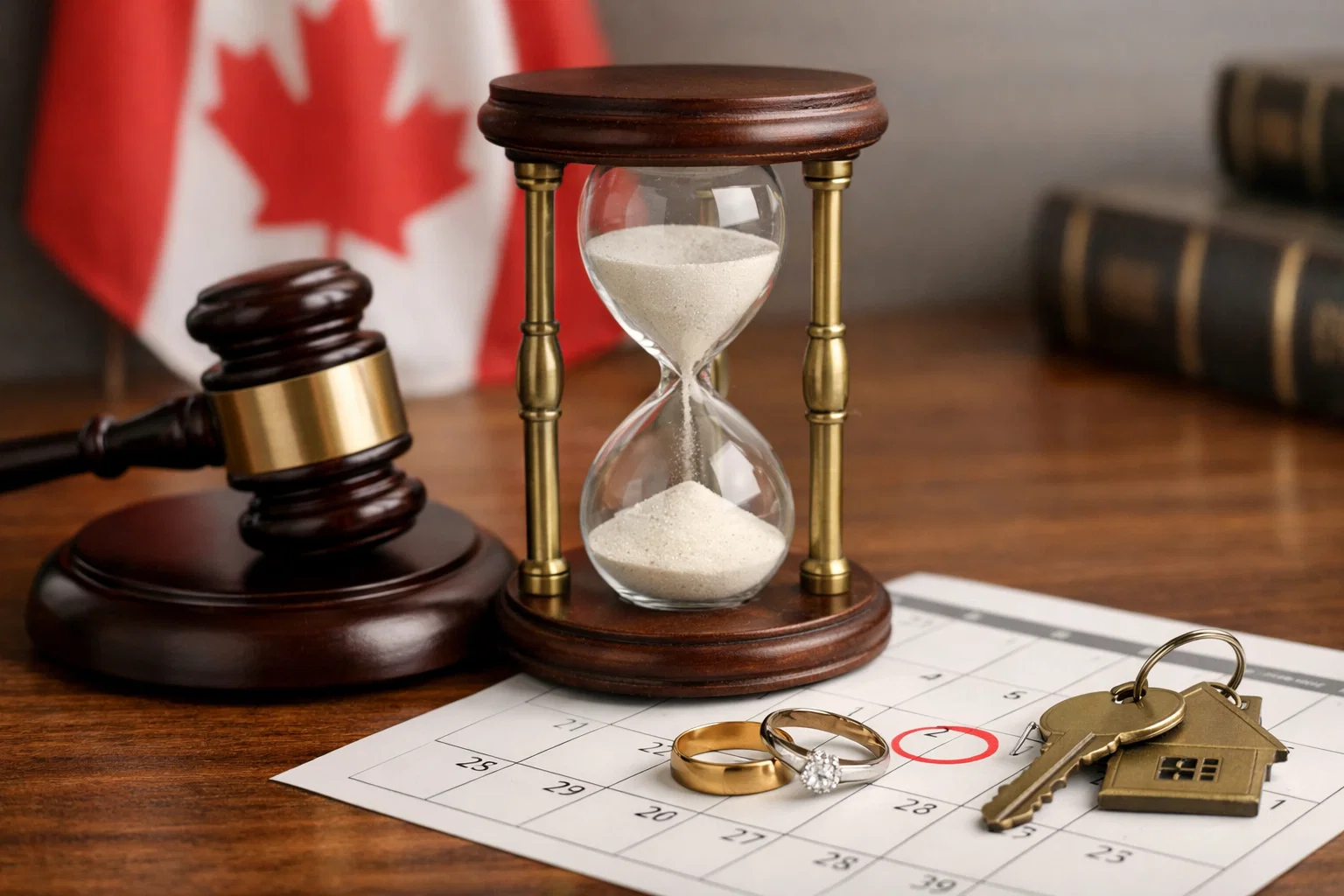

Separating is hard enough without worrying that a legal deadline is quietly ticking away in the background. For those who were married, time limits for division of property in Ontario can determine whether you can still ask a court to order an equalization payment, even if the numbers clearly favour you.
This article breaks down the key time limits, what they apply to, and the practical steps that help you stay protected while you negotiate, mediate, or prepare for court.
What Property Division Means for Married Couples in Ontario
Ontario typically doesn’t “split everything in half” by handing each spouse 50% of every asset. Instead, married spouses usually work through equalization of net family property, which aims to share the increase in value that occurred during the marriage.
Ontario’s government overview explains that the approach for married couples is different from common-law partners and focuses on how property is treated when a marriage ends.
In day-to-day terms, married property division often comes down to a few core building blocks:
- The valuation date (often the separation date) used to calculate each spouse’s net worth at the end of the relationship
- What each spouse owned on the date of marriage (starting point)
- Debts and liabilities at both the date of marriage and valuation date
- Special rules for the matrimonial home (which can change how exclusions work)
That framework matters because limitation periods generally attach to bringing an equalization claim to court, not merely “having a disagreement” about finances.
Time Limits for Division of Property in Ontario
Ontario’s Family Law Act sets firm deadlines for bringing a court application for equalization. The limitation period is based on the earliest applicable deadline, and commonly includes:
- Two years after the divorce (or judgment of nullity), or
- Six years after separation, where there is no reasonable prospect that the spouses will resume cohabitation, or
- Six months after the first spouse’s death (in situations involving estates).
Ontario’s government guidance also summarizes the practical takeaway for married spouses: if you need the court to decide the equalization amount, you generally have six years from separation or two years from divorce, depending on which deadline comes first in your situation.
Why divorce can shorten your window
People often assume separation is the only date that matters. But once a divorce is granted, the “two years after divorce” deadline can become the sooner cut-off. That’s why timing your next steps matters even if negotiations feel productive.
What Counts as “Separated” for Starting the Clock?
The six-year timeline is tied to separation and the idea that there’s no reasonable prospect of resuming cohabitation (that language is used in many explanations of the limitation rule).
Because real life is messy, separation can be gradual. Couples may stay under one roof for financial reasons or co-parenting. When a deadline is close, the separation date can turn into a major factual dispute.
Markers that often help clarify separation include:
- a clear conversation or written message confirming the marriage is over
- separate bedrooms and day-to-day routines
- telling family and friends you’re separated
- separating finances (new accounts, different bill payments)
- changes to the mailing address or government records
If your timeline is tight, documenting these details can become just as important as gathering financial documents.
What Happens If You Miss the Limitation Period?
If you start a court claim after the limitation date, the other spouse can raise the limitation period as a defence and ask the court to dismiss the equalization claim. In plain terms, missing time limits for division of property in Ontario can mean losing the ability to have a judge order equalization, even if you would have been entitled to it under the usual calculation.
This is one of the biggest traps for separating spouses who rely on “we’re working on it” for too long. Mediation and negotiation can be excellent, but they don’t automatically protect your court rights if the deadline expires.
Can a Court Extend the Time Limit?
Sometimes an extension may be possible, but it’s not automatic, and it’s not something you should count on. Ontario family law commentary often describes extensions as fact-specific and difficult, with courts looking at whether there’s a real basis for an equalization claim and whether delay would unfairly harm the other party.
Even when a spouse has a sympathetic reason for waiting, delay can create practical prejudice: records disappear, valuations get harder, and it becomes more difficult to trace assets or test credibility.
If you suspect you’re out of time, move quickly to get advice on whether an extension argument is realistic on your facts.
Steps to Protect Yourself While You Negotiate
You don’t need to rush into court just to be “safe,” but you do need a plan that respects the legal clock.
A practical approach for married property division often looks like this:
- Build a basic timeline: separation date, any reconciliation attempts, divorce status, major financial changes
- Collect key disclosure: tax returns, bank statements, mortgage documents, pension statements, business records
- List assets and debts at the date of marriage and the valuation date
- Get valuations when needed (home appraisal, business valuation, pension valuation)
- Track what’s missing and when you requested it, especially if disclosure is incomplete
Timelines and financial disclosure shape strategy, especially when spouses are trying to resolve property and asset issues without unnecessary conflict.
Key Takeaways on Dividing Property After the Marriage Ends
For married couples, the biggest risk isn’t usually misunderstanding the math. It’s waiting too long to preserve the right to ask a court to decide on equalization.
If you’re negotiating, keep the calendar in view and make sure disclosure is moving. The time limits for division of property in Ontario are easiest to manage when you treat them as part of the plan, not an afterthought.