

Toronto Domestic Misconduct While on Bail Lawyers
Home › Criminal Defence › Toronto Domestic Misconduct While on Bail Lawyers
You were released on a Toronto domestic charge with strict conditions, and now police say you broke them. A reply to a text. A stop at the house to pick up work boots. A new argument that someone reported. Nothing between charge and trial takes liberty away faster than a breach allegation on a domestic file, because it attacks the release order itself. But this situation has lawful fixes, and the earlier counsel starts working on them, the more of your life stays intact.
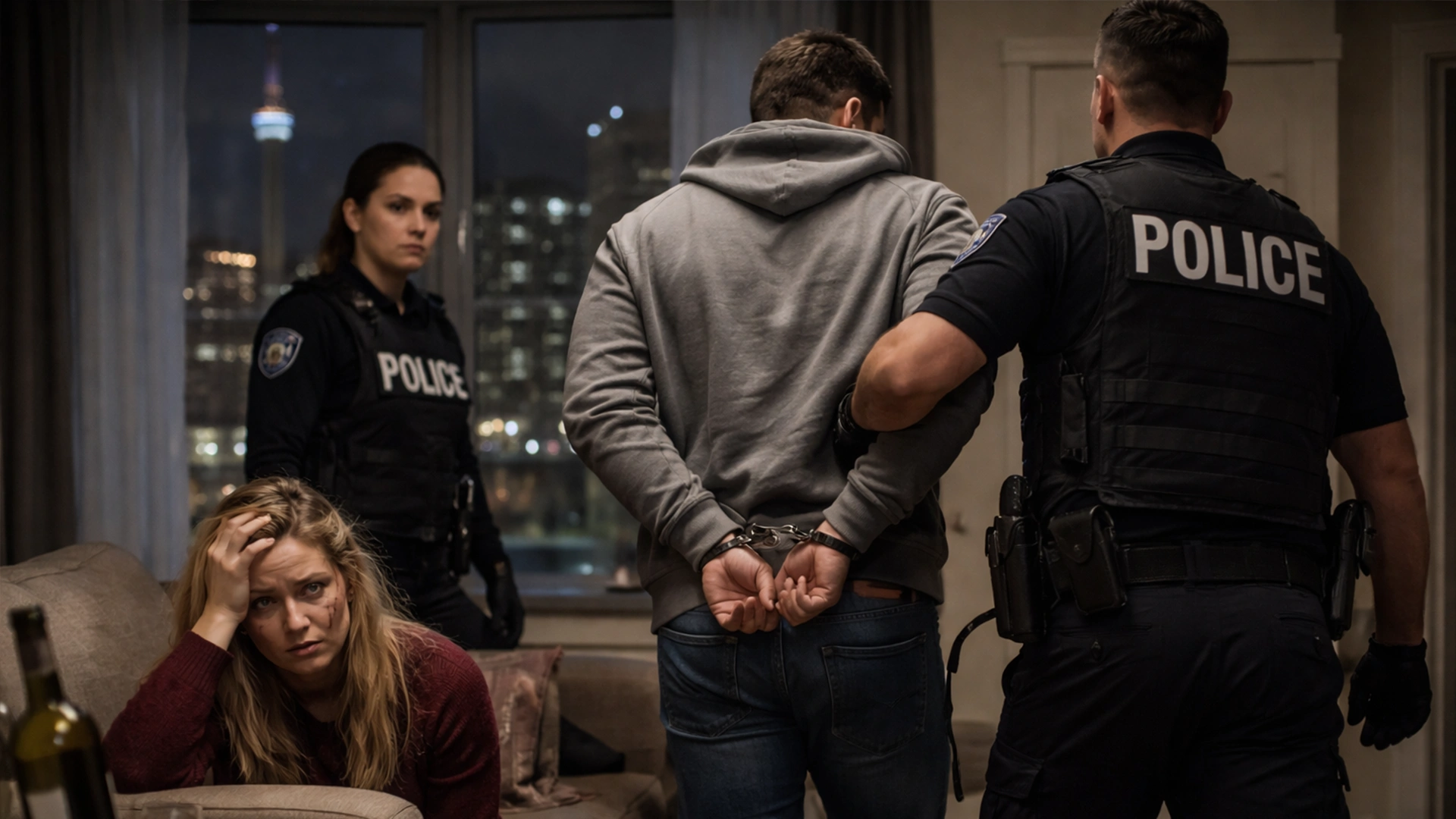
Accused of breaching bail on a domestic file in Toronto?
Call 647-588-3234 NowFree, confidential consultation. Offices in Toronto, Thornhill, North York and Oakville.
Results matter. See our recent case successes and read our client reviews on Google, then call 647-588-3234 for a free, confidential assessment of yours.
- The release order you are actually living under
- They contacted me first. Am I still in breach?
- What one allegation can set off
- What the Crown must prove on the breach
- Three reverse onus doors, kept straight
- The lawful ways back home
- Sureties in domestic files
- Toronto's Integrated Domestic Violence Court
- The s. 810.03 intimate partner peace bond
- When the allegation is a new incident
- How these files actually resolve
- The family court shadow
- Your first 48 hours
- Where this happens in Toronto
- Why Kazandji Law
- Frequently asked questions
The release order you are actually living under
Most Toronto domestic releases look alike. There is an undertaking signed at the station or a release order made at the Toronto Regional Bail Centre, and inside it a familiar stack of conditions: do not communicate, directly or indirectly, with the complainant. Do not attend within a stated distance of the home, the workplace, the school. Live at an approved address. Sometimes a surety stands behind all of it with pledged money.
The no-contact term comes straight from the Criminal Code. Section 515(4)(d) lets the court order an accused to abstain from communicating with any named person, and Toronto courts use it almost by default on intimate partner files. A parallel order under s. 515(12) can bar communication even while you sit in custody waiting for bail. These are not suggestions. Each condition is its own tripwire, and s. 145(5) makes breaching any one of them a criminal offence.
Two features of domestic conditions surprise people. First, they are broad on purpose. The court's first concern on an intimate partner file is safety, so the order removes grey zones: no calls, no texts, no messages passed through your kids or your cousin, no dropping by because it seemed harmless that day. Second, the order does not age. It stays exactly as written until a court changes it. Birthdays, anniversaries, a child's recital, a family emergency: none of that suspends it.
So read your paper carefully, keep a copy on your phone, and treat every line as enforceable. Toronto police do.
They contacted me first. Am I still in breach?
The order binds you, not them. If the complainant calls, texts, or invites you back home, your conditions still apply in full. A complainant cannot waive a court order, and a warm invitation is not a legal defence to answering it.
This single misunderstanding produces more domestic breach arrests than anything else we see. Couples reconcile while charges are pending. The complainant reaches out, the accused replies, a relative mentions it to someone, and now a s. 145(5) charge sits on top of the original file, with a revocation application aimed at the release itself.
What the law actually asks is whether you were at fault. In R. v. Zora, 2020 SCC 14, the Supreme Court of Canada held that breach of bail conditions requires subjective fault: the Crown must prove you breached knowingly or recklessly. An accident, an honest mix-up about what a varied order said, a condition that was genuinely impossible to follow that day, an ambiguous term: that is real defence terrain, and we argue it case by case.
But fault gets fought after an arrest. Prevention is better. If contact comes in, do not respond. Save the messages and the call logs, because they matter twice: they support your defence on fault, and they support a proper variation application by showing the complainant genuinely wants contact restored. Then have counsel pursue the change lawfully.
What one allegation can set off
On paper, failure to comply looks minor. Section 145(5) is a hybrid offence with a maximum of two years on indictment, small next to most charges it rides beside. In practice it is often the heaviest paper on the file, because one allegation sets four things moving at once.
- A new criminal charge. The breach is its own prosecution, with its own disclosure, its own court dates and its own record consequences if it sticks.
- A s. 524 revocation application. After a breach arrest, the prosecutor can ask the court to cancel your release. If the court finds you contravened your conditions, or finds reasonable grounds to believe you committed an indictable offence while on release, cancellation is mandatory. The section says the court shall cancel.
- A flipped burden. Once the release is cancelled, s. 524(4) orders detention unless you, after a reasonable opportunity to do so, show cause why custody is not justified under s. 515(10). The onus that once sat on the Crown now sits on you.
- Surety and family fallout. Pledged money is exposed, sureties lose confidence or ask to be relieved, and the underlying domestic file becomes harder to resolve well.
We cover the general breach machinery, including s. 524 hearings and re-release plans, on our Toronto failure to comply page. This page stays on the domestic lens, because intimate partner files add rules of their own. And if the original release order was never properly fought in the first place, our Toronto bail lawyers page explains first-instance release.
What the Crown must prove on the breach itself
A breach prosecution has more moving parts than people assume, and each one is a place the case can fail.
The Crown must prove there was a binding order in force, that it contained the condition alleged, that you knew about it in the form alleged, and that your act actually contravened it. Then comes the part R. v. Zora added in 2020: subjective fault. The Crown must prove you breached knowingly or recklessly. An honest, reasonable operating mistake is not a crime, and conditions themselves are supposed to be minimal and tailored to the individual, not boilerplate.
Domestic breach files raise their own recurring battlegrounds. Who actually sent the message from a shared account or an old logged-in device. Whether a varied order was ever communicated properly, so the accused was still following last month's version in good faith. Whether attendance at a place was covered by the condition as written or fell into an exception for counsel, court or child exchanges. Whether an indirect contact allegation, a message passed through a friend, was anything more than the friend's own idea. And on every branch, the words without lawful excuse sit on the face of the section.
None of this means breach charges are easy to beat. It means they are built from provable parts, and a defence that takes the parts seriously, with phone records, service records and the order's actual wording, often finds the gap.
Three reverse onus doors, kept straight
People use the phrase reverse onus loosely in domestic cases, as if being on bail by itself flips the burden. It does not. There are three separate doors, each with its own trigger, and knowing which one you are standing in changes how the hearing gets prepared.
| Provision | When it applies | What it changes |
|---|---|---|
| s. 515(6)(c) | You are charged under s. 145(2) to (5) with a breach alleged to have been committed while you were at large on release for another offence | You must show cause why your detention in custody is not justified |
| s. 515(6)(a)(i) | You are charged with an indictable offence alleged to have been committed while at large on release for another indictable offence | The same flip: release must be justified by you, not disproven by the Crown |
| s. 515(6)(b.1) | You are charged with an offence involving violence used, threatened or attempted against an intimate partner, and you have a previous conviction or s. 730 discharge for violence against an intimate partner | Reverse onus because of the prior finding, not because you were on bail |
The precision matters. A first-time accused with no record who allegedly breaches a no-contact term faces s. 515(6)(c) on the breach charge. Someone alleged to have committed a fresh indictable offence on release faces s. 515(6)(a)(i). The intimate partner provision in s. 515(6)(b.1) turns on a prior conviction or discharge for violence against an intimate partner, and on nothing else. Collapsing the three into one scary phrase leads to bad decisions, including consent detentions and guilty pleas that were never necessary.
Whichever door applies, the answer is the same discipline: a release plan the court can trust, built before the hearing rather than improvised inside it.
The lawful ways back home
There are exactly two legal routes back to your home, your partner or your children while conditions are in place. Both run through a court. Neither is a private arrangement.
Consent variation under s. 519.1. A release order made under s. 515 can be varied with the written consent of you, the prosecutor and any sureties, and the varied order is treated as a release order under s. 515. In practice, your lawyer puts a concrete proposal to the Toronto Crown: which condition should change, why the change is safe, and what supports exist around it. The Crown gathers the complainant's position, typically through victim services, before responding. When consent comes, the change is signed without a contested hearing.
Bail review under s. 520. When the Crown will not consent, you can apply to a judge of the Superior Court of Justice, in Toronto at 361 University Ave, to review the order. A review needs transcripts, affidavit evidence and a plan worth granting: address history, employment, sureties, counselling already underway, and a clear account of how contact or residence would work safely.
What never works is the quiet arrangement. Moving back in because you both agreed, deleting the texts, hoping nobody asks. The complainant cannot vary a court order, cannot consent you out of it, and cannot end the prosecution; in Ontario those decisions belong to the Crown. An informal reconciliation leaves you one argument away from a breach arrest inside your own house.
Timing is case by case. Consent variations can move quickly once the Crown finishes its consultation. Reviews take longer because transcripts and court dates are involved. Either way, the strongest applications are built early, on evidence, with the complainant's views gathered through proper channels rather than through you.
Sureties in domestic files
Most Toronto domestic releases involve a surety, often a parent or sibling who pledged money and promised the court to supervise. A breach allegation lands on them too.
The pledged amount is exposed through estreatment, a court process where forfeiture can be ordered after a hearing. It is not automatic, and sureties get to explain what they did to supervise. But the risk is real, and so is the relationship damage: a surety who loses confidence can apply to be relieved of the role, and if that happens you go back into custody until new bail is arranged.
Sureties also matter in the other direction. A credible surety with a workable address is frequently the difference between detention and release at a s. 524 hearing, and a strengthened surety plan is one of the most persuasive things counsel can put behind a variation application. Treat your surety as part of the defence team: keep them informed, follow the house rules they set, and never put them in the position of learning about contact from the police.
Toronto's Integrated Domestic Violence Court
Toronto has a court no other Canadian city has. The Integrated Domestic Violence Court, which first opened in 2011 at 311 Jarvis St, puts one judge in charge of both the criminal domestic charge and the related family law case. The Ontario Court of Justice describes it as the first and only court of its kind in Canada.
Eligibility is specific. The family case must be at the courthouse at 47 Sheppard Ave E or at 311 Jarvis St, and the criminal case at 10 Armoury St. The family matter must concern decision-making responsibility, parenting time, support or a restraining order. The criminal charge must be a summary conviction domestic violence charge, and the accused cannot be in jail. Divorce, property division and child protection cases stay outside the court.
On the criminal side, the IDVC hears bail variation applications, judicial pre-trials, guilty pleas and some trials. For a parent caught between a no-contact condition and a parenting schedule, that combination is the whole point. The judge deciding your bail variation is the same judge managing the parenting case, seeing the same family and hearing the same facts once instead of twice.
Admission is screened, and nobody can promise a file into the court. But when the eligibility lines fit, asking for the IDVC stream is often the smartest procedural move available, and it has to be raised deliberately rather than waited for.
The s. 810.03 intimate partner peace bond
Since April 8, 2025, the Criminal Code has carried a peace bond designed specifically for intimate partner cases. Under s. 810.03, anyone who fears on reasonable grounds that another person will commit an offence causing personal injury to their intimate partner or a child can lay an information before a provincial court judge. On some domestic files, entering this bond becomes the structured exit: a defined period under conditions instead of a continuing prosecution.
Its architecture is stricter than the general s. 810 recognizance. The standard term runs up to 12 months, but it stretches to 2 years where the defendant has a previous conviction for violence against an intimate partner or a partner's child. Refusing to enter a bond the court has ordered can mean committal to prison for up to 12 months. And where the informant or the defendant is Indigenous, the judge must consider recommending Indigenous support services instead of the recognizance.
The condition menu is long and modern: a court supervised treatment program, including addiction or domestic violence counselling; geographic limits; no-go terms; electronic monitoring where the Attorney General consents; abstention terms with bodily samples; and no-contact terms that can reach past the partner and children to the partner's relatives and close friends. The judge must also consider a firearms and weapons prohibition, and must give reasons on the record if one is not imposed.
Two more features matter for planning. Conditions can be varied on application, but where the defendant applies, the judge must first consult the informant and the protected person about their safety and security needs, under s. 810.03(11). And breach of the bond is prosecuted under s. 811, a hybrid offence carrying up to 4 years on indictment.
Where a peace bond is the right way out of a charge, the mechanics of that exchange live on our Toronto peace bond page. If someone has sworn a recognizance application against you and you intend to contest it, our Toronto 810 recognizance page covers the defended hearing.
When the allegation is a new incident, not a technicality
Sometimes the call to police is not about a text message. It is a fresh allegation: an assault, a threat, harassment. Now two prosecutions run side by side, and they cannot be defended in isolation.
The bail consequences arrive first. A new indictable allegation on release engages the same s. 524 cancellation machinery, plus the s. 515(6)(a)(i) reverse onus at any new bail hearing. The sentencing stakes climb too. If a court later convicts you of an offence involving abuse of an intimate partner, s. 718.2(a)(ii) makes that abuse an aggravating factor on sentence.
Defending the files together is not just tidier, it is necessary. The evidence overlaps, statements from one file surface in the other, and every resolution decision on one moves the other. Our Ontario domestic assault page goes deeper on defending the substantive charge itself.
How these files actually resolve
Domestic breach allegations end in a handful of recognizable ways, and knowing them early shapes every decision before them.
Where fault is thin, breach charges get withdrawn or folded into the resolution of the main file. A global resolution can deal with the breach and the domestic charge together, sometimes through a peace bond, sometimes through a plea structured to protect what matters most: your record, your work, your parenting time. Where the fault evidence is weak, trial remains a real option, because Zora put the burden of proving knowledge or recklessness squarely on the Crown. None of this is automatic and none of it can be promised, but almost all of it goes better when the s. 524 hearing was handled well at the start.
The family court shadow over every domestic release
Almost every client on this page is also a parent or a spouse with a family case running, filed or about to be filed. The two systems talk past each other, and people get hurt in the gap.
Here is the practical rule that prevents most of the damage: the criminal condition binds you regardless of what the family schedule says, until a court varies it. A parenting plan that assumes weekend exchanges does not soften a no-contact term. A separation agreement signed at a kitchen table does not authorize you to attend the house. If the two orders collide, the answer is a variation application, raised early, not a hopeful reading of the paperwork.
There are standard fixes, and Toronto courts see them daily. Conditions can be drafted or varied to allow communication through a third party or a parenting app solely about the children. Exchanges can run through a relative or a supervised access centre. Counsel-to-counsel channels stay open even when the parties cannot speak. And where the eligibility fits, the Integrated Domestic Violence Court puts one judge over both files so the carve-outs actually match the parenting order.
What we ask of clients is simple: tell your criminal lawyer everything happening in the family case, and make sure your family lawyer knows the exact wording of your release. When the two files are steered together, the conditions tend to shrink to what safety actually requires. When they are steered separately, one file keeps sabotaging the other.
One more thing worth saying plainly. If you are not a Canadian citizen, or you work in a licensed or vulnerable-sector job, say so at the first meeting. It changes which resolutions are safe for you, and it is far easier to plan for at the start than to repair at the end.
Your first 48 hours after a breach arrest
The first two days decide more than most people expect. Toronto bail moves fast by design, so preparation cannot wait for the courtroom.
- Do not respond to any further contact. Not to explain, not to apologize, not to say goodbye. Every reply becomes evidence.
- Preserve everything. Texts, call logs, voicemails, social media messages. They go to fault under Zora and to any later variation application.
- Line up sureties and an address. A parent, sibling or friend with stable housing and something to pledge, ready to be named, turns a weak plan into a winnable one.
- Write your timeline while it is fresh. Where you were, who saw you, which device sent what.
- Get counsel before the bail appearance, not after it. Under the Ontario Court of Justice practice direction in force since June 1, 2026, bail courts run on tight targets: consent releases are to be completed the same day within about 15 minutes, contested hearings within about 30, with video appearances the norm. Hearings that short are won by whoever arrives prepared.
Where all of this happens in Toronto
Adult bail and revocation matters in Toronto run through the Toronto Regional Bail Centre at 2201 Finch Ave W, where Courtroom 212 takes adult matters starting at 10 a.m. and appearances are video-enabled. The criminal charge itself is case-managed and tried at the consolidated courthouse at 10 Armoury St. Bail reviews under s. 520 go to the Superior Court of Justice at 361 University Ave. Families in the IDVC stream use the family courts at 311 Jarvis St or 47 Sheppard Ave E alongside the criminal court at 10 Armoury St.
Knowing the building matters less than knowing the rhythm inside it: how quickly duty counsel can be reached, whether your surety should attend in person or by video, and how fast a variation can be spoken to once the Crown has the complainant's position.
Why Kazandji Law
Domestic breach files sit at the intersection of criminal defence and family reality, and we treat them that way. We defend the breach and the underlying charge, run the s. 524 hearing with a plan the court can act on, pursue variations that reunite families lawfully, and keep one eye on the parenting case the entire time. It is precise work, and it is a core part of our Toronto criminal defence practice.
- Toronto (head office): 180 John St, Unit 320, minutes from the courthouses at 10 Armoury St and 361 University Ave.
- Thornhill: 7191 Yonge St, Suite 310, serving Markham and York Region clients.
- North York: convenient to the Toronto Regional Bail Centre at 2201 Finch Ave W.
- Oakville: serving Halton and the western GTA.
For province-wide context on these files outside Toronto, see our Ontario domestic misconduct while on bail page.
The revocation hearing is not the place to improvise.
Call 647-588-3234Free consultation. Evenings and weekends answered.
Frequently asked questions
What does domestic misconduct while on bail actually mean?
It is not a named Criminal Code offence. It describes breaching the conditions of a domestic release, usually no-contact or no-go terms, contrary to s. 145, or being accused of a new intimate partner offence while on release. Either allegation also puts your bail itself at risk under s. 524.
My partner wants the no-contact condition lifted. Can we just agree between us?
No. Only a court can change a release order, either through a written consent variation with the Crown and any sureties under s. 519.1 or through a bail review under s. 520. A private agreement changes nothing, and contact remains a criminal breach.
Can the complainant get the charges dropped?
No. In Ontario the Crown alone decides whether a domestic charge proceeds. A complainant who asks for the charges to be withdrawn does not end the prosecution, though their position is one factor the Crown considers.
They invited me over. Is that a defence?
The condition binds you no matter who initiates. The real legal issues are whether the Crown can prove you knowingly or recklessly breached, which is the fault standard from R. v. Zora, and whether the condition should be varied going forward.
What happens after a breach arrest?
The prosecutor can apply under s. 524 to cancel your release. If the court finds a breach, or reasonable grounds to believe you committed an indictable offence while on release, it must cancel, and you stay in custody unless you show cause for release under s. 515(10).
What is the reverse onus in domestic cases?
There are three separate ones. A breach charge alleged while on release triggers s. 515(6)(c). A new indictable offence on release triggers s. 515(6)(a)(i). And s. 515(6)(b.1) applies where an intimate partner violence charge meets a prior IPV conviction or discharge. Being on bail alone does not trigger the intimate partner provision.
How do I get back into my home?
Through a variation. Either the Crown consents in writing under s. 519.1 after consulting the complainant, or a Superior Court judge changes the order on a bail review under s. 520. Strong applications rest on a concrete plan: an address history, sureties, counselling underway, and the complainant’s position gathered through proper channels.
What is Toronto’s Integrated Domestic Violence Court?
A specialized Toronto court where one judge hears both the criminal domestic charge and the related family case involving parenting, support or a restraining order. It requires a summary conviction domestic charge at 10 Armoury St, a family case at 311 Jarvis St or 47 Sheppard Ave E, and an accused who is not in custody. It also hears bail variation applications.
What is the s. 810.03 peace bond?
An intimate partner specific recognizance in force since April 8, 2025. It runs up to 12 months, or up to 2 years with a prior conviction for intimate partner violence, and its conditions can include treatment programs, electronic monitoring with the Attorney General’s consent, and no contact with the partner, children and even the partner’s relatives or close friends. Refusing to enter an ordered bond can mean up to 12 months in prison.
If I apply to vary a s. 810.03 bond, does my partner get a say?
Yes. Before varying conditions on a defendant’s application, the judge must consult the informant and the protected person about their safety and security needs under s. 810.03(11).
What are the penalties if I am convicted?
Breach of release conditions under s. 145 is a hybrid offence with a maximum of 2 years on indictment. Breach of a peace bond under s. 811 carries up to 4 years. And on any new conviction for an offence involving abuse of an intimate partner, that abuse is an aggravating factor at sentencing under s. 718.2(a)(ii).
Where will I appear in Toronto?
Bail and revocation matters run through the Toronto Regional Bail Centre at 2201 Finch Ave W, with video-enabled appearances. The criminal file proceeds at 10 Armoury St, Superior Court bail reviews at 361 University Ave, and eligible families use the Integrated Domestic Violence Court stream.
If your matter is before the York Region courts instead, here is the same charge handled in Markham.
This page is legal information for Toronto and Ontario readers, not legal advice about your case. The law changes and outcomes turn on facts. For advice on a domestic breach allegation, speak with a lawyer. Kazandji Law, 180 John St, Unit 320, Toronto, ON. 647-588-3234.