

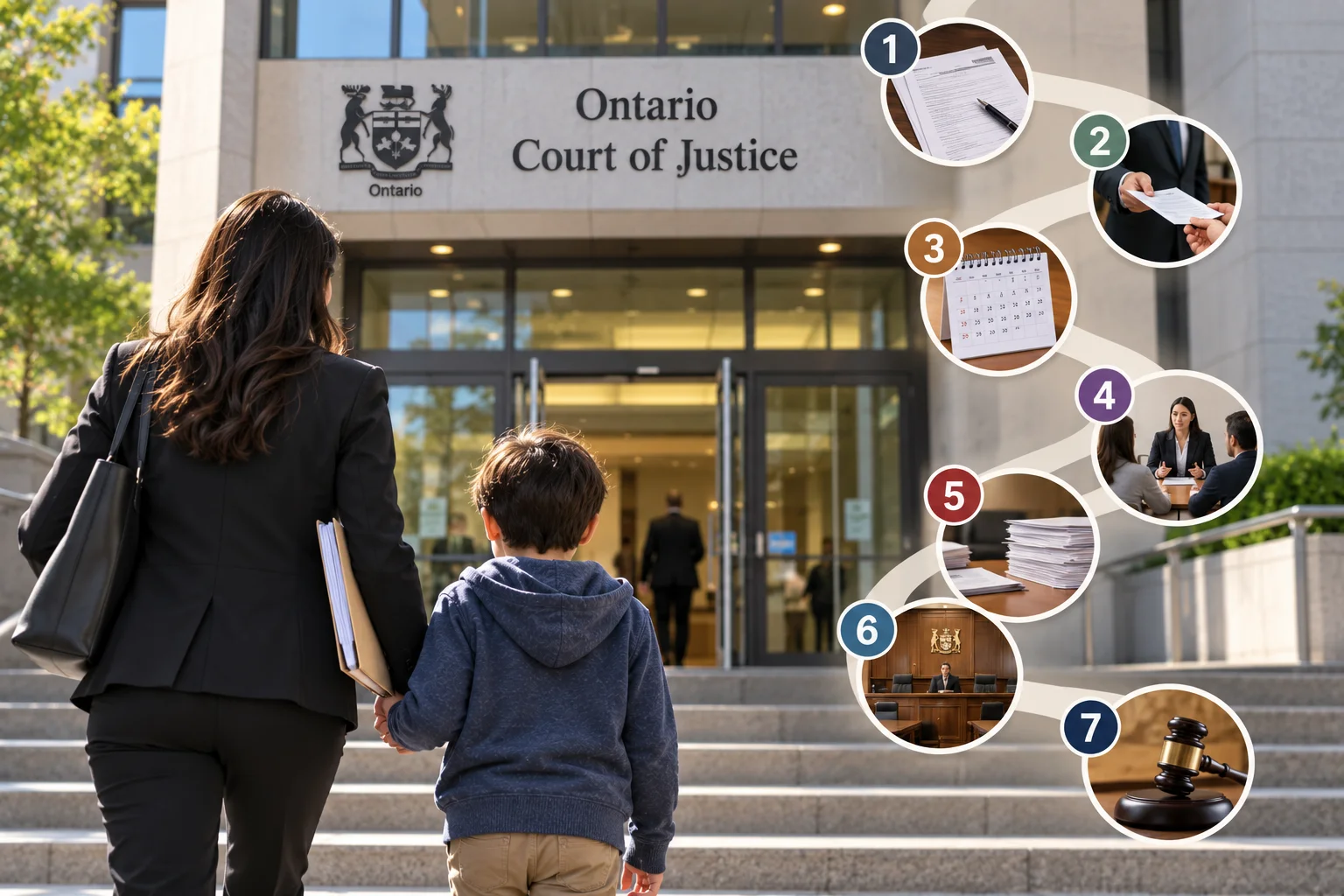

An Ontario family court case usually begins when the applicant prepares the correct application and supporting documents, has the court issue them, serves the other party, and files proof of service. This guide explains how a family court case starts in Ontario, what happens immediately afterward, and where early mistakes can affect the case.
The exact route depends on what you need the court to decide. A divorce or property claim does not always go to the same level of court as a parenting or support claim. Before filing for family court, identify every order you may need, choose the court with authority to make those orders, and make sure your forms tell one clear and accurate story.
Does Your Dispute Need Court
Not every separation has to become a court case. If both people can negotiate safely and exchange the information needed to make informed decisions, they may resolve parenting, support, or property issues in a separation agreement or consent order.
Family mediation can also help people work toward an agreement with a neutral mediator. It may reduce conflict and cost, but it is not suitable for every family. A history of violence, intimidation, hidden assets, urgent safety concerns, or a refusal to provide financial disclosure may make direct negotiation difficult or unsafe.
Court may be needed when one person will not respond, an enforceable order is required, a child may be at risk, property could disappear, or the parties cannot settle a central issue. Starting a case does not prevent settlement. Ontario’s family court procedure guide confirms that parties may continue trying to resolve issues while the case is underway.
Which Ontario Court Should You Use
The right court depends on both location and subject matter. Filing in a court that cannot grant the requested order can waste time and create added expense.
Ontario has three family court settings:
- The Ontario Court of Justice hears parenting, child support, spousal support, child protection, and adoption matters. It cannot grant a divorce or decide family property claims.
- The Superior Court of Justice can decide divorce, family property, and matrimonial home claims. It also hears parenting, support, and urgent safety matters.
- The Family Court Branch of the Superior Court of Justice is a unified family court. At its 25 locations, it can address all family law matters within one court.
The Superior Court of Justice explains this division of authority and lists the issues heard in each court. Existing court files, earlier orders, where the parties live, and where a child ordinarily lives may also affect where a new application belongs. Check the correct courthouse before preparing the caption on every form.
In practical terms, how a family court case starts in Ontario depends first on this jurisdiction choice. If your claims include divorce or property, the Ontario Court of Justice is not an option. If all claims concern parenting and support, more than one court may have authority, but only the correct local court should receive the case.
What Forms Start The Case
Most new contested family cases begin with Form 8, Application General. A simple or joint divorce uses Form 8A, Application Divorce. The current versions appear on Ontario’s official Family Law Rules Forms page.
A clear understanding of how a family court case starts in Ontario includes knowing that an application rarely stands alone. The orders requested determine which supporting documents must go with it. Common starting documents include:
- Form 8 for parenting, support, property, restraining order, or combined claims
- Form 8A when the case is a divorce application
- Form 35.1 when a party asks for decision-making responsibility, parenting time, or contact with a child
- Form 13 for support claims that do not include property claims
- Form 13.1 for property claims, or property and support claims together
- Form 13A to confirm the financial documents provided to the other party
- A Continuing Record and table of contents when required for the filing method and court
The government’s steps for filing an application explain which forms usually accompany each type of claim. Use the latest form version. An old form may be rejected even if the information in it is correct.
What Goes Into The Application
The application tells the other party and the court what orders you want and the material facts supporting those requests. It is not the place to copy every text message or recount every disagreement in the relationship.
A useful application should identify:
- The parties, children, relationship dates, and any earlier cases, agreements, or orders
- Each order requested, such as decision-making responsibility, parenting time, child support, spousal support, equalization, or exclusive possession of the matrimonial home
- The important facts connected to each claim
- Any immediate safety concern in clear, specific language
- The legal basis for the relief where the form requires it
Accuracy matters. Dates, income figures, addresses, and the wording of existing orders should be checked against source documents. If the case involves children, the requested parenting plan should be workable and tied to their best interests. If money or property is disputed, financial disclosure should be complete enough for the other person to understand the claim.
For background on the underlying issues, Kazandji Law’s Ontario family law page explains the main claim types. Separate guides cover divorce in Ontario, parenting time and decision-making, and property division.
How The Court Issues Your Case
Issuing the application gives the case its court file number and official start. Court staff review the documents for filing requirements, sign and seal the application, and may provide a first appearance date and notices for the Mandatory Information Program where those steps apply.
Court staff do not decide whether the claims are strong, and they cannot give legal advice. Acceptance for filing means the documents met the clerk’s procedural review. It does not mean a judge accepted the facts or agreed with the requested orders.
Ontario permits many family documents to be filed online or in person. The correct online route now depends on location. The Ontario Court of Justice filing guide states that Toronto family filings for 47 Sheppard Avenue East and 311 Jarvis Street use the Ontario Courts Public Portal. Other regions use Family Submissions Online, also called Justice Services Online. A document should be submitted through one filing method only.
Fees may apply in the Superior Court of Justice or its Family Court Branch. A person who cannot afford them may qualify for a fee waiver. Confirm the current fee and filing instructions before submission rather than relying on an older checklist.
How Service Makes The Case Active
After issue, the applicant must give the other party the issued application and required supporting documents through special service. Service is part of how a family court case starts in Ontario because it gives the respondent formal notice and a fair chance to answer.
The applicant cannot personally serve the application. Under Ontario’s official service guide, special service may be completed by an adult friend or family member, a professional process server, a lawyer who accepts service in writing, or another permitted method. Mailing with Form 6, Acknowledgment of Service, is possible only when the signed acknowledgment is returned.
The person who served the documents completes Form 6B, Affidavit of Service. That form records what was served, on whom, when, where, and how. It must be sworn or affirmed and then filed with the court as proof of service.
Do not improvise service when the other party is avoiding contact, lives outside Canada, or may become violent. International service may engage the Hague Service Convention. Safety concerns may support a request for court-arranged service or another method. Legal advice at this stage can prevent a later argument that the respondent did not receive proper notice.
What The Respondent Must Do
The respondent normally answers by serving and filing Form 10. Ignoring the application does not stop the case and may allow the applicant to ask the court to proceed without the respondent’s evidence.
Ontario’s family court deadline guide sets these response periods:
- 30 calendar days after service if the respondent was served in Canada or the United States
- 60 calendar days after service if the respondent was served elsewhere
- 10 calendar days for the applicant to serve and file Form 10A, Reply, after receiving an answer that raises new claims
The answer should state what the respondent agrees with, what is disputed, and any orders the respondent wants. If support or property is claimed, the respondent may also need a financial statement and supporting disclosure. A late response may require the court’s permission, so the date and method of service should be recorded immediately.
What The Information Program Covers
The Mandatory Information Program gives separating spouses and parents basic information about the court process, the effect of separation on families, dispute resolution options, and available services. It is education, not mediation, legal advice, or a hearing.
Under Rule 8.1 of the Family Law Rules, each party in a covered case must attend within 45 days after the case starts unless an exception applies. Ontario’s required steps in family court states that a session is generally one hour for people without children and two hours for people with children. Sessions may be online or connected to the courthouse.
Common exceptions include cases proceeding on consent, claims only for divorce or costs, a request to put an agreement or prior order into a court order, and people who have already attended a program. A judge may also grant an exception because of urgency, hardship, or another reason in the interests of justice.
After attending, the participant receives a certificate or other confirmation. It should be filed promptly. Except for limited steps, a party who must attend generally cannot move the case forward until the attendance certificate is filed.
What Happens At The First Date
The first scheduled event is usually procedural, not a trial. What happens depends on the court and the claims in the application.
At the Ontario Court of Justice, and at many Family Court Branch cases that do not include divorce or property, the first appearance is commonly an administrative meeting with a clerk. The clerk checks whether documents were served and filed, identifies missing material, and may schedule the case conference.
Cases in the regular Superior Court of Justice do not have that same first appearance. A party generally has to ask the court to schedule a case conference. A Family Court Branch case that includes divorce or property may also move directly toward a conference rather than an administrative first appearance.
The case conference is often the first time the parties speak with a judge about the disputed issues. Its purposes include exploring settlement, identifying what remains disputed, checking disclosure, and setting the next steps. A conference is not usually a final trial, but a judge can make procedural orders and orders based on consent.
Can You Seek An Urgent Order
Urgent relief may be available before the usual conference sequence, but urgency must be supported by facts and evidence. Filing an application does not automatically produce a temporary parenting, support, protection, or property order.
As a general rule, a motion for a temporary order follows a case conference. Rule 14 of the Family Law Rules allows an earlier motion when the court finds urgency, hardship, or another reason that makes a conference unnecessary in the interests of justice. A motion without notice is reserved for circumstances in which giving advance notice would probably have serious consequences or notice is otherwise not required by law.
Immediate danger calls for immediate safety action. Call 911 if someone is at risk. For a family court request, preserve messages, photographs, police occurrence information, medical records, financial records, or other reliable material that supports the urgency. Do not exaggerate. A focused affidavit with dates and concrete events is more useful than broad accusations.
Mistakes That Delay A New Case
Most early delays come from a mismatch between the requested order, the chosen court, and the forms filed. A rejected submission can be corrected, but lost time may be serious when parenting, housing, support, or safety is unsettled.
Watch for these problems:
- Filing in the wrong level of court, especially when the case includes divorce or property.
- Using an outdated form or leaving required sections blank.
- Asking for an order in the facts but failing to select it in the claims section.
- Filing a parenting claim without Form 35.1.
- Filing a support or property claim without the correct financial statement and disclosure.
- Serving the application personally instead of arranging special service.
- Missing the respondent’s answer deadline or the applicant’s reply deadline.
- Treating the first appearance or case conference as if it were a full trial.
- Sending emotional messages that may later become evidence.
- Assuming an urgent request will be heard without specific proof of urgency.
Good preparation does not mean making the application longer. It means requesting the right relief, giving the facts needed to support it, and following the service and filing rules in the correct order.
What To Gather Before Filing
Before preparing forms, collect the records that establish dates, income, assets, debts, existing arrangements, and the children’s needs. This makes the application more accurate and helps a lawyer identify missing information early.
Depending on the claims, useful records may include:
- Marriage certificate, separation agreement, domestic contract, and earlier court orders
- Recent income tax returns, notices of assessment, pay records, and proof of benefits
- Bank, investment, pension, mortgage, loan, and credit card statements
- Property valuations and records showing assets or debts at marriage and separation
- A proposed parenting schedule based on school, childcare, health, and travel needs
- A dated record of significant parenting or safety events
- Current addresses for service and information about any international residence
- The application, answer, or notice already received if another person started the case
Do not alter screenshots, delete difficult messages, or coach a child about what to say. Preserve original records and keep court documents in one organized folder. If there is a deadline, tell your lawyer the service date and next court date at the beginning of the conversation.
Questions About How A Family Court Case Starts In Ontario
These answers cover the first procedural questions people commonly ask. The correct forms and court still depend on the orders needed and the facts of the family.
What Is The First Step In Ontario Family Court
The first legal step is identifying the orders you need and the court authorized to make them. After that, how a family court case starts in Ontario usually involves completing Form 8 or Form 8A with all required supporting documents, having the court issue the application, arranging special service, and filing proof of service.
Which Form Starts A Family Court Case
Form 8, Application General, starts most parenting, support, property, and combined family claims. Form 8A is used for a divorce application. Other forms may be mandatory, including Form 35.1 for parenting claims and Form 13 or 13.1 for financial claims. The requested orders, not personal preference, determine the correct package.
How Long Does A Respondent Have To Answer
A respondent served in Canada or the United States normally has 30 calendar days to serve and file Form 10, Answer. A respondent served elsewhere normally has 60 calendar days. The deadline runs from the effective date of service, which can vary by service method. Get advice quickly if the time has passed.
Is The Mandatory Information Program Always Required
No. The program applies to many contested parenting, support, property, and restraining order cases, but there are exceptions. Parties proceeding on consent, people seeking only a divorce or costs, and people who already attended may be exempt. A judge can also excuse attendance for urgency, hardship, or another reason in the interests of justice.
Can I Bring A Motion Right Away
Usually, the parties must first attend a case conference dealing with the main issues. The court may hear an earlier motion when there is urgency, hardship, or another reason a conference is unnecessary in the interests of justice. A request without notice faces a higher threshold and requires careful evidence about why advance warning is unsafe or impractical.
Get Advice Before The First Filing
Kazandji Law can identify the correct court, review the orders you may need, prepare or assess the starting documents, and explain what should happen after service. If you need help with how a family court case starts in Ontario, early advice can prevent a filing problem from becoming a strategic problem later.
Call the Toronto office at 647-588-3234 or the Thornhill office at 647-697-5975. You can also use the Kazandji Law contact page to request a consultation. Keep any documents you received nearby when you call, especially the application, proof of service, an existing order, and the next court date. The first conversation is confidential.