

Markham Marijuana Drug Offence Lawyer
Home › Markham Criminal Defence › Marijuana Charges
Cannabis is legal in Markham inside three numbers and two absolutes. Thirty grams in public. Nineteen years old. Four plants per home. Never across the border, and never into or out of the illicit market. Step past any one of those lines and the Cannabis Act stops acting like a licensing statute and starts acting like a criminal one, with counts that reach 14 years. This page walks the lines in the order police actually enforce them.
Charged under the Cannabis Act in Markham? The lines are precise. So is the defence.
Call 647-588-3234Free consultation. Available 24 hours a day, 7 days a week. Offices in Thornhill, Toronto, North York and Oakville.
- The statute nobody reads until they are charged
- Number one: 30 grams
- Number two: 19 years old
- Number three: four plants
- Absolute one: the border
- Absolute two: the illicit market
- The 200 dollar ticket lane
- Ontario's rulebook
- If a night goes wrong
- The York process
- Your record: the outcome ladder
- Your first moves after a charge
- Why Kazandji Law
- FAQ
- Sentencing on a cannabis count
- Landlords, condos and the four plants
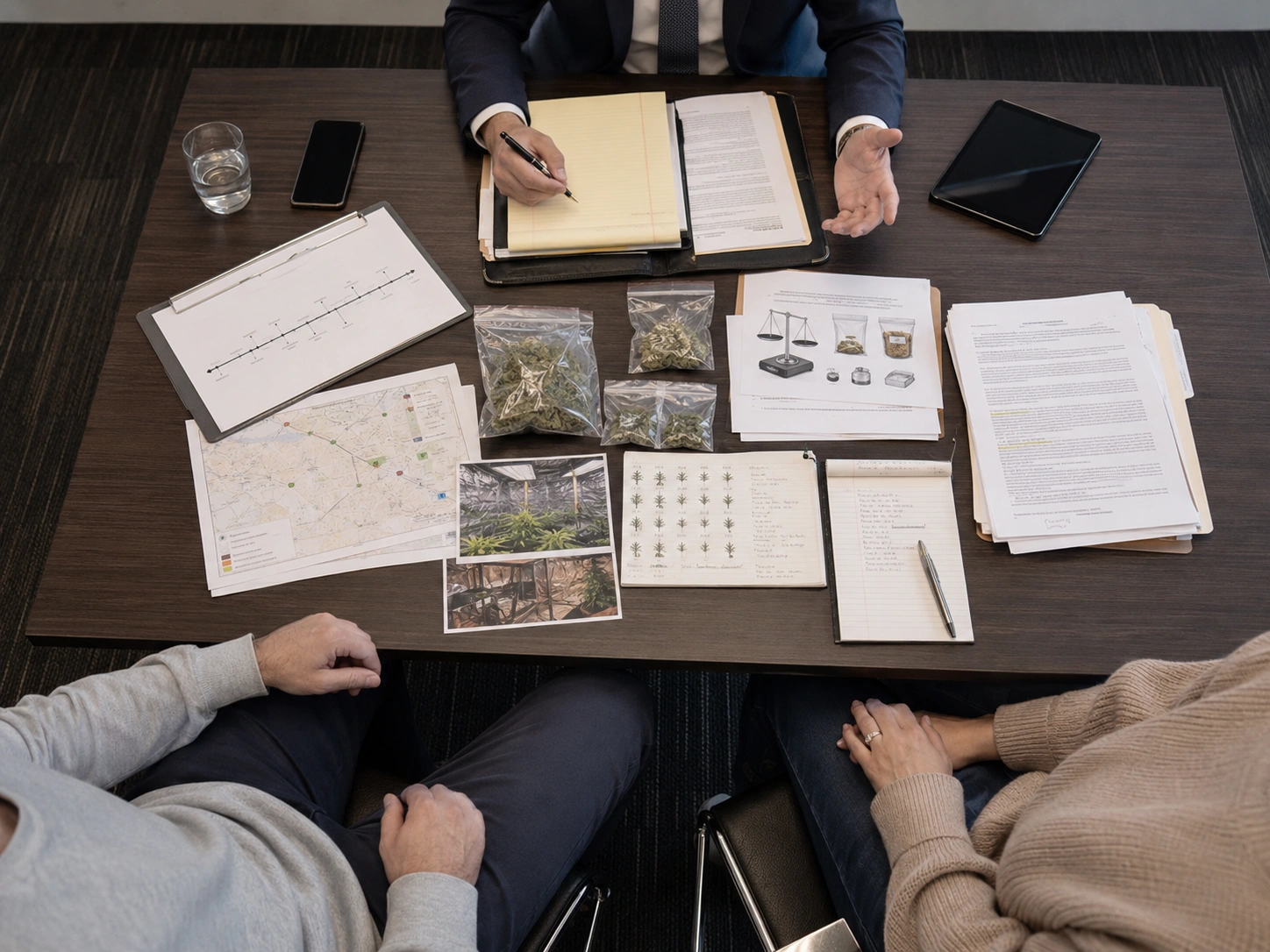
The statute nobody reads until they are charged
Legalization arrived on October 17, 2018 with a criminal statute attached. The Cannabis Act did not simply permit cannabis. It built a wall of offences around the legal market and handed police a parallel ticket lane for the small stuff. Its counts are not CDSA charges, and no cannabis case is CDSA trafficking, whatever was said at the roadside. What the Cannabis Act shares with the older drug law is consequence: the serious counts are criminal offences with maximums up to 14 years, they surface on record checks, and they end up in the same Newmarket courtroom building as every other Markham criminal charge.
So read your paperwork first. If it cites the Controlled Drugs and Substances Act, you are in a different world, and our Markham drug offence guide is the front door to it; if the count is CDSA section 5, go straight to the Markham drug trafficking guide. If your paperwork cites the Cannabis Act, keep reading. This is your statute, and it is more precise, and more dangerous at its edges, than most people who use cannabis ever suspect.
Number one: 30 grams, and where you are standing when you carry it
An adult may possess up to 30 grams of dried cannabis, or its equivalent, in a public place. Both halves of that sentence carry weight. The cap is measured in dried-cannabis equivalents, so different products convert at different rates. And a public place includes a vehicle in public view, which is how a routine Highway 7 traffic stop turns into a possession file when the console holds more product than the law allows.
| One gram of dried cannabis equals | Amount |
|---|---|
| Fresh cannabis | 5 grams |
| Edible products | 15 grams |
| Liquid products | 70 grams |
| Concentrates, solid or liquid | 0.25 grams |
| Seeds | 1 seed |
Carrying more than 30 grams equivalent in public is a hybrid offence with a ceiling of 5 years less a day. The same section holds a sharper edge: knowingly possessing illicit cannabis, product sourced outside the legal system, is an offence at any amount. Ten legally purchased grams are fine. The same ten grams from an unlicensed seller, if the Crown can prove you knew where they came from, are a criminal count. For small over-limit amounts, up to 50 grams equivalent, police can choose a ticket instead of a charge, and the ticket lane gets its own section below.
Number two: 19 in Ontario, and the harder federal line at 18
Ontario sets 19 as the age to buy, possess, use or grow cannabis. The federal Act draws its own line at 18, and everything involving minors is where cannabis law bites hardest. Distributing or selling cannabis to a person under 18 is an indictable offence with a 14 year maximum, and even the summary route carries a fine of up to 15,000 dollars and 18 months. An honest belief the person was older helps only if you took reasonable steps to confirm age. In practice that means checking identification, not guessing from a beard and a confident manner.
Using a young person to commit a cannabis offence is a separate 14 year count of its own. Young people themselves sit in a different lane entirely: a person aged 12 to 17 commits the federal possession offence only above 5 grams equivalent, and their cases run under the Youth Criminal Justice Act with its stronger diversion options. Ontario adds a Youth Cannabis Diversion Program for provincial cannabis offences committed by people aged 12 to 18. If you are a parent reading this because of a phone call from a school or from York Regional Police, the youth lane has its own rules and its own opportunities, and it rewards early legal advice.
Number three: four plants, one household
Adults may grow up to four cannabis plants at their own residence, from legal starting material. The cap belongs to the home, not the person. Three adults sharing a house in Cornell still share four plants, and the law counts the yard and the outbuildings as part of the dwelling, so the greenhouse behind the garage is inside the count. Growing anywhere that is not your own home is prohibited. So is cultivating from seed or plant material you know is illicit. Five or six plants can be dealt with by ticket at police discretion. Beyond that, over-cap growing is a criminal offence with a 14 year ceiling.
That is the whole rulebook at this page's altitude, on purpose. Grow investigations, the solvent extraction offence that makes butane hash oil its own 14 year count, and the premises questions that decide who answers for what was growing in a shared house all live in our Markham production and cultivation guide. The equipment side, where the Cannabis Act makes it an offence to possess or sell anything intended for producing or distributing illicit cannabis, is mapped in our drug paraphernalia guide.
Absolute one: cannabis never crosses the border
Section 11 of the Cannabis Act prohibits importing or exporting cannabis, in any amount, in either direction, unless you hold one of the rare federal authorizations. The maximum is 14 years. Legality on the other side of the line is irrelevant. Product bought lawfully at an Ontario store becomes a serious criminal allegation in the security queue at Pearson, edibles in a carry-on included, and the offence works the same way coming home. Possessing cannabis for the purpose of exporting it is charged under the same section, so the count can arrive before anything ever leaves the country.
Cross-border files have their own machinery, intercepted parcels, joint-forces investigations and, for non-cannabis substances, the heaviest ceilings in the CDSA. Our Markham import and export guide covers that terrain, including how a package intercepted upstream becomes a knock at a Markham door.
Absolute two: stay out of the illicit market
The Act protects its legal market with two 14 year offences. Distribution, under section 9, covers passing cannabis along without a sale. It turns criminal when the amount tops 30 grams equivalent, when the recipient is under 18 or an organization, or when you know the cannabis is illicit. Selling, under section 10, covers any unauthorized sale, and it stretches to substances represented or held out to be cannabis, so selling fake product is still the full offence. Possessing cannabis for the purpose of distributing or selling is charged the same way as the completed act.
Passing a joint to an adult friend, legal product, inside the limits, is lawful. Fronting a few ounces from an unlicensed source to a contact is a 14 year indictable count. Most Markham cannabis prosecutions live somewhere in the distance between those two sentences, and the elements that separate them, knowledge, amount and intent, are exactly the things a defence can test. The Crown does not get to round up.
The 200 dollar ticket: when police can skip the criminal charge
For the small stuff, the Act gives police a choice. Adults caught in the minor branches, possession or distribution up to 50 grams equivalent, five or six plants, one or two plants over the household cap, can be handed a ticket instead of a criminal charge. The ticket is 200 dollars plus the surcharge, and it exists precisely so that minor cannabis slips do not have to become criminal prosecutions.
Payment does something unusual in Canadian law: it is deemed a complete and absolute discharge. A finding of guilt is entered, but the record must not be used in any way that would identify you as a person dealt with under the Act. If you contest the ticket and lose, the fine is capped at 200 dollars and no probation can be attached. Two cautions belong beside that good news. First, the ticket is police discretion, not a right you can demand, and officers who see aggravating context will lay the charge instead. Second, if you are not a Canadian citizen, or your work takes you across the US border, get advice before paying anything. Even a deemed discharge deserves ten minutes of thought when status or travel is in play.
Ontario's rulebook on top of the federal Act
The province layers its own rules over the federal statute, and York Regional Police enforce both. Nineteen to buy, use, possess or grow. Legal supply through the Ontario Cannabis Store and licensed retailers. No smoking or vaping in enclosed public places or workplaces, on school property or within 20 metres of it, near playgrounds, or in vehicles and boats that are being driven. Landlords and condo boards can layer private restrictions on top of all of it.
Provincial infractions are tickets rather than crimes, but they stack. A single evening can produce a provincial consumption ticket and a federal possession count from the same stop. When we review a cannabis file we sort that pile first, because the criminal count sets the stakes and the provincial paper is usually noise around it. Do not pay anything, provincial or federal, before you know which documents are which.
One Markham-specific habit worth building: treat the car as a public place, because the law does. The corridors people drive every day, Highway 7, Warden Avenue, the routes past Markville and through Milliken, are where most of these files start, and product that is perfectly lawful on a kitchen counter becomes a criminal count when it is over-limit or illicit in a vehicle in public view. Keep purchases sealed and labelled, keep the receipts, keep quantities under the cap when moving product between homes, and never consume in a vehicle that is being driven. Ten seconds of habit removes most of the roadside risk this page describes.
If a night goes wrong: the 911 exemption, then the defences
The Cannabis Act has its own Good Samaritan rule. Under section 8.1, a person who seeks emergency medical or police help during a medical emergency, and everyone at the scene when help arrives, cannot be charged or convicted of the simple possession offence based on evidence obtained because help was sought, with matching protection for related condition breaches. Call 911 first. The statute is written so you can.
Past emergencies, cannabis defences run on the statute's own precision. Was the amount actually over the cap once the equivalencies were properly converted? Can the Crown prove you knew the cannabis was illicit, which is the element that decides most possession-of-illicit files? Were reasonable steps taken on age? Were the stop, the search and the questioning Charter-compliant, because exclusion of the evidence ends a cannabis file exactly the way it ends a CDSA file? A cannabis count is built from measurable elements. Measured things can be re-measured, and we do.
The York process: one building, ordinary bail, a federal or provincial Crown
Criminal cannabis counts for Markham proceed at the Newmarket courthouse, 50 Eagle Street West, the criminal court location for all of York Region. Bail follows the ordinary rule, the Crown must justify detention, because no Cannabis Act count triggers a reverse onus. Prosecution can be federal or provincial. Youth files run in the Youth Criminal Justice Act lane with its own protections and its own diversion paths.
The building is the same one that hears the region's CDSA files, and the defence disciplines transfer directly: disclosure pressure, element-by-element proof problems, Charter litigation, and resolution engineering where the record is the real concern. If your situation also involves driving, cannabis behind the wheel is its own regime with its own timelines, covered in our Markham drug DUI guide. If your charge arose in Toronto rather than York Region, our Toronto marijuana drug offence guide covers the city's version of these files. And for the wider practice, from possession to commercial allegations, our Ontario drug trafficking lawyers page shows how we run drug files across the province.
What a cannabis file does to your record, and what it does not
Outcomes in cannabis files sit on a ladder, and every rung reads differently afterward. A paid ticket under the Act is deemed a complete and absolute discharge, and the record of it must not be used in a way that identifies you as someone dealt with under the Act. Withdrawn counts and completed diversion leave no conviction at all. Discharges resolve a charge without a conviction record, though they remain visible for a period on some checks. A conviction on a serious cannabis count sits at the top of the ladder and behaves like any criminal conviction: it surfaces on record checks, complicates licensing and travel, and stays there until it is dealt with.
Youth records live behind the Youth Criminal Justice Act and its strict access rules, which is one of several reasons the youth lane needs its own advice. Non-citizens need tailored advice before accepting any outcome at all, because immigration law reads criminal dispositions through its own lens, and a resolution that looks sensible in a courtroom can read very differently inside a permanent residence application or at a port of entry.
None of that is cause for panic. It is cause to pick the target outcome early, before the first Crown conversation, and to negotiate toward the rung of the ladder that protects what you actually need protected. That is how we run every cannabis file, from the 200 dollar ticket that should stay a ticket to the indictable count that needs to become something smaller.
Your first moves after a Cannabis Act charge in Markham
Start by sorting the paper. A single stop can generate a federal criminal count, a Cannabis Act ticket and a provincial consumption ticket, and they are not the same thing, do not carry the same consequences, and should not be paid or answered the same way. Photograph everything you were handed and bring all of it to the first consultation. Paying the wrong document early can close doors the defence needed open.
Then preserve what helps you. Receipts and order histories from legal retailers speak directly to the illicit-cannabis element. Packaging matters, because legal product is stamped and labelled. If age is in issue, the identification you checked and the messages around the exchange matter. If the stop is in issue, write down everything you remember about it the same week: where you were, what was said, when you were told why you were stopped, and when you were allowed to call a lawyer.
Say nothing substantive to investigators in the meantime. The right to silence does not pause because the substance involved is sold legally at a store up the street. Explanations offered at the roadside have a way of becoming the Crown's best exhibit, and the time to tell your story, if telling it ever helps, is after we have read theirs.
Then let the process work. Disclosure arrives, the equivalency math gets re-done properly, the elements get mapped against the actual evidence, and the file usually shows its weak point within the first two months. Cannabis counts are precise, and precision cuts both ways. The Crown must prove every element to a criminal standard, and a case that began as a roadside impression often looks very different once it has to survive that standard in front of a judge.
Why Markham cannabis files come to Kazandji Law
Most cannabis clients are not career anything. They are students, employees, parents and business owners who stepped over a line most people do not know exists, and the job is protecting a record, a job, a licence or an immigration status from a statute with 14 year ceilings. We treat cannabis counts with CDSA-level seriousness because the consequences deserve it, and because the prosecutors across the aisle certainly do.
Kazandji Law runs four offices. The Thornhill office at 7191 Yonge Street, Suite 310 sits minutes up Yonge Street from Markham's west side and anchors our York Region work. The Toronto head office is at 180 John Street, Unit 320, with North York and Oakville offices completing the GTA coverage. Wherever we first meet, the file gets built for the courtroom it will actually be argued in.
Results matter. See our recent case successes and read our client reviews on Google, then call 647-588-3234 for a free, confidential assessment of yours.
A cannabis charge is still a criminal charge. Treat it like one before it treats you like one.
Call 647-588-3234Free, confidential consultation with a Markham cannabis charges lawyer. Nights and weekends available.
Markham cannabis charge FAQ
Cannabis is legal. Why am I facing a criminal charge in Markham?
Because legalization has edges built from numbers: 30 grams in public, age limits, four plants per household, no border crossings and no unlicensed market. Anything past those lines is still a criminal offence under the Cannabis Act, and the serious counts carry up to 14 years.
How much cannabis can I carry in public?
Up to 30 grams of dried cannabis or its equivalent. One gram of dried equals 5 grams of fresh cannabis, 15 grams of edibles, 70 grams of liquid product, 0.25 grams of concentrate, or one seed. A car on Highway 7 counts as a public place when it is in public view.
What happens if I had more than 30 grams?
Over-limit public possession is a hybrid offence with a maximum of 5 years less a day. For small amounts up to 50 grams equivalent, police have the option of a 200 dollar ticket instead of a criminal charge. It is their choice, not yours.
Should I just pay the cannabis ticket?
Payment ends the case and the law deems it an absolute discharge whose record cannot be used to identify you as someone dealt with under the Act. That is usually far better than a conviction, but get advice first if you are not a citizen or you cross the US border for work.
Is passing a joint to a friend illegal?
Adult to adult, with legal cannabis, inside the limits, no. It becomes a 14-year offence when the distribution involves more than 30 grams equivalent, an organization, cannabis you know is illicit, or anyone under 18.
What if I honestly thought the person was of age?
For counts involving someone under 18, an honest belief only helps if you took reasonable steps to confirm age. Checking identification is the difference. The same rule applies to possession for the purpose of selling or distributing to a minor.
My teenager was caught with cannabis in Markham. What now?
A young person aged 12 to 17 commits the federal possession offence only above 5 grams equivalent, and youth cases run under the Youth Criminal Justice Act with diversion options preserved. Ontario also operates a Youth Cannabis Diversion Program for provincial cannabis offences by 12 to 18 year olds.
Can I fly to the US from Pearson with legal cannabis?
No. Importing or exporting cannabis is a criminal offence with a maximum of 14 years, in both directions, at any amount, regardless of the law on the other side. That includes edibles in a carry-on and product bought legally in Ontario.
I grew six plants. Is that a criminal record?
The cap is four plants per dwelling-house, shared by everyone living there. For five or six plants police can issue a ticket rather than lay a charge; bigger grows, growing from seed you know is illicit, or growing somewhere that is not your home are criminal counts. See our production and cultivation guide.
What does illicit cannabis mean?
Cannabis sold, produced or distributed by someone prohibited from doing so under the Act or provincial law. Knowingly possessing, distributing or selling it is an offence even in small amounts, and knowledge is exactly the kind of element a defence tests.
Where can I legally smoke in Markham?
Broadly, private residences and many outdoor public places, but not in enclosed public places or workplaces, on school property or within 20 metres of it, near playgrounds, or in vehicles being driven. Landlords and condo boards can restrict further. Provincial tickets apply on top of the federal Act.
Where would my cannabis charge be heard and who prosecutes it?
Criminal cannabis counts for Markham proceed at the Newmarket courthouse, 50 Eagle Street West, under ordinary bail rules. Prosecution can be federal or provincial. Call 647-588-3234 and we will tell you which lane your paperwork is in.
Sentencing on a cannabis count: what the judge must weigh
The Cannabis Act carries its own sentencing code, and it reads differently than people expect. The purpose clause tells judges to encourage rehabilitation and treatment in appropriate circumstances while acknowledging the harm done to victims and the community. Parliament wrote treatment into the statute itself, and part of defence work at sentencing is holding the court to that.
The Act then lists what makes a cannabis offence worse. Using or threatening violence, or carrying a weapon. Selling or distributing in or near a school or any other public place usually frequented by young persons. A prior record of designated drug offences, and a CDSA record counts. Where the judge finds an aggravator proven but still decides against jail, the statute requires reasons on the record. That list is exactly where the Crown pushes in a file with a school zone allegation or a prior, so it is exactly where the defence has to do its best work.
Two structural points keep the range open. No Cannabis Act offence carries a mandatory minimum, so even the 14 year counts have no statutory floor. And because of that, a conditional sentence, jail served in the community under strict conditions, is legally available whenever the fit sentence lands under two years and the Criminal Code criteria are met. The serious counts are also hybrid. Prosecuted summarily, most carry a fine of up to $5,000 and up to six months, rising to $15,000 and up to 18 months where someone under 18 was involved, so the Crown's election often shapes the whole file.
Treatment has a statutory door too. A sentencing judge may delay sentencing so an offender can complete a drug treatment court program approved by the Attorney General or a treatment program under section 720(2) of the Criminal Code. Which treatment court or program a York Region file can actually reach is something we confirm case by case before building a sentencing position around it. And for anyone aged 12 to 17, the framework shifts into the Youth Criminal Justice Act, with its own sentencing rules.
Landlords, condo boards and where your four plants can actually live
Ontario's cannabis rules leave room for a second layer of law that surprises people: landlords and condominium corporations can add their own bans on smoking, vaping and growing. So a Markham tenant hears two answers at once. The federal Act says an adult household may grow four plants at its dwelling from legal starting material. The lease or the condo declaration says zero. Both answers are real. They just live in different systems.
Breaching a building rule is a housing problem. It can put a tenancy or an owner's standing with the condo at risk, and those fights run through housing law, not criminal court. What a building rule cannot do is move the criminal lines. Growing within the four plant household cap at your own home stays lawful under the Cannabis Act even where a landlord forbids it, and going over the cap stays criminal whatever the lease says.
The trap sits one step further on. The Act makes it an offence to cultivate cannabis anywhere that is not your own dwelling house, with a ceiling of 14 years. So the tenant who moves plants to a rented storage unit or a friend's garage to keep the landlord happy has converted a lawful hobby into a criminal count. If your building bans growing, the realistic choices are to stop growing or to change homes. Relocating the grow is the one move the statute punishes.
Remember what the cap actually measures: four plants per dwelling house, shared by everyone who lives there, with the yard and outbuildings counted as part of the home. Roommates cannot stack allowances, and a backyard greenhouse is not a loophole. Where a grow allegation is already in play, our Markham drug production and cultivation guide covers the charges, the tickets for five or six plants, and the defences in full.
This page is legal information for people facing cannabis and marijuana charges in Markham and York Region, not legal advice about your specific situation. Statutes, penalties and program details summarized here reflect the law of Canada and Ontario as of July 2026 and can change. Speak with a lawyer before acting on anything you read here. Kazandji Law, Barristers and Solicitors. Free consultations: 647-588-3234.