

Thornhill Hit & Run Defence Lawyer
The same collision can be charged two completely different ways, and which one you are facing decides almost everything. Section 320.16 of the Criminal Code is the criminal charge, carrying a permanent record. Section 200 of the Highway Traffic Act is the provincial version, which carries a fine, demerit points, and a licence suspension but no criminal record at all. The officer chooses, and you cannot be convicted under both.
There is also a defence built into the criminal charge that many people do not know exists. The Crown has to prove you knew there had been an accident, or were reckless about whether there had been one. There is no longer any presumption that leaving means you were trying to escape liability, so a driver who genuinely did not realise they had made contact is arguing about something the Crown must actually establish.
Check your paperwork first, then contact a lawyer immediately. Hit and run charges move faster than most Ontario drivers expect, and the evidence that helps you has a short shelf life. A Thornhill Hit & Run Defence Lawyer can tell you from the section number alone which court you are heading to and roughly what you are facing.
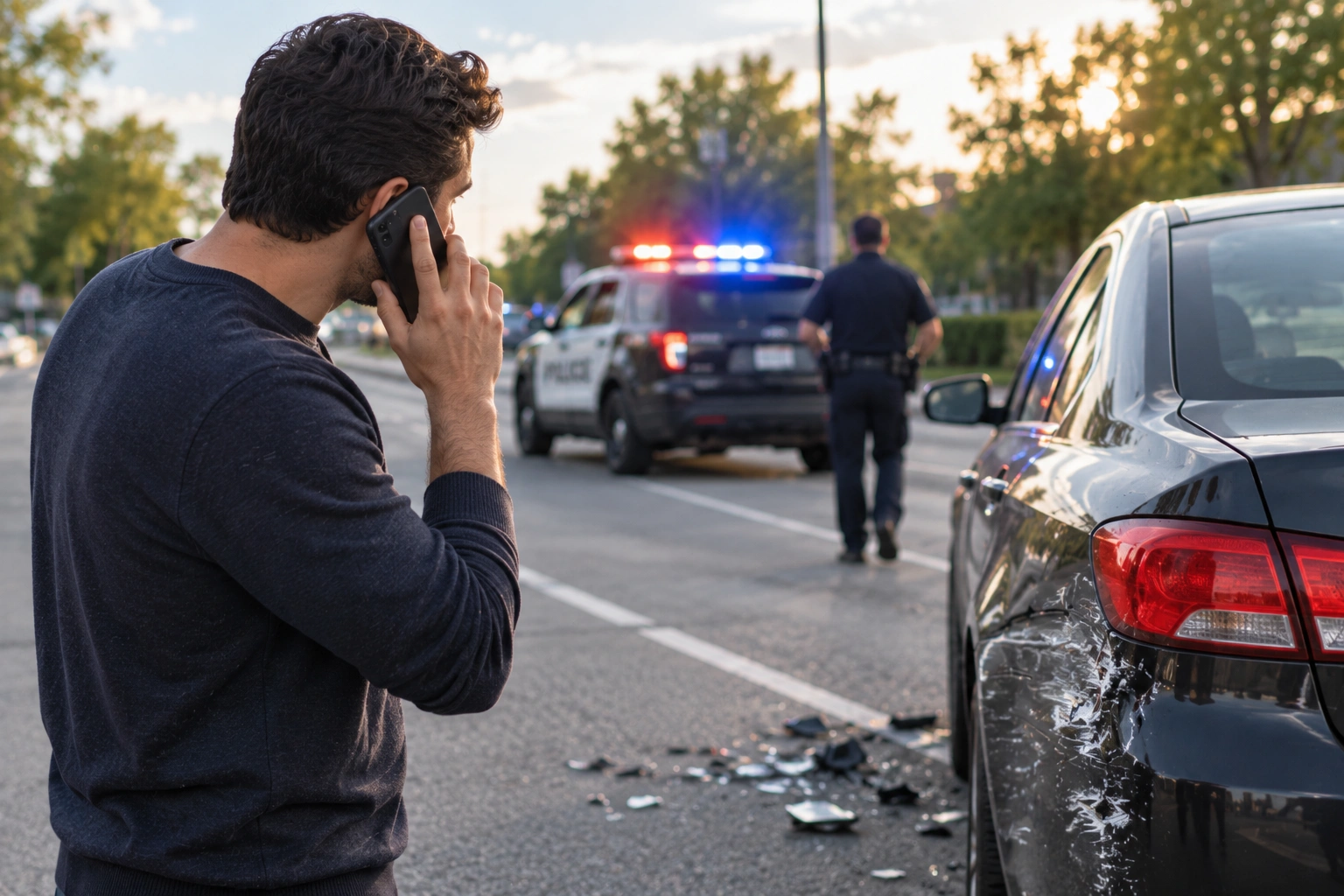
What Must the Crown Prove on a Criminal Hit and Run Charge?
Knowledge, and a failure to perform one of three duties. Under subsection 320.16(1) the Crown must prove you were operating the vehicle, that you knew or were reckless as to whether it had been involved in an accident, and that without reasonable excuse you failed to do what the section requires.
The three duties are cumulative in the sense that failing any one of them is enough. You must stop. You must give your name and address. And where any person has been injured or appears to need assistance, you must offer it.
That last duty is broader than people assume. Offering assistance can mean calling 911 rather than performing any kind of rescue, and a driver who stopped, looked, decided the other person seemed fine, and drove off can still be caught by it.
The knowledge element is where these cases are genuinely fought. The word accident is not defined in section 320.16, and in practice it covers any contact between vehicles, or between a vehicle and a person or cyclist. A minor car accident with no visible damage counts, and so does contact between a motor vehicle and a parked one. A light impact in a parking lot, a mirror clipped on a narrow street, contact felt as a bump on a rough road: whether the driver knew is a real question, not a formality.
Are You Charged Criminally or Provincially?
Look at the section number on your paperwork, because it decides which courthouse you attend. This is where the two systems diverge sharply in York Region.
A charge under section 320.16 of the Criminal Code goes to the Ontario Court of Justice at 50 Eagle Street West in Newmarket, along with every other criminal matter from York Region. A charge under section 200 of the Highway Traffic Act goes instead to one of York Region’s Provincial Offences courts, either Newmarket at 17150 Yonge Street or Richmond Hill at 50 High Tech Road. The first four digits of the offence number on a provincial ticket are the location code, with 4960 for Newmarket and 4961 for Richmond Hill.
So two drivers involved in similar collisions on the same Thornhill street can end up in different buildings, prosecuted under different statutes, with only one of them at risk of a criminal record. Where an accident in Thornhill causes injuries in Thornhill or anywhere else in York Region, the choice narrows sharply, since injuries caused by the accident push the matter into the criminal stream and raise the tier of the offence. Thornhill sits on both sides of Yonge Street, with Vaughan to the west and Markham to the east, and neither side changes any of this. A police investigation in Thornhill runs through York Regional Police #2 District at 171 Major Mackenzie Drive West in Richmond Hill, which covers Thornhill on both sides of Yonge along with Richmond Hill itself.
There is one more distinction worth knowing. The Criminal Code charge applies anywhere a collision happens, including parking lots and private property, while the Highway Traffic Act version is generally aimed at collisions on a roadway. A leaving the scene charge Thornhill drivers pick up in a plaza parking lot is therefore more likely to be criminal than provincial.
Do You Have to Report the Collision, and What Changed in 2025?
Yes, above a threshold, and that threshold moved recently. Ontario raised the property damage reporting level from $2,000 to $5,000 effective January 1, 2025, so a good deal of the advice online is now out of date.
Sections 199 and 200 of the Highway Traffic Act require drivers to stop, exchange information, and report a collision to police where the total property damage exceeds that amount, or where anyone is injured. Reporting is normally done at a collision reporting centre rather than at the roadside, and failing to report carries a fine of up to $1,000 along with demerit points. Ontario law treats the reporting duty as separate from the duty to stop, so it is possible to comply with one and breach the other. Insurance companies also look at the reporting record when they assess a claim.
Here is the practical point for someone who has already left. Reporting late is very often better than not reporting at all. It does not undo the departure, but it changes the picture the Crown sees, and it is inconsistent with the intention to avoid responsibility that a hit and run allegation implies. Speak with a lawyer before you make that call, though, because what you say when you report becomes evidence.
What Does a Thornhill Hit & Run Defence Lawyer Look For?
Evidence about what the driver could have known, and how the identification was made. A Thornhill Hit & Run Defence Lawyer starts with those two questions because they cover the great majority of viable defences on this charge.
Hit and run allegations turn on evidence that is gathered rather than argued, and every hit and run allegation is examined the same way at the start. Criminal litigation of this kind is won in the disclosure long before anyone stands up in court. The specific areas:
- The physical damage on both vehicles, since minimal contact supports an argument that the driver never registered an impact.
- The nature of the collision, including road noise, weather, the speed involved, and whether anything would have been visible in the mirrors.
- How the accused was identified. A partial plate, a bystander description, or a vehicle located hours later all raise the question of who was driving, which the Crown must prove.
- Any video, from private security cameras, doorbell cameras, or dashcams, which in a residential area often exists but has a short retention window.
- Whether the driver stopped at all, since drivers who stopped briefly and exchanged some information are in a very different position from those who did not.
- Whether a reasonable excuse applies, such as leaving to get help, driving on because stopping was unsafe, or a medical emergency.
Video is the one to chase immediately. Residential and commercial systems commonly overwrite within days, so a request made in week one can retrieve footage that is simply gone by week four.
Can You Avoid a Criminal Record?
Often, yes, and there are two separate routes. This is the most important thing on the page for most people reading it.
The first is resolution to a provincial offence. Where the evidence of knowledge is weak or the identification is shaky, a Crown may agree to withdraw the criminal charge in exchange for a plea to failing to remain under section 200 of the Highway Traffic Act. That leaves a fine, demerit points, a possible licence suspension, and a real insurance problem, but no criminal record.
The second is a discharge. For a section 320.16(1) charge with no bodily harm or death, where the Crown proceeds summarily, a discharge is an available sentencing option. A discharge means a finding of guilt without a conviction being registered, so there is no criminal record. That option does not exist for impaired driving, which is why a hit and run charge standing alone is often in a better position than people expect.
Which of the two is realistic decides your next steps, and it is the first thing a lawyer can help you settle. Neither outcome is automatic and neither can be promised at a first meeting. Both depend on the disclosure, on whether anyone was hurt, and on your record, and counsel should tell you which one is realistically in play before quoting you anything.
What Are the Penalties If You Are Convicted?
They rise steeply across three tiers, depending on what the driver knew about the consequences. The Criminal Code sets them out in section 320.16.
Where no one was hurt, the offence is hybrid with a maximum of ten years on indictment. Where the driver knew or was reckless as to whether the accident caused bodily harm, the maximum rises to fourteen years. Where death resulted, the maximum is life imprisonment. A driving prohibition accompanies a criminal conviction in each case.
The Highway Traffic Act version is far less severe but not trivial. Section 200 carries a fine of not less than $400 and not more than $2,000, imprisonment of up to six months, and a licence suspension of up to two years, along with demerit points that most insurers treat as a major conviction.
The consequences beyond the sentence follow the criminal record rather than the driving. Employment screening, professional licensing, and entry to the United States are all affected. Because the offence is hybrid with a ten year maximum, a conviction prosecuted by indictment can amount to serious criminality under section 36(1) of the Immigration and Refugee Protection Act, which matters a great deal for permanent residents and temporary residents.
What Does a Thornhill Hit & Run Defence Lawyer Do First?
Preserves evidence before it disappears. One lawyer stays with the file, and a Thornhill Hit & Run Defence Lawyer contacted in the first week can send preservation requests to nearby businesses before their footage cycles out, which is not something anyone can do later. A hit and run lawyer Thornhill residents reach a month afterwards is working with much less.
After that the work is fairly predictable. We request the disclosure, examine how the identification was made, look hard at the knowledge element, and open the conversation with the Crown about whether the matter belongs in criminal court at all. Where the file is strong against you, we say so and work on keeping the record clean instead. Fees are quoted by stage, so you know what a Thornhill Hit & Run Defence Lawyer will cost before you commit to anything.
Our office is at 7191 Yonge Street in Thornhill, on the municipal line, and we appear at Newmarket regularly. We also handle the provincial side, so a charge that moves from the Criminal Code to the Highway Traffic Act stays with the same team from start to finish rather than being handed on. Plenty of law firms split those two systems between different people, and the handover is where things get dropped.
One point worth being clear about, because people arrive at the wrong door. We act for the driver who has been charged. If you were the one hit and you are looking for compensation, that is a different area of law entirely and we will point you toward a firm that does it rather than take your file.
What we do offer is a free consultation with a defence lawyer who handles these charges regularly, and honest legal advice about your case before you spend anything. Our experienced team stays with you at every step of the way, and we guide you through the process rather than leaving you to decode it. Not all lawyers in Thornhill handle both the criminal and provincial sides, so ask before you retain anyone. Our criminal work covers Thornhill, Markham, Vaughan, and Richmond Hill, and a criminal lawyer in Ontario can act across Ontario, so a client who moves does not need to start again. The same small law team handles the file throughout.
What Should You Do Right Now?
Stop talking about it and start preserving what exists. The instinct to explain is the thing that damages these files most.
- Do not speak to police about what happened before you get advice. What people in Thornhill say in the first phone call to an officer often becomes the strongest evidence against them. Explaining that you did not think you hit anything supplies the knowledge element the Crown has to prove.
- Do not repair the vehicle. Damage evidence cuts both ways and altering it looks far worse than leaving it alone.
- Write down the route, the time, the weather, and what you noticed or did not notice, while it is fresh.
- Note whether anyone was with you in the car, since a passenger’s account can be significant on the knowledge question.
- If you have not reported the collision, get advice about doing so rather than deciding either way on your own.
Frequently Asked Questions
Is hit and run a criminal offence in Ontario?
It can be either. Section 320.16 of the Criminal Code creates a criminal offence carrying a permanent record, while section 200 of the Highway Traffic Act creates a provincial offence with a fine, demerit points, and a possible suspension but no criminal record. The charging officer decides, and you cannot be convicted under both.
What if I did not know I hit something?
That is a genuine defence. The Crown must prove you knew, or were reckless as to whether, the vehicle had been involved in an accident. There is no presumption of intent under section 320.16, so evidence about minimal contact, road noise, or limited visibility goes directly to an element the Crown has to establish.
Where is a Thornhill hit and run charge heard?
A Criminal Code charge goes to the Ontario Court of Justice, 50 Eagle Street West in Newmarket. A Highway Traffic Act charge goes to a York Region Provincial Offences court, either Newmarket at 17150 Yonge Street or Richmond Hill at 50 High Tech Road. The location code on a provincial ticket tells you which.
When do I have to report a collision in Ontario?
Where anyone is injured, or where total property damage exceeds $5,000. That threshold rose from $2,000 on January 1, 2025, so older guidance is out of date. Reporting is usually done at a collision reporting centre, and failing to report carries a fine of up to $1,000 plus demerit points.
Can a hit and run charge be reduced?
Sometimes. Where the knowledge element or the identification is weak, a Crown may agree to resolve a Criminal Code charge on a Highway Traffic Act failing to remain charge instead, which avoids a criminal record. Availability depends on the disclosure, whether anyone was injured, and your driving and criminal history.
Can I be charged if the collision happened in a parking lot?
Yes. The Criminal Code offence applies wherever a collision occurs, including parking lots and private property, while the Highway Traffic Act version is generally aimed at collisions on a roadway. Parking lot incidents are therefore more likely to be charged criminally than many drivers expect.
Get the Video Requested Before It Is Gone
Call this week rather than next. Nearby cameras are the single most useful thing in most hit and run files, and the footage that answers the question is usually deleted on a rolling cycle measured in days.
The consultation is a real conversation rather than an intake script. We will ask what section you are charged under, where the collision happened, what contact you were aware of at the time, whether anyone was injured, and how police came to identify you. From there we can help you understand your rights, whether the knowledge element looks provable, whether a provincial resolution is realistic, and what needs to happen first. We will also explain the legal process and help you decide what to do this week rather than leaving you to work it out. Everything you tell us is protected by solicitor-client privilege whether or not you retain us, and the first conversation is free.
Thornhill: 647-697-5975. Toronto: 647-588-3234. Reach us through our contact page, or come to the office at 7191 Yonge Street, Suite 310, Thornhill, Ontario L3T 0C4, minutes from either side of the municipal line. Our Thornhill driving offence lawyer page explains the two court systems in more detail, and where alcohol was involved as well, our Thornhill DUI lawyer page covers impaired driving. For the province wide picture, see our driving offence lawyer Ontario page, and our Thornhill criminal defence lawyer page sets out how criminal files run at Newmarket generally.
This page is provided for informational purposes and does not constitute legal advice. It does not account for the facts in individual cases, and you should speak with a lawyer about your own situation before making any decision.
Talk it through with a lawyer today. No cost, no obligation, and the conversation stays confidential.