

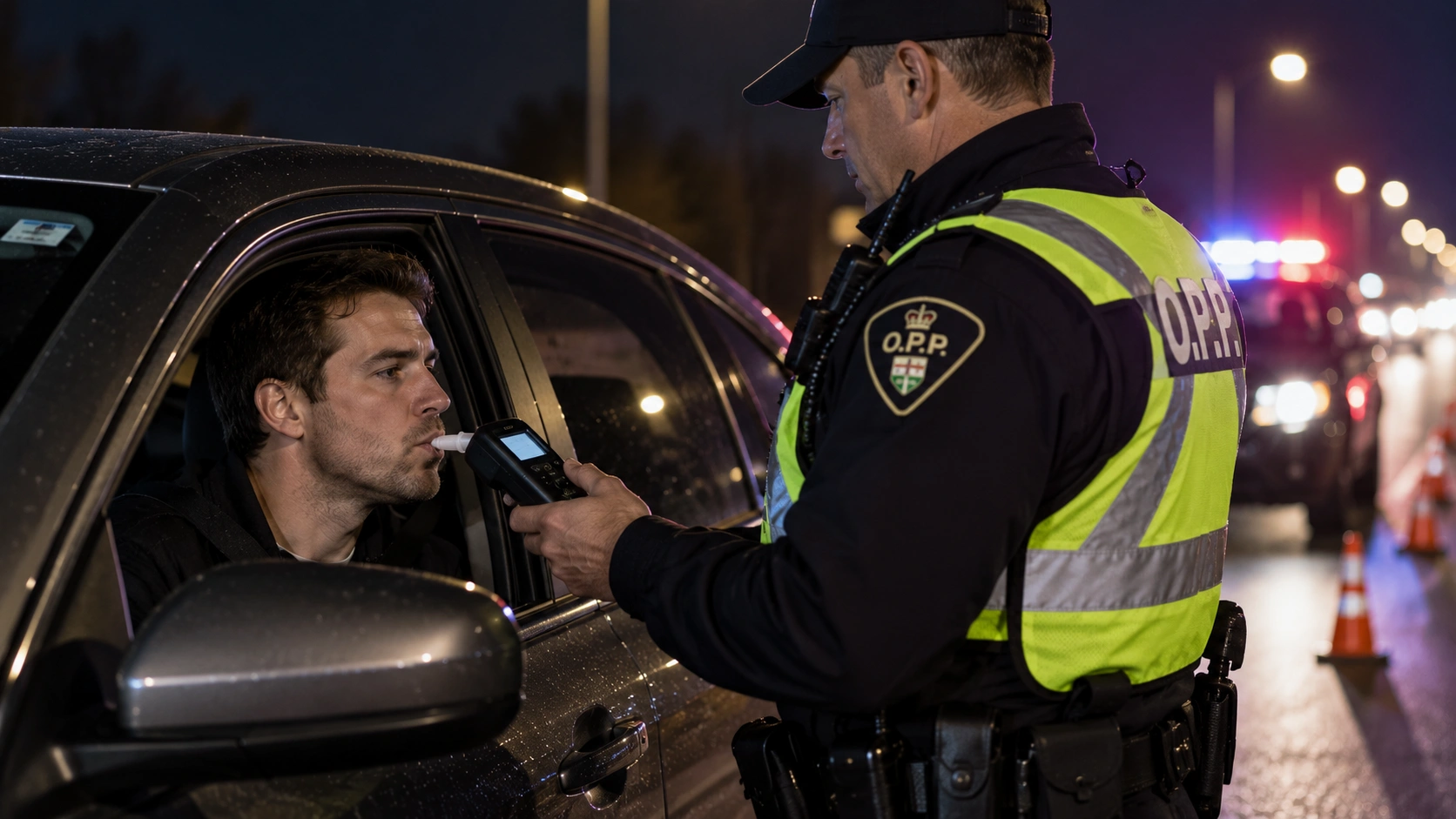

Three things changed on January 1, 2026, and all of them made the consequences worse for Ontario drivers. Roadside licence suspensions for warn-range and zero-tolerance readings more than doubled, the period Ontario looks back to count prior impaired driving occurrences went from five years to ten, and anyone convicted of impaired driving causing death now faces an automatic indefinite driver’s licence suspension.
What did not change is the part most people fixate on. The 90-day administrative suspension after a criminal-level reading works exactly as it did before, and the Criminal Code thresholds are untouched. Ontario’s new penalties tightened around the edges, in the provincial administrative penalties that apply before anyone is convicted of anything. So here is what the 2026 impaired driving law changes in Ontario actually mean for a driver stopped today, and why one of these new rules matters far more than the headlines suggested.
What Are the 2026 Impaired Driving Law Changes in Ontario?
The 2026 impaired driving law changes in Ontario centre on three areas: longer immediate roadside suspensions, a doubled look-back window for repeat occurrences, and harsher consequences for the most serious driving offences. All of it took effect January 1, 2026, under the Ontario Highway Traffic Act.
These are provincial changes, which is an important framing point. Ottawa did not amend the Criminal Code. Ontario adjusted its own administrative penalty scheme, the one police apply at the roadside without any court involvement. That means the 2026 rules bite immediately, before a Crown attorney reviews the file and long before a trial date is set.
The province framed the changes around deterrence, particularly for drivers who register in the warn range or breach zero-tolerance conditions and previously walked away with a three-day suspension. Whether tougher impaired driving penalties change behaviour is genuinely debatable. What is not debatable is that the cost of a warn-range reading roughly doubled overnight.
How Did Roadside Suspensions Change Under Ontario’s New Rules?
Immediate roadside suspensions for warn-range and zero-tolerance drivers more than doubled on a first impaired driving occurrence, jumping from three days to seven. The escalation for repeat occurrences steepened as well.
For a blood alcohol concentration between 0.05 and 0.079, the current structure runs:
- A first occurrence brings a seven-day licence suspension, a $250 penalty, and a mandatory eight-hour education course
- A second occurrence brings fourteen days, a $350 fine, and treatment programming rather than education alone
- A third or subsequent occurrence brings thirty days, a $450 penalty, treatment, and a six-month ignition interlock device requirement
Zero-tolerance violations moved on the same schedule. Drivers under 21 and anyone holding a G1, G2, M1, or M2 licence must have no alcohol whatsoever in their system, meaning zero alcohol and zero drugs, and a first violation now carries a seven-day suspension plus the $250 penalty and the eight-hour course.
A $281 reinstatement fee applies before you can drive again. For a first warn-range occurrence, that puts real out-of-pocket costs past $530 before the course fee or lost work.
What Does the 10-Year Look-Back Period Actually Mean?
Ontario now counts prior impaired driving occurrences going back ten years when determining whether your current event is a first, second, or subsequent offence. The previous window was five years, so the change doubled it.
This is the most consequential piece of the whole package, and it drew the least attention. Consider how it works in practice. A driver with a warn-range suspension from 2018 would previously have had a clean slate by 2024. Under the 2026 changes that same event still counts today, which turns a warn-range reading into a fourteen-day suspension, a $350 penalty, and mandatory treatment instead of an eight-hour course.
The look-back runs across the entire escalation ladder, so it applies to warn-range readings, zero-tolerance violations, and criminal-level suspensions alike. Anyone who has had any impaired driving contact with police in the past decade should assume it counts against them now.
Worth noting: the ten-year window aligns the administrative scheme with how long an impaired driving conviction already stayed on an Ontario driver’s record. The two systems now run on the same clock.
Who Is Most Affected by the 2026 Impaired Driving Law Changes in Ontario?
Young and novice drivers, and anyone with a prior impaired driving occurrence in the past decade. Those two groups absorb most of the impact, though commercial drivers carry their own exposure.
Novice and young drivers feel it hardest because zero tolerance means the threshold is not 0.05 or 0.08; it is any detectable amount of alcohol or drugs. A G2 driver who has one drink at dinner and registers 0.02 faces the same seven-day suspension and $250 penalty as someone at 0.07. There is no warn range for them, only compliance or a suspension.
Drivers with older records feel it through the look-back. Someone who treated a 2017 or 2018 incident as long behind them now finds it reactivated for penalty purposes, which is a difficult thing to learn at the roadside.
Commercial drivers face an additional layer, since a suspension can affect a commercial vehicle operator’s registration alongside the individual licence, putting employment at risk in a way that does not apply to most drivers. These administrative penalties also reach beyond cars to boats, snowmobiles, and off-road vehicles.
What Did Not Change Under the New Impaired Driving Laws?
The criminal side is unchanged. Criminal Code thresholds, the offences themselves, mandatory minimum penalties, and the 90-day administrative suspension for criminal-level readings all operate exactly as they did before.
Still in place:
- The 0.08 threshold defining the criminal offence, with the 90-day Administrative Driver’s Licence Suspension following a reading at or above it, a refusal, or a failed drug recognition evaluation
- Mandatory alcohol screening powers, meaning police who have an approved device can demand a breath sample from any lawfully stopped driver without needing reason to believe alcohol is present
- The seven-day vehicle impoundment and $550 penalty attached to that suspension
- A minimum $1,000 fine and a one-year driving prohibition on a first criminal conviction
- Mandatory completion of the Back on Track program before licence reinstatement after any impaired driving conviction
- Ignition interlock streams that let most first offenders drive before the full prohibition expires
One point deserves emphasis because it causes real confusion. The 2026 impaired driving law changes in Ontario are provincial administrative measures, not criminal ones. Nothing in them creates a criminal charge or a criminal record, and a warn-range suspension under the new laws is no more criminal than it was before. How a warn-range reading works in full sits in our guide on warn range blood alcohol in Ontario.
Drug-impaired driving is treated the same way it was, with a failed drug recognition evaluation triggering the same 90-day suspension as an alcohol reading over the limit. Separate Criminal Code offences like dangerous driving and other risky driving conduct were also untouched by the provincial changes.
Do the New DUI Rules Apply to Incidents Before January 2026?
The new penalties apply to occurrences on or after January 1, 2026, but prior events still count toward your record for escalation purposes. That distinction is easy to get backwards.
If you registered a warn-range reading in 2024, you served the three-day suspension that applied then, and the seven-day period does not retroactively extend it. What the change does is make that 2024 event countable for a full decade, so a new occurrence today lands as a second occurrence with steeper penalties attached.
So the new DUI rules Ontario introduced are forward-looking in application and backward-looking in counting. Old incidents keep their old penalties. They simply stay on the books much longer as a basis for escalating whatever happens next.
Frequently Asked Questions
What changed in Ontario’s impaired driving laws in 2026?
Effective January 1, 2026, immediate roadside suspensions for warn-range and zero-tolerance readings increased from three days to seven on a first occurrence, the look-back period for counting prior occurrences doubled from five years to ten, and impaired driving causing death now triggers an automatic indefinite provincial licence suspension on conviction.
How long is the warn-range suspension in Ontario now?
A first occurrence carries a seven-day licence suspension with a $250 penalty and a mandatory eight-hour education course. A second occurrence within ten years brings fourteen days and a $350 penalty. A third brings thirty days, a $450 penalty, and a six-month ignition interlock requirement.
What is the 10-year look-back period?
Ontario now examines the previous ten years, rather than five, when deciding whether a current impaired driving occurrence counts as a first, second, or subsequent event. A warn-range suspension from eight years ago now makes a new reading a second occurrence, bringing longer suspensions and mandatory treatment programming.
Did the 90-day suspension change in 2026?
No. The 90-day Administrative Driver’s Licence Suspension still applies to drivers who register 0.08 or higher, refuse a breath or drug testing demand, or fail a Drug Recognition Expert evaluation. The accompanying seven-day vehicle impoundment and $550 penalty also remain unchanged.
Do the 2026 changes create a criminal record?
No. The 2026 amendments are provincial administrative penalties under the Highway Traffic Act, imposed by police at the roadside without court involvement. They do not create a criminal record. Criminal consequences arise only from a Criminal Code conviction, which follows an entirely separate process.
Stopped Under the New Rules? Get Advice Before You Accept Anything
The tougher scheme makes early advice more valuable, not less. A first occurrence today costs roughly double what it did a year ago, and the ten-year look-back means whatever happens now shapes your exposure for the next decade.
At Kazandji Law, we defend impaired driving charges across Ontario, and the work begins with what actually happened during the stop. Was the detention lawful? Was the screening demand properly made? Was the approved instrument correctly operated by a qualified technician? Those questions decide any impaired driving case, and a successful defence keeps you off the escalation ladder entirely. Understanding the 2026 impaired driving law changes in Ontario shows you what is at stake, but the defence itself determines the outcome. Consequences of a conviction are covered in our guide on getting your licence back after a DUI, and there is more on our criminal defence page.
Reach us at 647-588-3234 in Toronto or 647-697-5975 in Thornhill, or book a free consultation through our contact page. If you have been charged or suspended under the new rules, call before your court date.