

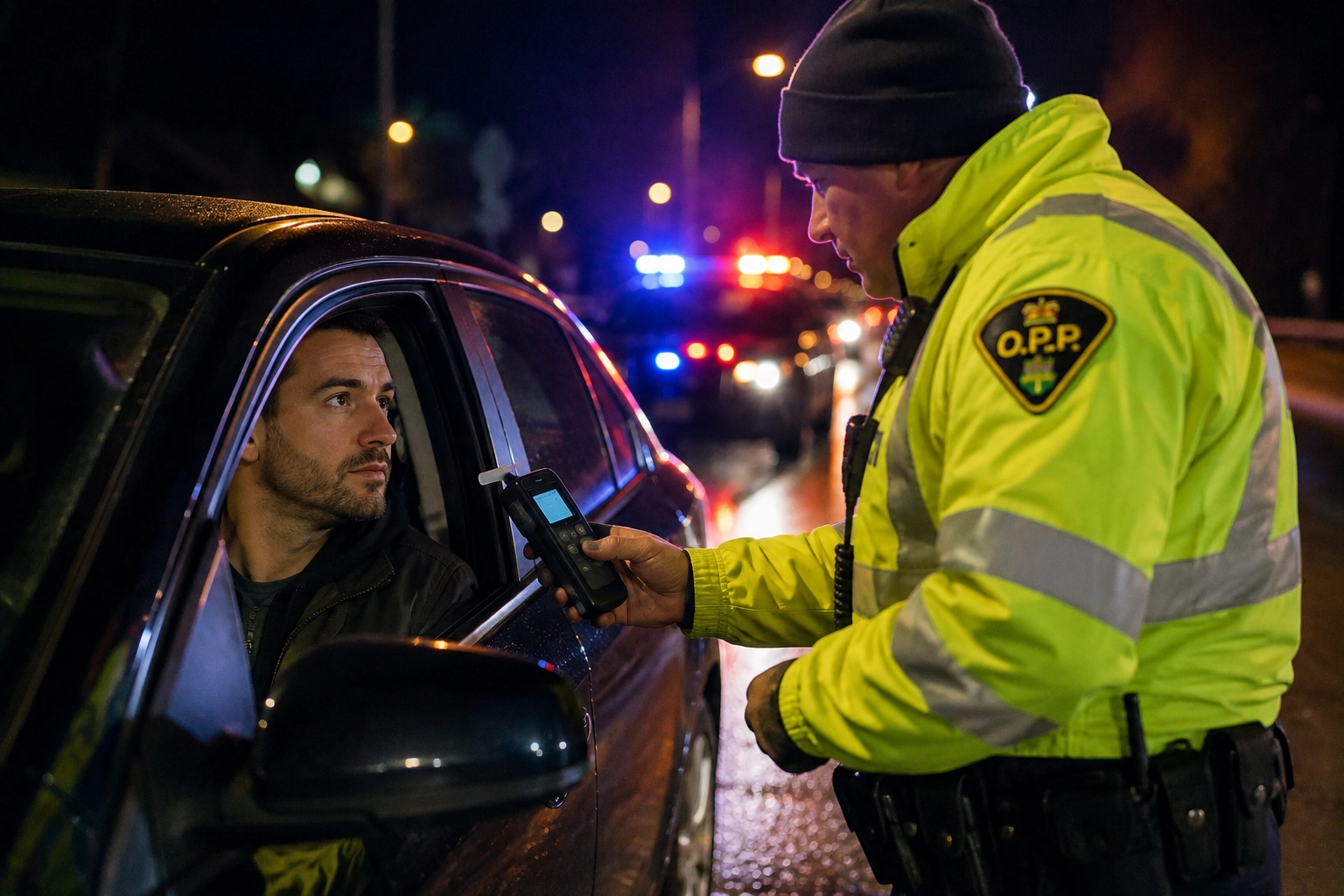

You are not being charged with a crime. A warn range reading means your blood alcohol concentration fell between 0.05 and 0.079, below the 0.08 BAC threshold that defines the criminal offence, so what follows are penalties under provincial law rather than a criminal DUI charge. No court date, no criminal record, and no Criminal Code prosecution flows from the reading alone.
That is genuine relief for most drivers who hear it. What comes next is less comforting, because Ontario’s warn range penalties got considerably tougher on January 1, 2026. Your driver’s licence suspension starts at the roadside on the spot, a fine applies immediately, and an alcohol education program becomes mandatory. So here is what warn range blood alcohol in Ontario actually triggers, how the escalating administrative penalties work, and where the line sits between a provincial matter and a criminal one.
What Counts as Warn Range Blood Alcohol in Ontario?
Warn range blood alcohol in Ontario means a blood alcohol concentration between 0.05 and 0.079, measured in milligrams of alcohol per 100 ml of blood. It falls below the 80 mg per 100 ml legal limit that defines criminal impaired driving under the Criminal Code, which is why a reading in this range produces administrative rather than criminal consequences.
The reading typically comes from an approved screening device at the roadside, the handheld unit an officer uses after a lawful stop. Under mandatory alcohol screening rules introduced in December 2018, police carrying a device can demand a breath sample from any lawfully stopped driver without needing to suspect alcohol first. A “warn” result triggers the administrative process immediately.
The suspension is imposed under section 48 of the Highway Traffic Act, meaning it comes from the officer rather than a judge. No court reviews it beforehand. The officer takes your licence, issues a notice of immediate licence suspension, and the clock starts that day. Drivers who blow in the warn range are dealt with entirely outside the criminal courts.
What Are the Warn Range Penalties for Blowing 0.05 in Ontario?
Blowing 0.05 now carries a seven-day licence suspension on a first occurrence, a $250 fine, and a mandatory eight-hour education course. Those figures changed on January 1, 2026, when the province substantially increased the penalties you could face for driving with a blood alcohol reading in this range.
The escalation works like this:
- First occurrence: seven-day roadside suspension, up from three days, plus a $250 penalty and an eight-hour alcohol education program
- Second occurrence: fourteen-day suspension, a $350 penalty, and mandatory education or treatment programming rather than education alone
- Third or subsequent occurrence: thirty-day suspension, a $450 penalty, treatment participation, and a six-month ignition interlock condition on your licence
A $281 licence reinstatement fee applies before you can drive again. The suspension does not simply expire; you reinstate through ServiceOntario the same way you would after any administrative suspension.
One change matters more than the suspension lengths and slipped past most drivers. Ontario now counts prior occurrences on your driving record going back ten years rather than five. A warn range event from eight years ago that would previously have been irrelevant now makes your current reading a second occurrence, with the longer suspension and treatment requirement attached. These warn-range penalties are provincial administrative sanctions, so they escalate on their own track separate from any criminal impaired driving history.
Does Warn Range Blood Alcohol in Ontario Give You a Criminal Record?
No. A warn range roadside suspension is an administrative penalty under Ontario law, not a criminal conviction, so nothing appears on your criminal record and no court proceeding attaches to it.
This is the single most important distinction on this page. Warn range blood alcohol in Ontario stays entirely within the provincial licensing system administered by the Ministry of Transportation. You are not charged with a criminal offence, not prosecuted, and not convicted. Travel to the United States is unaffected, employment background checks show nothing, and no Criminal Code driving prohibition applies. The incident is not a criminal matter in any sense that follows you long term.
Where drivers get confused is that the practical inconvenience feels punitive. Losing your licence at the roadside, paying a fine, and completing a mandatory course all carry the texture of punishment. Legally, though, the two systems are separate, and a warn range reading does not produce the consequences that follow a conviction, which we cover in our guide to getting your licence back after a DUI.
One practical caveat worth naming. While the suspension itself is not criminal, it can still affect your insurance, since insurers may treat a suspension on your driving record as a risk factor regardless of how it arose.
Warn Range vs Criminal DUI: When Does a Reading Become a Charge?
When something beyond the reading itself gives police grounds to arrest. A 0.06 result does not become a criminal DUI charge on its own, but a warn range screening result can prompt further investigation that produces one.
The realistic paths from administrative to criminal:
- The officer observes signs of impairment independent of the reading, such as poor coordination or erratic driving, which can support an alcohol-impaired driving charge even below the 0.08 BAC threshold
- Drugs or alcohol in combination, potentially leading to a drug recognition evaluation and a separate charge
- Refusing a further breath demand, which is its own criminal offence carrying penalties comparable to an impaired driving charge
- An arrest followed by an evidentiary test on an approved instrument returning 0.08 or higher, at which point you are charged with a criminal offence based on that instrument
That last point deserves clarity. The roadside device screens; it does not establish your precise BAC in Ontario for criminal purposes. Its result can only justify further investigation. If a station test reads over the alcohol limit for driving in Ontario, the criminal charge flows from that instrument rather than the roadside warn. And a criminal conviction brings the 90-day licence suspension at arrest, a one-year prohibition, and the Back on Track program before licence reinstatement.
Ontario also enforces zero tolerance separately for young and novice drivers. Anyone under 21 or holding a G1, G2, M1, or M2 licence cannot have any alcohol in your system at all, and those drivers face suspensions for readings that would not otherwise fall within this range.
Can You Fight a Warn Range Roadside Suspension?
Rarely, and the grounds are narrow. Unlike a criminal charge, an administrative suspension involves no trial, no Crown disclosure, and no presumption of innocence as a courtroom would apply it.
Limited review mechanisms exist and focus on technical questions rather than the merits. Was the device an approved screening device? Was it properly calibrated and operated? Was the stop lawful? Did the officer follow the required procedure? Those are the arguments with any prospect of success.
What will not work is arguing hardship, that you only had one drink, or that the amount of alcohol you consumed could not have produced that number without a technical basis for the claim. Needing your licence for work is not a ground for review.
For most drivers the practical answer is to serve the suspension, complete the required course, pay the licence reinstatement fee, and stay mindful of the ten-year lookback. Where an arrest followed and you are now facing impaired driving charges, that is an entirely different situation, and one where a criminal defence lawyer matters. Our guide on mandatory alcohol screening in Canada covers what police can lawfully demand at the roadside.
Frequently Asked Questions
What is the warn range for BAC in Ontario? The warn range covers a blood alcohol concentration between 0.05 and 0.079, sitting below the 80 mg per 100 ml of blood threshold that defines the criminal offence. A reading in this range produces administrative penalties under the Highway Traffic Act, including an immediate roadside licence suspension, rather than a criminal charge.
How long is the suspension for blowing 0.05 in Ontario? Since January 1, 2026, a first occurrence carries a seven-day roadside suspension, increased from three days. A second occurrence within ten years brings fourteen days, and a third or subsequent occurrence brings thirty days. Penalties of $250, $350, and $450 apply respectively, plus a $281 reinstatement fee.
Does a warn range suspension create a criminal record? No. A warn range roadside suspension is imposed under provincial law and is not a criminal conviction. Nothing appears on your criminal record, no court appearance is required, and no consequences arise for United States travel or employment background checks from the suspension itself.
Can you refuse the roadside breath test in the warn range? No. Refusing to comply with a lawful breath demand is a criminal offence carrying penalties comparable to impaired driving, including a criminal record and a driving prohibition. Refusing is considerably worse than registering a warn range reading, which produces only administrative consequences under Ontario law.
How far back does Ontario look at previous warn range occurrences? Ten years, extended from five as of January 1, 2026. A prior warn range suspension within the previous decade makes a new occurrence a second or third event, triggering longer suspensions, higher fines, mandatory treatment programming, and potentially an ignition interlock device requirement.
Stopped and Not Sure Where You Stand? Let’s Sort It Out
A warn range reading on its own is a provincial matter, and for most drivers the path forward is straightforward. What complicates things is when the roadside stop produced more than just a reading.
At Kazandji Law, our DUI lawyers handle impaired driving in Ontario at every level, and the first thing we examine is what actually happened during the stop. Was the detention lawful? Was the screening demand properly made? Did an arrest follow, and if so, was the subsequent testing done correctly? In impaired driving cases that began as a warn range stop, those questions decide the outcome. If a warn range blood alcohol in Ontario reading escalated into a criminal DUI charge for you, that deserves a conversation with a defence lawyer. There is more on our criminal defence page.
Reach us at 647-588-3234 in Toronto or 647-697-5975 in Thornhill, or book a free consultation through our contact page. If you were arrested rather than simply suspended, call before your first court date.