

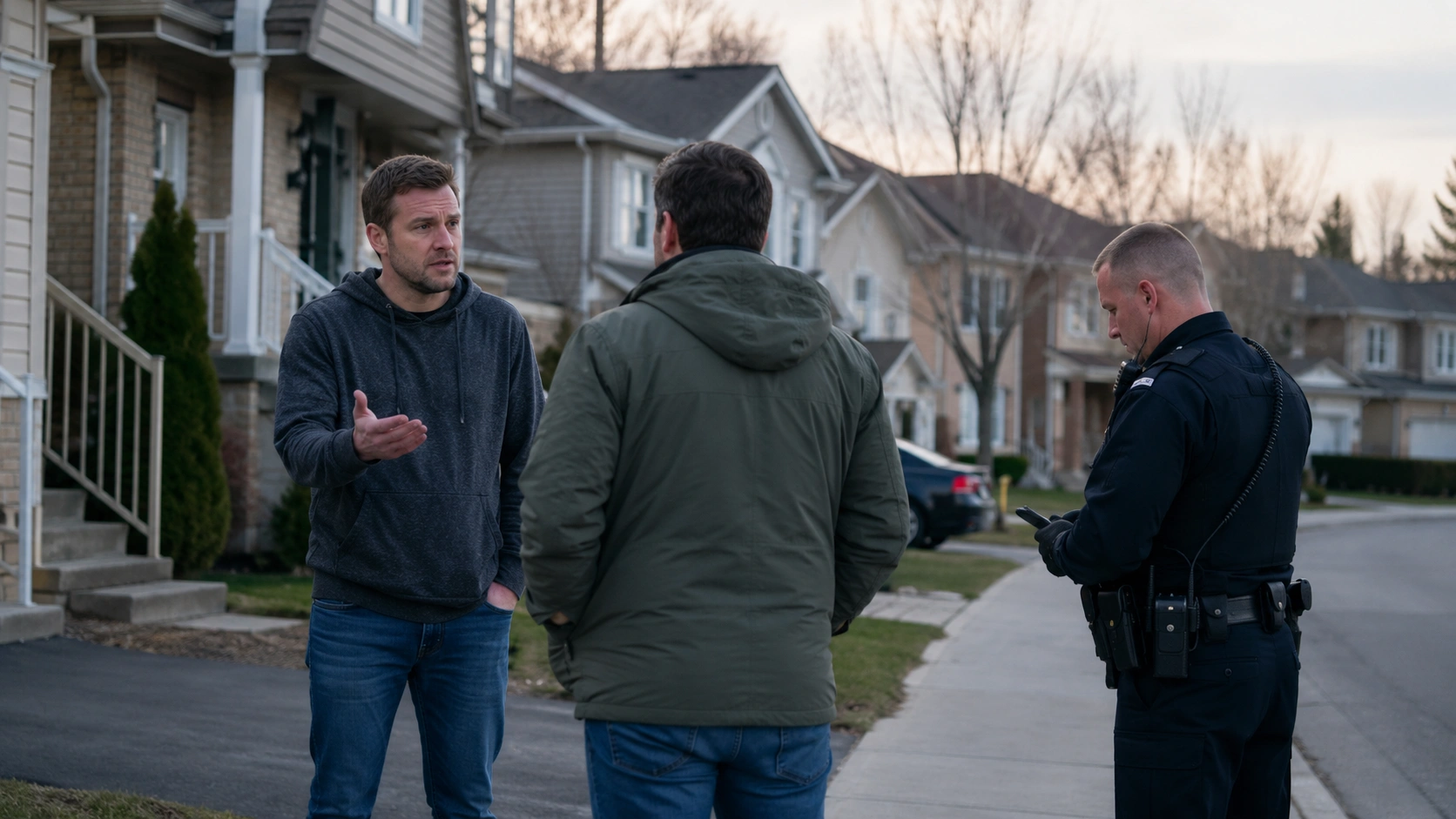

It starts small. A parking spot that keeps getting taken. A fence built six inches into the wrong yard. Or a dog that won’t stop barking at two in the morning. Most neighbourhood disputes in Ontario stay where they belong: an awkward conversation over the fence, or a strongly worded note left in a mailbox. But sometimes they don’t. Voices get raised. Someone gets too close, a shove happens, and before either person has fully processed it, there’s a police cruiser parked out front.
What comes next can feel wildly out of proportion to what started it. An assault charge born of one moment of frustration between two neighbours still carries real consequences, and they follow you well past the incident itself. This post covers how these charges arise in Ontario and what the law actually says. It also looks at your defence options when you’re on the wrong end of a charge that started with a neighbourhood dispute.
How a Neighbourhood Dispute Becomes a Criminal Matter
Most people don’t set out to commit a crime when they confront a difficult neighbour. The trouble is that Ontario criminal law doesn’t require you to have intended serious harm. Under Section 265 of the Criminal Code of Canada, assault occurs when a person intentionally applies force to another without their consent, attempts or threatens to apply force in a way the other person reasonably believes can be carried out, or confronts someone while openly carrying a weapon.
That definition is broader than most people expect. You don’t need to throw a punch. Grabbing an arm can meet the legal threshold. So can a push, or a threatening gesture made while you happen to be holding something. And once police are called to a neighbourhood dispute they’re required to respond and investigate. If what they hear at the scene convinces them an offence occurred, an arrest or a summons can follow very quickly.
Neighbour-related incidents that commonly lead to assault charges include:
- A physical confrontation over a property line or fence placement
- A push or shove during an argument about noise, parking, or shared space
- Threatening words or gestures made in the heat of the moment
- Any physical contact during an argument that the other party did not consent to
- Grabbing or blocking someone who was trying to leave during a dispute
Maybe the other person started it. Maybe they raised their voice first, or they’ve spent years making your life difficult. None of that automatically gives you a defence. What matters legally is the specific conduct alleged and the evidence available to support it.
The Types of Assault Charges That Can Come From These Situations
Not all assault charges carry the same weight. Ontario courts deal with several levels under the Criminal Code, and the charge you face depends on what happened and how serious the outcome was.
Common assault under Section 266 is the starting point for most neighbourhood cases where no significant injury occurred. It’s a hybrid offence, which means the Crown can pick its route: summary conviction or indictment, depending on the facts. On a summary conviction, the maximum penalty is two years less a day. On indictment, it goes up to five years.
If the altercation caused actual bodily harm, Section 267 applies. This carries a maximum of ten years on indictment. And if the assault resulted in wounding, maiming, disfiguring, or endangering someone’s life, Section 268 governs, with a maximum of fourteen years.
Most neighbourhood dispute cases that result in assault charges land at the common assault level. But even that conviction means a criminal record. Probation and court-ordered conditions can hang over your daily life for years as well.
What Happens After Police Lay a Charge
Once a charge is laid, things move on a timeline most people aren’t prepared for. The accused is either held for a bail hearing or released with conditions. Those release conditions often include a no-contact order preventing any communication with the complainant and a no-go zone that may cover your own street or neighbourhood.
If you share a fence with the person who made the complaint, this can become genuinely complicated. Courts set these conditions to prevent further conflict while the matter is before them, but the practical impact on your daily life can be significant. Violating those conditions, even accidentally, is a separate criminal offence.
The Crown must ultimately prove the charge beyond a reasonable doubt. That’s a high standard, and the burden sits entirely with the prosecution. Your job as the accused isn’t to prove your innocence. It’s to raise enough doubt about the Crown’s case that a conviction can’t stand.
Defences That Come Up Most Often in Neighbourhood Assault Cases
Several genuine defence paths come up again and again in these cases. A criminal defence lawyer will work through each of them carefully before advising you on how to proceed.
Self-defence under Section 34 of the Criminal Code is one of the most common. It applies when you had reasonable grounds to believe force or threat of force was being used against you and your response was reasonable in the circumstances. Courts consider factors like who initiated the physical contact, the size and age of the parties, whether a weapon was involved, and whether the force used was proportionate to the threat.
Defence of property under Section 35 comes up in neighbour cases specifically. Say someone was trespassing, or damaging your property, or physically taking something from your land. If you used reasonable force to stop that from continuing, this defence may apply.
Credibility challenges matter a great deal here too. Neighbour disputes often produce two conflicting accounts and no independent witnesses. When it comes down to one person’s word against another’s, a skilled defence lawyer digs into the inconsistencies in the complainant’s statements and the history between the parties, and uses that context to undermine the Crown’s case.
A Peace Bond under Section 810 of the Criminal Code is another option worth knowing about. In some cases, particularly where there is no serious injury and the relationship between the parties is genuinely one of ongoing tension rather than targeted violence, the Crown may agree to resolve the matter through a Peace Bond. If accepted, the criminal charges are withdrawn. The accused agrees to keep the peace and abide by certain conditions for a set period. No conviction is registered.
What a Criminal Record After a Neighbourhood Dispute Actually Means
People sometimes underestimate the long-term impact of an assault conviction because the incident itself felt minor. But the consequences extend well beyond whatever happens in the courtroom.
A criminal record for assault can affect:
- Employment, particularly in roles involving vulnerable populations, children, or positions of trust
- Your ability to travel to the United States, which routinely denies entry to people with assault convictions
- Immigration status, including permanent residency applications and citizenship
- Professional licences in regulated fields
- Future bail conditions if any subsequent criminal matter arises
These consequences don’t fade on their own. Clearing them means seeking a record suspension, a process with its own steps and waiting periods. It’s far easier to get the charge handled properly the first time than to manage the fallout afterward.
Why the Early Stages of the Case Matter Most
Ask any experienced criminal defence lawyer and you’ll hear the same thing: the decisions made in the first hours and days after a charge can define the entire trajectory of the case. What you say to police at the scene matters. So does trying to explain yourself without a lawyer present, and so does how long you wait before retaining counsel.
You have the right to remain silent, and the right to speak to a lawyer before answering questions. Using them isn’t an admission of guilt. It’s exactly what the legal system expects and allows for.
Getting a defence lawyer involved early also opens the door to proactive steps. Disclosure materials get reviewed as soon as they become available. Any Charter violations during the arrest or investigation get identified. And communication with the Crown starts at a stage where resolution options are still fully on the table.
Charged After a Neighbour Conflict? Talk to Kazandji Law
Facing an assault charge after a neighbourhood dispute is stressful, and usually confusing too. The charge can feel wildly out of scale with what happened, while the process somehow moves too fast and too slow at once. You need a defence lawyer who knows how these cases actually play out in Ontario courts, someone who’ll give you a straight assessment of where you stand.
At Kazandji Law, we defend assault charges across Ontario, including those that start with a neighbour disagreement and escalate into something neither party expected. We look at the full picture: the evidence, the credibility of the complainant, the circumstances of the arrest, any Charter issues, and what resolution options realistically exist before a trial becomes necessary. You can review our assault offences page and our criminal defence overview to understand how we approach these files.
Reach us at 647-588-3234. One line covers our Toronto and Thornhill offices. You can also book directly through our contact page. The sooner you get legal advice after a neighbourhood dispute charge, the more options you have.