

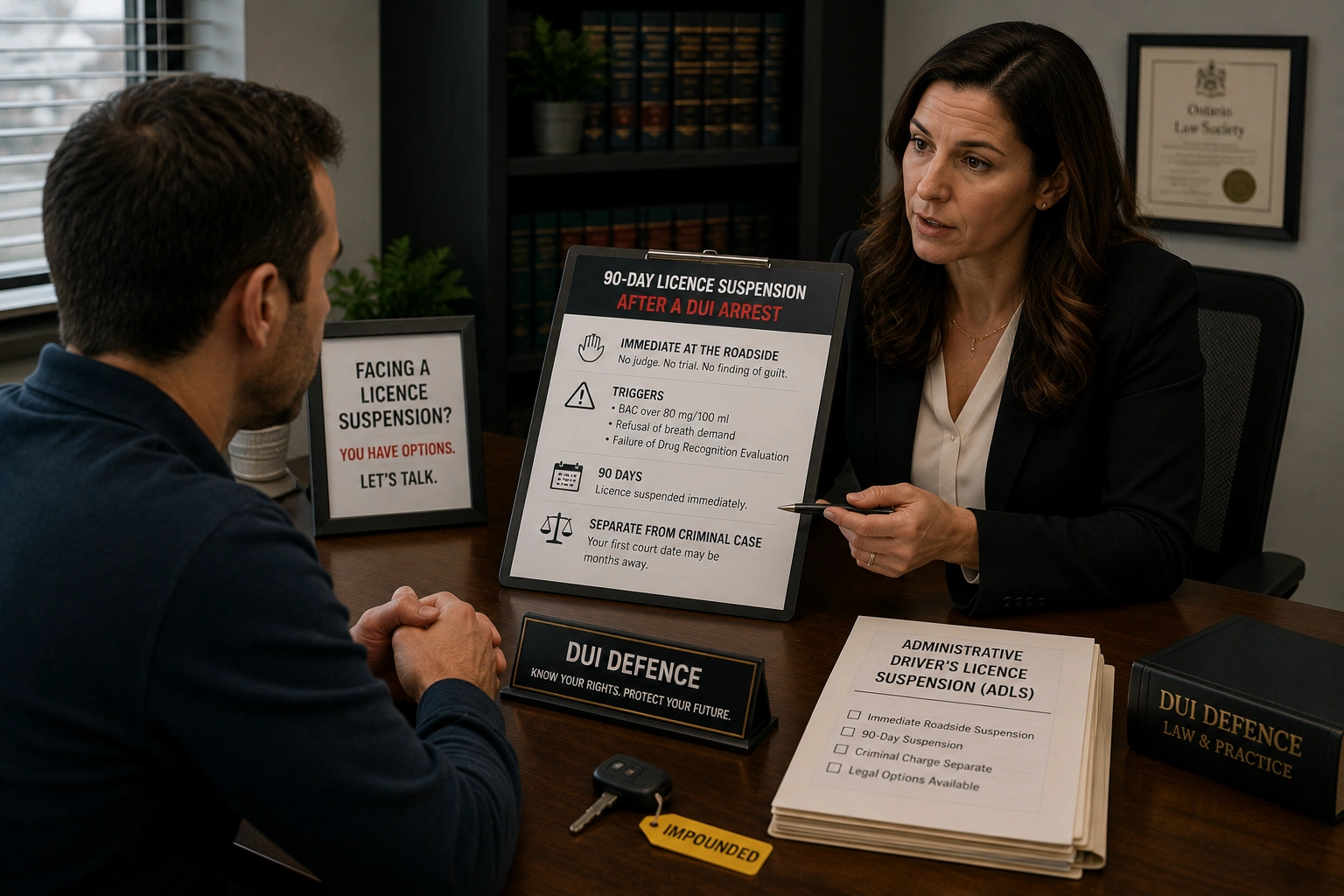

Your driver’s licence is gone before you ever see a courtroom. In Ontario, an Administrative Driver’s Licence Suspension takes effect immediately at the roadside when your blood alcohol concentration exceeds 80 milligrams of alcohol per 100 millilitres of blood, when you refuse a breath demand, or when you fail a drug recognition evaluation. No judge is involved, and no finding of guilt is required.
That distinction confuses almost everyone it happens to. You have been charged, not convicted, and your first real court date might be a year away. Yet the 90-day licence suspension after a DUI arrest is already running, your car is sitting in an impound lot, and you are trying to work out how to get to work tomorrow. So here is what this suspension actually is, why it exists separately from the criminal case, and what you can realistically do about it.
What Is the 90-Day Licence Suspension After a DUI Arrest?
The 90-day licence suspension after a DUI arrest is a provincial administrative penalty imposed under the Highway Traffic Act of Ontario, issued by police at the roadside without any court process. The program is known as ADLS, short for Administrative Driver’s Licence Suspension, and the officer takes your licence on the spot and forwards it to the Ontario Ministry of Transportation.
What triggers it is the reading or the refusal, not a conviction. Register a BAC of 0.08 or higher on an approved instrument, refuse to comply with a lawful demand for an alcohol or drug test, or perform poorly during a Drug Recognition Expert evaluation, and the suspension applies automatically. Whether the criminal charge later proceeds, resolves, or gets withdrawn has no bearing on it.
Two other immediate consequences arrive alongside the licence suspension. Your motor vehicle is impounded for seven days, with towing and daily storage fees at your expense. And a $550 administrative monetary penalty attaches. All of this lands within an hour or two of the stop, well before you have spoken to a criminal defence lawyer.
Why Does This Happen Before You Are Convicted of Anything?
Because the suspension is administrative rather than criminal. Ontario treats driving as a licensed privilege the province regulates, so the Ministry of Transportation can act on the charge itself without waiting for a criminal court to rule.
Two separate systems are running at once here, and understanding that is the single most useful thing you can take from this page. The provincial track covers the immediate roadside suspension, the impoundment, and the administrative penalties. The federal track is the criminal charge under the Criminal Code of Canada, prosecuted by the Crown, which decides whether you end up with a criminal record, a fine, potential jail time, or a driving prohibition.
The timelines diverge sharply. Provincial consequences hit within hours. An impaired driving charge in Ontario often takes twelve to fifteen months or longer to reach trial. That gap is exactly why people are stunned to lose their driving privileges long before anyone has argued the merits of the case. This suspension is not a verdict on whether you were driving under the influence. It is a licensing decision made administratively.
Can You Fight the 90-Day Licence Suspension After a DUI Arrest?
Rarely, and only on narrow grounds. A review of the ADLS exists, but it is not an appeal on the merits of the impaired driving offence, and the suspension generally cannot be stayed while the criminal case proceeds.
Reviews that succeed tend to turn on limited, technical questions:
- Whether you were in fact the person operating the motor vehicle or in care and control of it
- Whether the device used was an approved instrument, properly calibrated and operated by a qualified technician
- Whether the demand to provide a sample was lawfully made in the first place
- Whether a genuine procedural failure occurred in how the roadside licence suspension was issued
What will not succeed is arguing that you need your licence for work, that you have a clean driving record, or that you do not believe you were impaired. Those arguments carry real weight in the criminal case. They carry almost none in an administrative review, which asks only whether the suspension was validly issued.
Knowing that early helps you direct your energy where it matters. For most people, the real fight is the criminal charge, and a strong defence there is what protects your licence over the long term.
How Do You Get Your Licence Back After the Suspension Period?
Once the 90-day licence suspension after a DUI arrest has run its full course, you attend a ServiceOntario centre on day 91 and pay the licence reinstatement fee, currently $281. Nothing is automatic, and the suspension does not simply lapse on its own.
After reinstatement, you can drive again while the criminal case is still before the court. That surprises people, but it follows directly from the two-track structure. The administrative penalty has been served; the criminal matter has not yet been decided. So you are lawfully back on the road unless and until a court orders otherwise.
Several practical points on this stage:
- Bring valid government-issued photo identification and be ready to confirm the status of your driving record
- Licence reinstatement restores your driving privileges but does nothing to resolve or affect the criminal charge
- If you are later convicted, a fresh driving suspension and a Criminal Code driving prohibition follow, and no credit is given for the 90 days already served
That last point catches people badly. Time served under the administrative suspension does not shorten the minimum one-year prohibition that follows a first offence conviction. The two run entirely separately, which is one more reason the criminal defence deserves your attention more than the administrative piece does.
What Happens to Your Licence If You Are Actually Convicted?
A DUI conviction brings a separate and much longer licence suspension, plus a Criminal Code driving prohibition that applies Canada-wide. A first impaired driving conviction carries a minimum one-year prohibition and a $1,000 minimum fine.
The penalties for impaired driving escalate from there. A second offence brings at least 30 days in jail and a minimum two-year suspension. A third brings a minimum of 120 days in jail and a three-year suspension. Ontario now counts prior occurrences going back ten years rather than five, so something from years ago can push a current charge into second-offence territory with progressively longer suspensions attached. A conviction for impaired driving causing death triggers an automatic indefinite provincial suspension, effectively a lifetime licence suspension.
Before any licence reinstatement after a conviction, you must complete Ontario’s Back on Track program, the mandatory remedial measures program under the Highway Traffic Act. It involves an assessment, an education or treatment workshop depending on that assessment, and a follow-up interview. The program can take up to eleven months, so registering promptly matters.
Most first-time offenders will also need to install an ignition interlock device to drive before the prohibition period ends. The ignition interlock is an in-car breathalyzer that prevents the vehicle from starting if it detects alcohol. Under Stream A, a first offender sentenced within three months of the offence can install the interlock 90 days after conviction. Under Stream B, where sentencing occurs more than three months out, the wait is six months. While on the program you cannot have any alcohol in your system when operating a vehicle.
What Changed Under Ontario’s 2026 Impaired Driving Laws?
The 90-day ADLS stayed the same, but the surrounding rules tightened considerably as of January 1, 2026. The changes hit warn-range and zero-tolerance drivers hardest.
The key shifts:
- Warn-range immediate roadside suspensions, for a BAC between 0.05 and 0.079, rose from three days to seven on a first occurrence, with a $250 penalty and an eight-hour education course
- Zero-tolerance rules for drivers under 21 and those holding G1, G2, M1, or M2 licences saw the same increase, since Ontario enforces a strict no-alcohol standard for novice and young drivers
- The lookback window for counting occurrences extended from five years to ten
- Commercial drivers face additional exposure, since suspensions can affect a commercial vehicle operator’s registration alongside the individual licence
These administrative penalties apply to boats, snowmobiles, and off-road vehicles too, not just cars. And they sit entirely apart from other Highway Traffic Act offences like careless driving, which carry their own suspension consequences.
Frequently Asked Questions
What is an ADLS in Ontario? ADLS stands for Administrative Driver’s Licence Suspension. It is a 90-day provincial suspension imposed immediately at the roadside under the Highway Traffic Act when a driver registers a BAC of 0.08 or higher, refuses a breath or drug testing demand, or fails a Drug Recognition Expert evaluation. No court involvement is required.
Can the 90-day suspension be shortened or cancelled? Generally no. Limited review mechanisms exist, but the grounds are narrow and technical, focused on issues like whether the demand was lawful or the instrument approved. The suspension cannot ordinarily be stayed pending trial, and hardship such as needing your licence for work is not a valid ground for review.
How much does licence reinstatement cost? The reinstatement fee is currently $281, payable at a ServiceOntario centre on or after the 91st day. You remain separately responsible for towing and daily storage fees from the seven-day vehicle impoundment, plus the $550 administrative monetary penalty attached to the suspension itself.
Can you drive while your DUI charge is still before the court? Yes, once the suspension period ends and you pay the reinstatement fee. The administrative suspension and the criminal case run on separate tracks, so reinstatement permits driving while awaiting trial. A conviction later triggers a new suspension and a Criminal Code driving prohibition that applies across Canada.
Does the 90-day suspension count toward a suspension after conviction? No. You receive no credit for time served administratively. A first impaired driving conviction carries a minimum one-year driving prohibition in addition to the 90 days already served, and completion of the Back on Track program is required before your licence can be reinstated.
Charged and Not Sure What Comes Next? Let’s Talk
Losing your licence at the roadside can feel like the case is already decided. It is not. The administrative suspension is a licensing consequence, and the criminal charge behind it is where your defence actually lives, including whether the stop, the demand, and the testing were carried out lawfully.
At Kazandji Law, we defend impaired driving in Ontario at every level, and that work begins by scrutinizing everything from the moment you were pulled over. Was the stop lawful? Was the breath demand properly made? Was the approved instrument operated correctly? Those questions decide cases, and they are where a DUI lawyer earns the best possible outcome available on your facts. Where the roadside process itself is in question, our guide to mandatory alcohol screening in Canada explains what police can and cannot demand. There is more on our criminal defence page.
Reach us at 647-588-3234 in Toronto or 647-697-5975 in Thornhill, or book a free consultation through our contact page. If a 90-day licence suspension after a DUI arrest has just landed on you, call now rather than waiting for your court date, because the early work is what shapes everything that follows.