

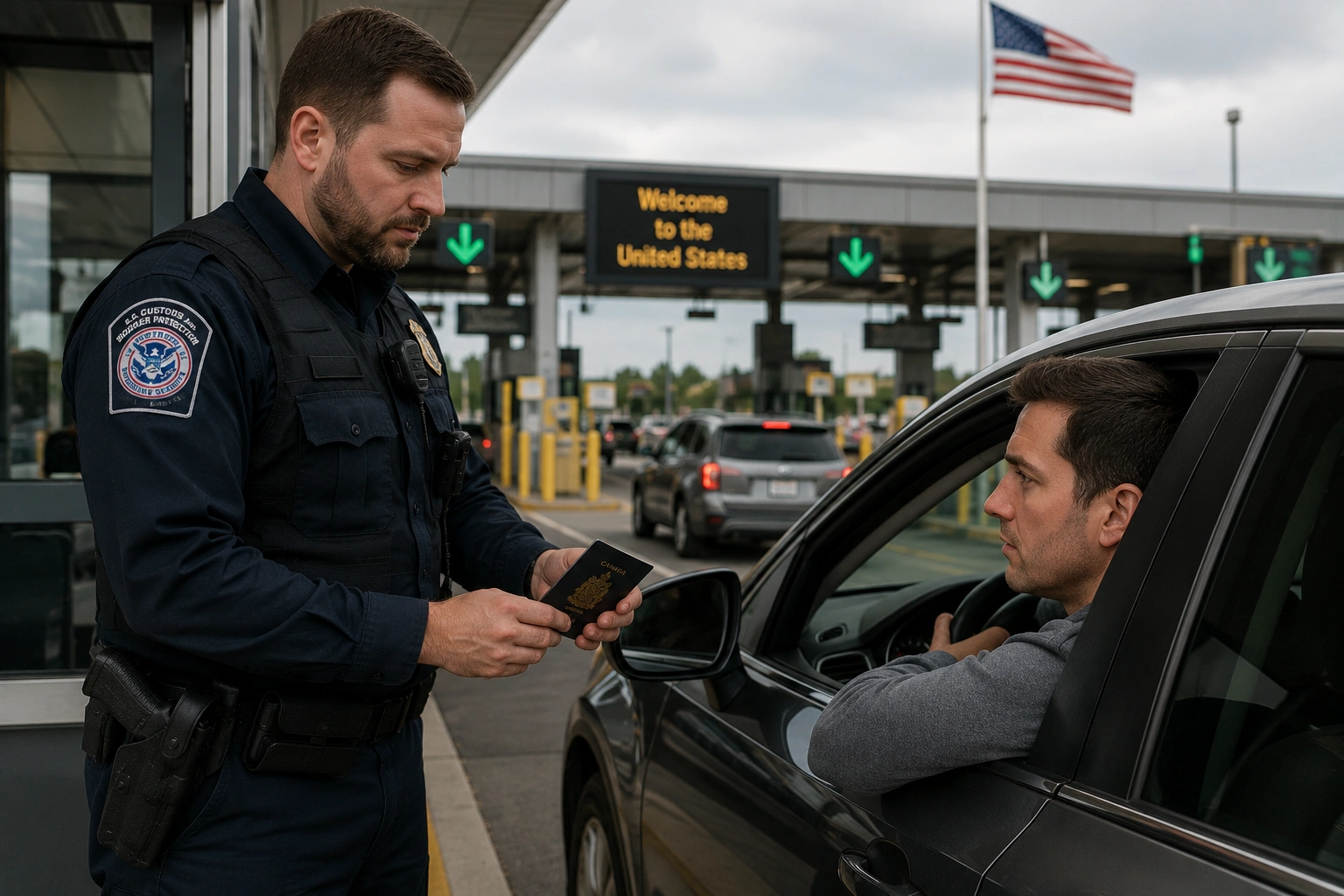

Usually not, and that surprises almost everyone who asks. A single DUI conviction is generally not treated as a crime involving moral turpitude under US immigration law, which means most Canadians with one impaired driving conviction can still cross the border. The entry rules are considerably harsher going the other direction, with Canada regularly refusing Americans over the same offence.
That said, “usually not” is carrying real weight in that sentence. Certain DUI offences absolutely do make you inadmissible, entry is at the discretion of the officer at any port, and assuming you are fine without checking is how people end up refused entry at Buffalo with a family trip cancelled. So here is where travelling to the US with a DUI actually stands, what the exceptions look like, and how to work out which category you fall into before you get in the car.
Can You Enter the United States With a DUI on Your Record?
In most cases, yes. US Customs and Border Protection generally will not deny entry to a Canadian based on one simple DUI conviction, because driving under the influence on its own does not appear on the list of crimes involving moral turpitude that trigger inadmissibility.
The framework comes from American immigration law, which bars entry for anyone convicted of a crime involving moral turpitude, usually shortened to CIMT. That category covers conduct considered inherently base or contrary to accepted moral standards, capturing offences like theft, fraud, and many assaults. Operating a motor vehicle while impaired, in its basic form, is generally treated as a negligence-based offence rather than one involving moral depravity, so it sits outside the definition.
Worth knowing before you go: your criminal history is fully visible. The RCMP-operated CPIC database interfaces with the US National Crime Information Center, so a DUI in Canada shows up the moment your passport is scanned. Nobody crosses on the hope it will not surface. It will. The real question is whether it legally bars you, and for a single DUI without complications, typically it does not.
When Does Travelling to the US With a DUI Become a Real Problem?
Travelling to the US with a DUI becomes genuinely risky once aggravating features enter the picture. Several circumstances shift the analysis from an admissible offence into a genuine barrier, and these are the situations where people get turned around.
The main problem categories:
- Drug-impaired driving. Any violation of a law relating to controlled substances is an independent ground of inadmissibility. A DUI involving cannabis can bar entry even though an alcohol-based conviction would not.
- Multiple DUI convictions. Two or more DUIs, or multiple DUI offences alongside other charges, can lead border officials to conclude there is a public safety concern.
- Aggravating facts within the offence itself. Impaired driving causing bodily harm or death, a child in the vehicle, or a sentence long enough to meet the CIMT threshold changes the assessment.
- Health-related grounds. US law has a separate inadmissibility ground for physical or mental disorders with associated harmful behaviour, and multiple DUIs can be treated as evidence of alcohol dependence.
- A DUI alongside any other criminal conviction, particularly theft, fraud, assault, or drug offences, since those other convictions are usually the actual barrier.
The cannabis point deserves emphasis for Ontario residents. Legalization under Canadian law changed nothing at the American border, where federal law still classifies it as a controlled substance. A drug-impaired conviction and an alcohol one are treated very differently, and the first can cause you to be denied where the second would not.
Does a Pardon or Record Suspension Help at the Border?
No, and this is among the most persistent misconceptions people hold. A Canadian record suspension, formerly called a pardon, does not remove your record from American systems.
Once a conviction has been shared with US authorities, it remains in their databases permanently. A record suspension seals the record within Canada, which genuinely helps with domestic employment and licensing. It does nothing to the copy already sitting in American hands. Many people assume that travelling to the US with a DUI gets easier once a pardon is granted, then find a Customs and Border Protection officer asking about a conviction they believed was long buried.
That is not an argument against seeking a record suspension, since the Canadian benefits are real. It is an argument against relying on one as a border strategy. If unimpeded international travel is the goal, a pardon is not the tool that gets you there.
What Happens if You Are Denied Entry and Need a Waiver?
You are refused admission and returned to Canada, and the refusal is logged, which affects future crossings. Being denied entry for a DUI is rarely permanent, though. Where a criminal record makes you inadmissible and requires a waiver, one is available.
The process runs through an Application for Advance Permission to Enter as a Nonimmigrant, known by its form number I-192. This waiver of inadmissibility grants special permission to enter the US despite a disqualifying ground, typically valid for one to five years before renewal. Processing frequently takes several months to close to a year, so anyone who needs to enter for work or family should apply well in advance rather than weeks before a trip.
Two things improve your odds on an entry waiver application:
- Complete honesty about your record, since concealment is treated far more seriously than the underlying offence and can result in a lengthy or permanent bar
- Strong supporting material, including court documents confirming the disposition of the charge, proof you completed any court-ordered programs, and evidence of rehabilitation such as a clean record since, stable employment, and community ties
A DUI attorney or an immigration lawyer experienced with waiver applications can help assemble that package properly, which matters because a poorly documented application simply gets refused and the processing time starts over.
Is Travelling to the US With a DUI Different if the Charge Is Still Pending?
Yes, and often it is harder than after a conviction. A pending DUI charge creates real uncertainty for a border agent, and attempting to cross the border while your matter is unresolved carries its own risk.
Officers have discretion to refuse anyone they believe may end up convicted of a disqualifying offence. An outstanding charge, or a bench warrant of any kind, can raise that concern even where the eventual outcome would not have barred you. Provincial warrants that are unenforceable outside their jurisdiction have still caused problems crossing at American ports of entry.
There is a practical side too. Leaving the country while a criminal matter is before an Ontario court can conflict with bail conditions or attendance requirements. Anyone in that position should confirm with counsel before booking, rather than assuming travel is fine.
Why Is It Harder for Americans to Get Into Canada With a DUI?
Because Canada treats impaired driving far more seriously. Since December 18, 2018, the offence has carried a maximum penalty of ten years under the Criminal Code of Canada, which made it an indictable offence serious enough to qualify as serious criminality under the Immigration and Refugee Protection Act.
The practical result is that an American with a DUI can be refused entry to Canada regardless of how long ago the offence occurred, because impaired driving no longer qualifies for deemed rehabilitation. The Canada Border Services Agency can deny entry to people whose conviction is decades old. Even a DUI arrest without a conviction can trigger questioning at the Canadian border, since the arrest itself stays visible to border officials.
Americans with a DUI who need to enter Canada without special permission generally cannot. Their options are criminal rehabilitation, which requires that enough time has passed since the sentence was completed, or a temporary resident permit for a specific trip. Both require an application to the Border Services Agency well before travel.
That asymmetry is worth understanding if your family or business crosses in both directions. The same conduct is treated as a minor matter by one country and serious criminality by the other, even if the conviction is identical on paper.
Frequently Asked Questions
Can Canadians travel to the US with a DUI conviction?
Generally yes. A single DUI is not classified as a crime involving moral turpitude under US immigration law, so it usually does not make a Canadian inadmissible. Complications arise with drug-impaired driving, multiple DUI convictions, aggravating facts such as bodily harm, or other offences appearing on the same record.
Does a DUI show up at the US border?
Yes. Canadian records held in CPIC, operated by the RCMP, interface with the US National Crime Information Center. A DUI conviction is visible to Customs and Border Protection officers as soon as your passport is scanned. Attempting to conceal it is far more damaging than the conviction itself.
Does a Canadian pardon remove a DUI from US records?
No. A record suspension seals the record within Canada but does not remove information already shared with American authorities, which remains in their databases permanently. A pardon helps with Canadian employment and licensing, but it does not restore unimpeded access at the border.
What is a US entry waiver?
The I-192 waiver, formally an Application for Advance Permission to Enter as a Nonimmigrant, allows someone otherwise inadmissible to enter the US. Approval typically lasts one to five years before renewal is required. Processing often takes several months to close to a year, so apply well in advance of travel.
Is a drug-impaired DUI treated differently than alcohol?
Yes, significantly. Any conviction involving a controlled substance is an independent ground of inadmissibility under US federal law, regardless of Canadian legalization. A cannabis-impaired driving conviction can bar entry in circumstances where an equivalent alcohol-based conviction would not create any problem.
Worried About the Border? Deal With the Charge First
The strongest protection at any border crossing is not having the conviction at all. Once a DUI is registered, it becomes a permanent data point in systems on both sides of the line, and no domestic remedy fully undoes that.
At Kazandji Law, we defend impaired driving charges across Ontario, scrutinizing the lawfulness of the stop, the validity of the breath demand, how the approved instrument was operated, and whether Charter rights held up. Where a conviction cannot be avoided, the specific offence and outcome matter enormously for your ability to travel internationally, since a drug-impaired conviction and an alcohol-based one carry very different consequences at the border. If travelling to the US with a DUI matters for your work or family, that belongs in the defence strategy from day one. The licence side is covered in our guide on getting your licence back after a DUI. There is more on our criminal defence page.
Reach us at 647-588-3234 in Toronto or 647-697-5975 in Thornhill, or book a free consultation through our contact page. If you have been charged and cross-border travel matters to you, raise it at the first meeting so it shapes how your case is handled.