

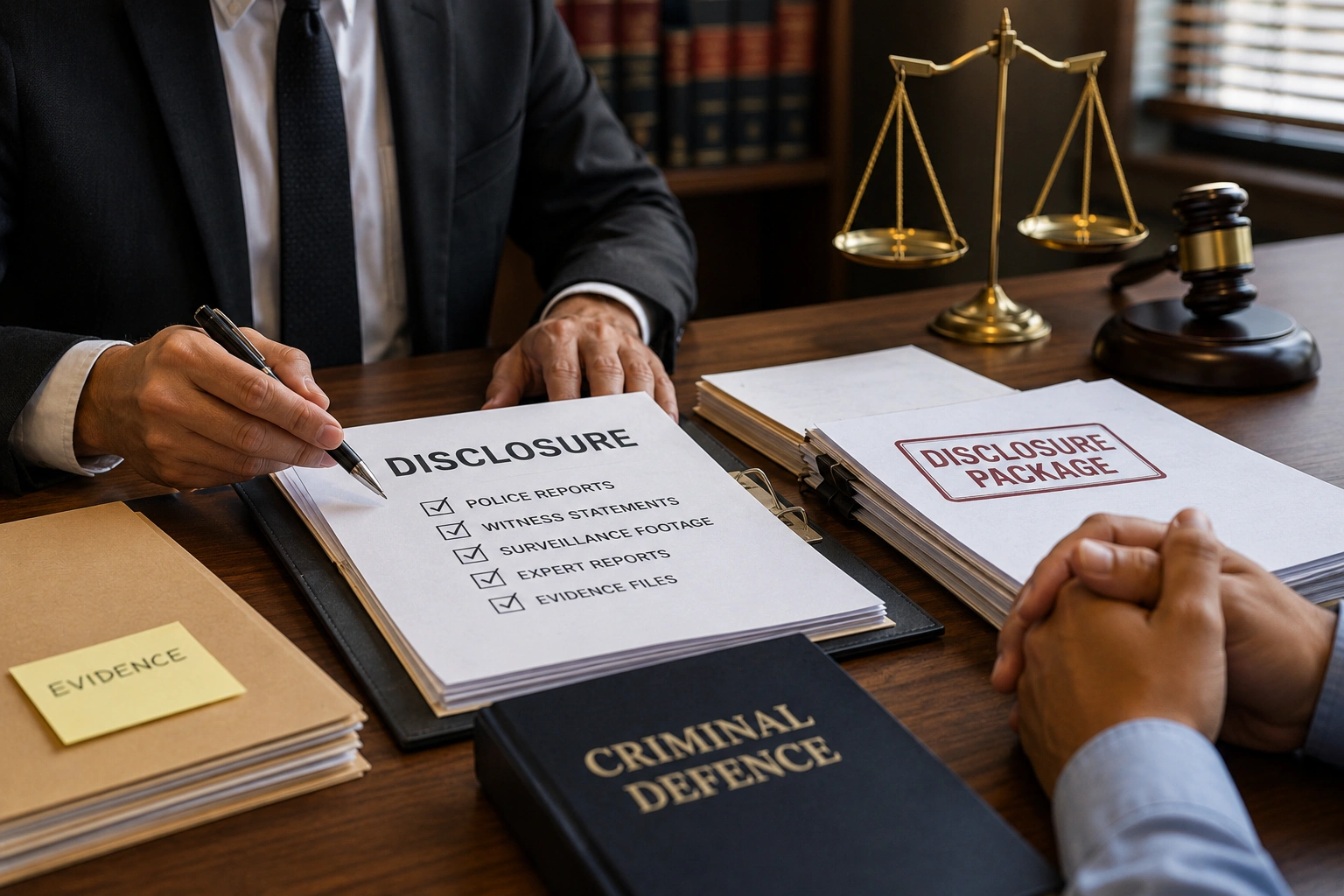

You have a constitutional right to see the evidence the Crown has against you, and that right is not a professional courtesy anyone is doing you. It comes from Section 7 of the Charter, and the Supreme Court of Canada settled it in 1991 in a case called R. v. Stinchcombe. The prosecution has to hand over the relevant material in its possession, including material it has no intention of using at trial.
Most people charged with an offence have no idea this exists until a lawyer explains it. They assume the Crown shows up at trial and springs its case on them like a movie courtroom. That is not how it works here. Disclosure in a criminal case is the file, the notes, the recordings, the statements, all of it, delivered to your side so you can actually mount a defence. And how carefully somebody reads that material often decides how the case ends.
What Is Disclosure in a Criminal Case?
It is the Crown’s file on you, turned over to your side. Every relevant thing the police gathered while investigating, whether it helps the prosecution or quietly wrecks it, has to come across.
That last part is what surprises people. The Crown does not get to hand over only the material that makes you look guilty. In Stinchcombe, Justice Sopinka wrote for a unanimous Court and framed the point sharply: the fruits of an investigation are not the Crown’s private property to secure a conviction with. They belong to the public, and their purpose is to see that justice actually gets done. Relevant evidence goes to the defence whether the Crown likes what it says or not.
The legal foundation sits in Section 7 of the Charter, specifically your right to make full answer and defence. The Supreme Court treated that right as a principle of fundamental justice, and reasoned that you cannot possibly answer a case you are not allowed to see. So the duty to disclose flows directly out of it. The Criminal Code, oddly enough, does not spell out a disclosure procedure. The whole framework is constitutional and built on case law.
One more thing worth knowing early. The obligation does not stop once you get the first package. Disclosure in a criminal case is an ongoing duty, so if new material surfaces three months in, it has to come to you too.
What Should Be in Your Disclosure Package?
More than most people expect. A proper package is not a summary or a charge sheet; it is the actual investigative material, and in a serious file it can run to hundreds of pages plus hours of video.
Depending on the charge, you should generally expect to see:
- The arresting and investigating officers’ notes, in full, including the parts that are hard to read
- Witness statements, along with will-say statements setting out what each witness is expected to testify to
- Any statement you gave to police, whether written, audio, or on video, which is often the single most important document in the file
- Audio and video recordings: cruiser cam, body-worn camera, booking video, station footage, 911 calls
- Photographs from the scene, and any surveillance footage police obtained from businesses or neighbours
- Forensic and expert reports, plus the qualifications of whoever wrote them
- Your criminal record, if you have one
- In an impaired driving file, the intoxilyzer maintenance and calibration records, the technician’s notes, and the certificate
- Where a warrant was used, the Information to Obtain, meaning the sworn document police used to convince a justice to authorize the search
The intoxilyzer records and the ITO are good examples of why this matters. Neither one looks dramatic. Both are places where cases quietly fall apart when the paperwork does not hold up.
When Do You Actually Get Your Disclosure?
Usually at or shortly after your first court appearance. The Ontario Crown Prosecution Manual directs Crowns to provide disclosure as soon as practicable once they receive material from the police, and in a straightforward file that often means the initial package is ready right at the outset.
Reality is messier than the standard, though. Simple matters move quickly. Complex files, anything with digital forensics, wiretaps, multiple accused, or a mountain of video, come in waves over months. You get an initial package, then supplementary disclosure, then more.
Timing is not just an administrative annoyance either. It ties directly into delay. Under R. v. Jordan, the Supreme Court set presumptive ceilings on how long a case can take, 18 months in provincial court and 30 months where there is a preliminary inquiry or the matter is in superior court. Late disclosure that pushes a case past those ceilings can support an application to have the charges stayed entirely. Crowns know this, which is part of why persistent disclosure delays are worth documenting rather than shrugging at.
Can the Crown Legally Hold Things Back?
Some things, yes. The duty is broad but it has real limits, and the Crown keeps a degree of discretion over what counts as relevant and when material goes out.
The recognized exceptions are narrower than people fear:
- Privileged material stays out. That covers solicitor-client privilege, informer privilege, which protects the identity of confidential police sources, and public interest privilege.
- Privacy interests can justify redactions, particularly in sexual offence files where a complainant’s identifying details or certain records are involved.
- Ongoing investigations can delay disclosure of specific material, though delay is not the same as refusal, and the material should still come once the concern passes.
- Clearly irrelevant material does not have to be produced, and this is where the friction usually lives, because the Crown makes the first call on relevance.
That discretion has been criticized for decades. Stinchcombe set a strong principle but gave fairly thin guidance on what “relevant” actually means, which leaves Crowns with room to decide. Your lawyer’s job is to test that judgment rather than accept it.
How Does Disclosure in a Criminal Case Shape Your Defence?
Almost everything a defence lawyer does flows out of the disclosure package. Until it has been read line by line, nobody can honestly tell you whether your case is strong, weak, or a candidate for resolution.
Reading it properly is where the work happens. An officer’s notes say one thing; the witness statement says something slightly different; the body cam shows a third version. Those gaps are not trivia. They are cross-examination material, and they are how reasonable doubt gets built.
Disclosure is also what makes Charter applications possible. If the notes reveal that a search happened without proper grounds, or that you were not told about your right to counsel without delay, that is a Section 8 or Section 10(b) argument, and it comes straight out of the paperwork. This is exactly how a challenge to police searching your phone without a warrant gets built, since the whole question turns on what officers recorded about the search.
It shapes the practical decisions too. Whether to run a trial or negotiate. Whether the Crown’s case is as solid as the charge sheet suggests. Whether a key witness has a credibility problem nobody flagged. None of those calls can be made responsibly on guesswork.
And there is an obligation running the other way. Courts have been clear, in cases like R. v. Dixon and R. v. Barbour, that the defence must actually review what it receives and identify what appears to be missing. You cannot sit on incomplete disclosure, say nothing, then complain about it after a conviction. Due diligence is expected.
What If the Crown Doesn’t Hand Over Everything?
You push, and formally if that is what it takes. The first step is usually a written request identifying the specific missing item, because the onus falls on the defence to particularize what it wants rather than ask vaguely for more.
If the material still does not appear, the next move is a Stinchcombe application, asking a judge to order the Crown to produce it. The court can order disclosure, adjourn the matter, and in serious cases where non-disclosure has genuinely undermined trial fairness, it can go further, including a stay of proceedings.
Real-world non-disclosure is rarely dramatic. It is a missing page of notes, a video nobody uploaded, a witness statement that never got scanned. Small on its face. Occasionally decisive.
What About Records the Crown Doesn’t Even Have?
Different rules apply entirely. Stinchcombe covers first party disclosure, meaning material in the hands of the prosecution and police. Records held by someone outside the prosecution team are third party records, and the Crown cannot hand over what it does not possess.
Getting those requires an O’Connor application, named for the Supreme Court decision that set out the process. Think medical records, therapy notes, employment files, a complainant’s counselling records held by a clinic. The defence has to show the records are likely relevant, then a judge reviews them privately before deciding what, if anything, gets released.
For sexual offence cases, the bar climbs higher again. Sections 278.1 through 278.91 of the Criminal Code impose a stricter regime for records in which a complainant has a reasonable expectation of privacy, requiring a separate application and a fuller balancing of interests before anything is produced.
Frequently Asked Questions
What is disclosure in a criminal case in Canada? Disclosure is the evidence the Crown holds against an accused person, which it must provide to the defence. Following R. v. Stinchcombe (1991), the Crown must turn over all relevant material in its possession, whether or not it plans to use it at trial and whether it helps or hurts the prosecution’s case.
Do you have a right to see the evidence against you? Yes. That right flows from Section 7 of the Charter and your right to make full answer and defence, which the Supreme Court has treated as a principle of fundamental justice. You do not need to apply for basic disclosure. The Crown must provide it as a matter of course after charges are laid.
How long does it take to get Crown disclosure in Ontario? Often the first package arrives at or shortly after the first court appearance. The Ontario Crown Prosecution Manual directs Crowns to disclose as soon as practicable. Complex files involving digital forensics, multiple accused, or extensive video usually arrive in stages, with supplementary disclosure continuing for months.
Can the Crown refuse to disclose evidence? Only in limited circumstances. Privileged material, including solicitor-client and informer privilege, stays protected. Privacy concerns can justify redactions, and an ongoing investigation may delay release. Clearly irrelevant material need not be produced. Where you believe something is being wrongly withheld, your lawyer can bring a Stinchcombe application.
What happens if the Crown fails to disclose something important? Your lawyer can request it in writing, then bring a Stinchcombe application asking a judge to order production. Courts can order disclosure, grant an adjournment, or in serious cases stay the proceedings where non-disclosure has compromised trial fairness. Late disclosure can also support a delay application under R. v. Jordan.
Get Someone to Read the File Properly
Nobody can tell you where your case really stands until the disclosure has been read closely, and read by someone who knows which gaps matter. That is not a formality. It is the work.
At Kazandji Law, we request disclosure early, review every page and every minute of video, and chase down whatever the Crown left out. Then we tell you honestly what the evidence actually supports, including when it is weaker than the charge suggests. Handling disclosure in a criminal case well is what turns a vague sense of dread into a real strategy, whether that means a Charter application, a negotiation, or a trial. Much of it also traces back to the very start of a case, which is why what you said or did not say matters so much when answering police questions in Canada. There is more on our criminal defence page.
Reach us at 647-588-3234 in Toronto or 647-697-5975 in Thornhill, or book a free consultation through our contact page. If you have a court date coming and have not seen the evidence yet, that is the first thing we fix.