

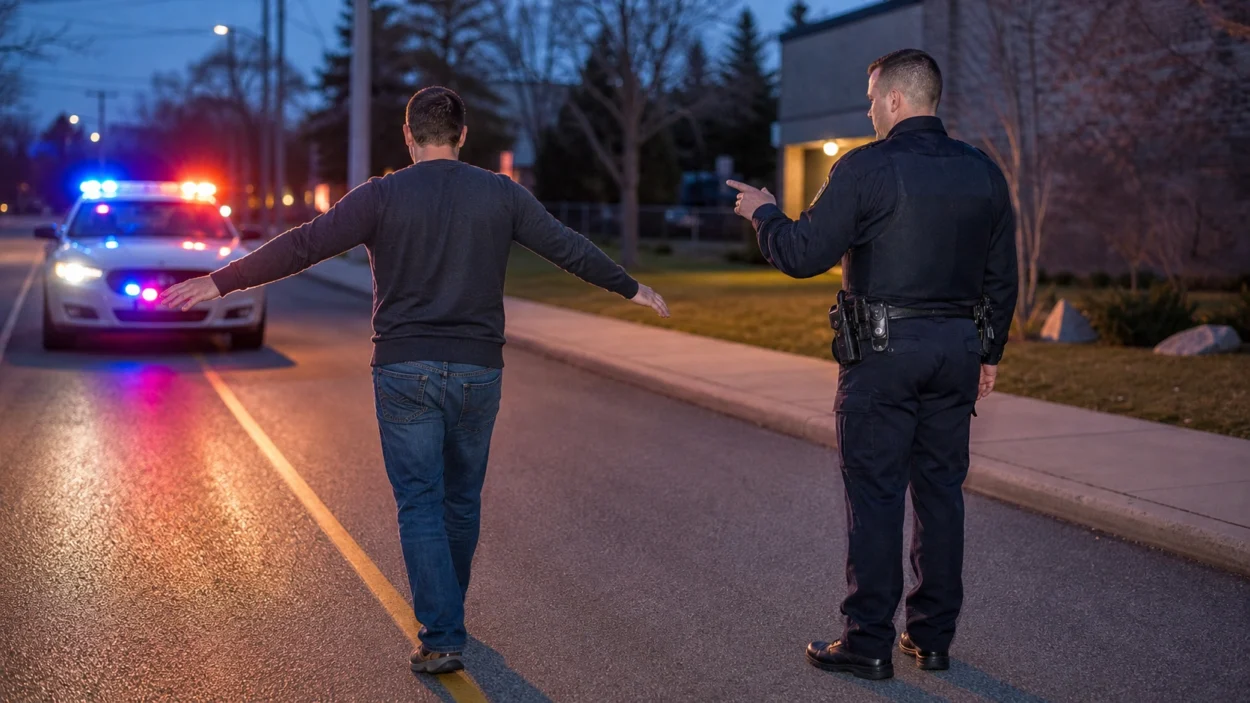

A roadside stop can feel longer than it really is.
Your hands are cold. Traffic is passing beside you. The officer is asking questions, watching how you speak, and looking for signs that something is off. Then you are asked to step out of the vehicle and perform physical tests at the roadside. That is when a Standard field sobriety test can turn a stressful stop into a serious impaired driving investigation.
In Canada, police may use roadside testing when they suspect alcohol or a drug is in a driver’s body and the person operated a vehicle within the relevant time period. Section 320.27 of the Criminal Code allows officers to demand approved screening, coordination tests, or other steps depending on the circumstances. These tools can play a major role in impaired driving and drug-impaired driving cases.
At Kazandji Law, we help clients across Ontario deal with DUI, drug DUI, refusal, care and control, and related impaired driving charges. If your case began with roadside testing, our Ontario Drug DUI Lawyers page and Ontario DUI Lawyers page are useful starting points before a consultation.
What A Standard Field Sobriety Test In Canada Usually Involves
Roadside sobriety testing is meant to help police decide whether there are grounds to move the investigation forward.
The most common physical coordination tests include:
- horizontal gaze nystagmus
- walk-and-turn
- one-leg stand
Federal regulations identify these as the standard field sobriety tests used in impaired operation evaluations. The walk-and-turn and one-leg stand tests look at balance, attention, coordination, and ability to follow instructions. The horizontal gaze nystagmus test looks at involuntary eye movement that may be linked to impairment.
Justice Canada materials describe roadside indicators such as slurred speech, bloodshot eyes, coordination problems, and physical testing as part of impaired driving investigations.
That sounds straightforward on paper. In real life, it is less clean.
You may be standing beside a road at night. The ground may be uneven. You may be nervous, tired, injured, or taking medication. You may not fully understand the instructions because the moment feels overwhelming. Those details can matter.
Why Standardized Field Sobriety Testing Is Not A Perfect Measure
Standardized field sobriety testing can help police gather information, but it does not make the case automatic.
Roadside tests depend heavily on how the officer gives instructions, how the driver responds, and how the officer records what happened. A person can look unsteady for reasons that have nothing to do with alcohol or drugs.
Possible issues include:
- poor lighting
- uneven pavement
- bad weather
- footwear problems
- knee, hip, back, or ankle injuries
- anxiety during the stop
- fatigue after work
- medical conditions affecting balance
- language or comprehension issues
In a Standard field sobriety test, small details can become important. Did the officer explain the task clearly. Was the surface safe. Was the person given a fair chance to perform the test. Did bodycam or dashcam video support the officer’s notes. Did the officer treat nervousness as impairment without considering other explanations.
At Kazandji Law, we look at those questions carefully because a roadside test is only one piece of the case.
What Happens After A Driver Performs Roadside Tests
A roadside test may lead to more investigation.
If police believe the driver shows signs of impairment, they may move toward additional steps. In drug-related cases, that can include a Drug Recognition Expert evaluation. Canada’s drug-impaired driving guidance explains that trained officers and Drug Recognition Experts are used to assess suspected drug impairment, and more officers across Canada have been trained in SFST and DRE methods.
A DRE evaluation is more involved than a quick roadside test. It may include physical observations, coordination testing, vital signs, eye exams, statements, and biological samples depending on the case.
This is where drivers often feel trapped. They may think the roadside result already decided everything. It has not. The Crown still has to prove the charge. The defence can still review the grounds for the stop, the demand, the testing, the officer’s notes, and whether the evidence supports the allegation.
How Roadside Testing Can Affect Drug DUI Cases
Roadside testing is especially common in drug-impaired driving investigations.
People often think DUI means alcohol only. In Ontario, impaired driving cases can involve cannabis, prescription medication, illegal drugs, or a mix of substances. Our Ontario Drug DUI Lawyers page discusses drug-related impaired driving cases, including cannabis and prescription drug allegations.
That matters because drugs do not always produce the same outward signs as alcohol. A driver may be accused based on slow responses, poor balance, red eyes, confusion, or coordination concerns. Some of those signs may have other explanations.
A person may be:
- exhausted after a long shift
- dealing with pain
- recovering from an injury
- taking legal medication
- anxious during police questioning
- affected by a medical condition
None of these facts automatically defeats the allegation. But they can affect whether the officer’s conclusion was fair and whether the Crown can prove impairment beyond a reasonable doubt.
Can You Refuse A Roadside Sobriety Test?
Refusal can create its own legal problem.
Police demands in impaired driving investigations should be taken seriously. Section 320.27 gives police authority to require certain testing when the legal grounds are met. Refusing or failing to comply with a valid demand may lead to separate criminal consequences.
That does not mean every demand is automatically valid. It means you should not treat the roadside moment casually. If you were charged after refusing, or if you believe the officer made an unlawful demand, the right move is to get legal advice and review the record closely.
A defence review may look at:
- what the officer observed before the demand
- whether reasonable suspicion existed
- whether the demand was clear
- whether you understood what was being asked
- whether any medical issue affected your ability to comply
- whether the officer documented the interaction properly
At Kazandji Law, we focus on the full chain of events, not only the final charge.
How We Challenge A Standard field sobriety test Result
A Standard field sobriety test is not beyond challenge.
The defence may review the officer’s training, the instructions given, the testing environment, bodycam footage, dashcam footage, police notes, medical records, and any explanation for performance problems. Kazandji Law’s impaired driving content discusses challenging the legality of the stop, the accuracy of field sobriety or breathalyzer tests, procedural errors, medical conditions, and Charter issues.
That kind of review matters because many DUI cases are built from a sequence of steps. If the first step was weak, rushed, or poorly documented, it may affect what came after it.
Important questions may include:
- Was the initial stop lawful
- Did the officer have proper grounds to suspect impairment
- Were the instructions clear
- Was the test performed under fair conditions
- Did medical or physical limitations affect performance
- Did later evidence support or contradict the roadside observations
A failed roadside test does not mean the case is over. It means the evidence needs to be tested.
Common Mistakes Drivers Make After Testing
After roadside testing, many people panic.
They try to explain too much. They apologize without thinking. They send texts about the stop. They assume the officer’s notes are final. They wait too long to request help because they think nothing can be done.
A better approach is to stay organized.
Keep:
- your release papers
- any licence suspension documents
- court paperwork
- medication records if relevant
- medical records if balance, pain, or injury was an issue
- names of passengers or witnesses
- notes about weather, footwear, road surface, and lighting
Write down what happened while you still remember it. Do not rely on memory weeks later. Roadside details fade quickly, and those small details may matter more than you expect.
Frequently Asked Questions
What Is The Purpose Of A Roadside Sobriety Test?
Police use roadside sobriety testing to help assess whether alcohol or drugs may be affecting a driver. The result may lead to more testing or further investigation.
What Are The Three Main Tests?
The main physical coordination tests are horizontal gaze nystagmus, walk-and-turn, and one-leg stand. Federal regulations list these as standard field sobriety tests.
Can Medical Problems Affect The Result?
Yes. Balance problems, pain, injuries, fatigue, anxiety, or certain medical conditions may affect performance. These details should be reviewed carefully in the defence.
Does Failing The Test Mean You Will Be Convicted?
No. A failed roadside test does not equal a conviction. The Crown still has to prove the offence, and the defence can challenge the stop, demand, procedure, observations, and testing conditions.
What Should You Read First On Our Site?
Start with our Ontario DUI Lawyers page if your case involves alcohol impairment. If drugs, cannabis, or prescription medication are involved, our Ontario Drug DUI Lawyers page is the better starting point.
Talk To Kazandji Law Before The Roadside Test Defines The Case
If your case involves a Standard field sobriety test, do not assume the officer’s interpretation tells the whole story. Roadside testing can be affected by instructions, setting, stress, health, fatigue, and how carefully the officer documented the event.
At Kazandji Law, we help clients across Ontario review impaired driving allegations with a clear plan. If you were charged after roadside testing, get advice before you make assumptions about the strength of the case. The earlier we review the stop, the demand, the test conditions, and the disclosure, the better we can identify the issues that may protect your licence, record, and future.